
What are the methods of oil-water separation? Differences between flotation, centrifugation, and membrane【Basic Knowledge】
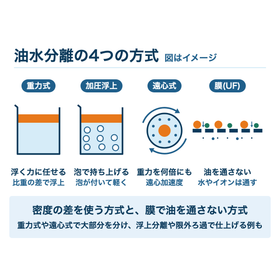
Wait for the oil to float, lift it with bubbles, separate it by spinning, or filter it through a membrane. The size of the oil droplets is a clue for choosing the method.
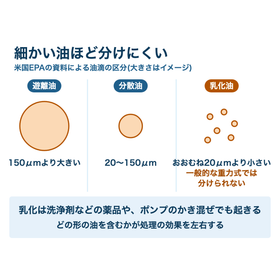
■What does an oil-water separator separate? It is a device that separates oil and water from wastewater containing oil, utilizing the non-mixing properties of oil and water. There are various methods, including those that use the difference in density between oil and water, and those that use membranes to prevent oil from passing through. ■Oil types are classified by the size of oil droplets According to the classification by the U.S. Environmental Protection Agency (EPA), oil in water is categorized by the size of oil droplets as follows: 1. Free oil: droplets larger than 150 micrometers 2. Dispersed oil: 20 to 150 micrometers 3. Emulsified oil: generally smaller than 20 micrometers The type of oil present affects the effectiveness of treatment. ■Why is it difficult to separate fine oil? When emulsified, the difference in buoyancy is too small for conventional gravity methods to separate them. When the weights of the oil droplets and water are nearly balanced, gravity methods become ineffective. Emulsification occurs when cleaning agents mix in. If detergents used for cleaning floors or machinery enter the wastewater, the oil that was previously floating becomes harder to separate. Emulsified oil requires different methods, such as breaking the emulsion with coagulants and then floating it. Please feel free to consult us first.
basic information
■Gravity method relies on buoyancy This method uses the difference in specific gravity between oil and water to float the oil. It involves attaching oil droplets to plates or fillers to combine and enlarge them for buoyancy. It is designed to separate free oil that floats when left undisturbed, but emulsified oil cannot be separated by this method alone. ■Pressurized flotation lifts with bubbles? When the pressure of water that has dissolved air is reduced, fine bubbles are produced. When these bubbles attach to oil droplets or fine particles, the entire mass becomes lighter and floats to the water surface. This method often involves adding a coagulant during the flotation process. By using a coagulant to break the emulsion and gather the oil into flocs, bubbles can be attached to them, allowing for the separation of emulsified oil. ■Centrifugal method multiplies gravity?! The centrifugal method also utilizes the difference in density between oil and water, but it greatly increases gravity through centrifugal acceleration caused by rotation. The need for power to rotate is what distinguishes it from the gravity method. ■Membrane does not allow oil to pass? In ultrafiltration (UF) membranes, pressure is applied to pass wastewater through fine pores, allowing water and ions to pass while blocking oil. This method separates based on pore size, which allows it to separate oils with small density differences, distinguishing it from other methods.
Price range
Delivery Time
Applications/Examples of results
■Weakness of Membranes: Clogging?! The accumulation of organic matter and other contaminants (fouling) on the membrane surface reduces the amount of permeate water over time, necessitating regular shutdowns for cleaning. To minimize fouling, it is important to reduce oil and dirt as much as possible in the processes preceding the membrane. ■Reasons for Combining Methods Oil that floats is first removed using gravity, and emulsified oil is separated after breaking the emulsion with coagulants and then using pressurized flotation. By reducing oil in the earlier processes, the burden on subsequent processes can be lightened. To ensure compliance with standards, adsorption may also be added after flotation treatment. The appropriate combination depends on the form of oil in the wastewater. ■Points to Confirm Before Implementation 1. Is the oil in the wastewater floating or emulsified? 2. Are there any chemicals, such as cleaning agents, mixed in? 3. The size of the installation area and maintenance effort required. 4. Disposal methods for separated oil, concentrated liquids, and sludge. It is also necessary to consider the disposal methods for separated oil and sludge. Our company offers consultations on treatment methods for wastewater containing oil and the selection of coagulants. Please feel free to contact us for more information.
catalog(2)
Download All Catalogs

Recommended products

Distributors

Since our founding, we have continued to provide flexible services with the motto of accurately supplying a diverse range of products that respond to changes in the times and the diversification of consumer needs, tailored to various applications and requirements. With the corporate slogan "Chemical Engineering Partner," we, as a group of experts in chemical technology, actively discover ideas to solve our customers' problems from advanced technologies both domestically and internationally, and propose them.