
What are the methods for treating oil-containing wastewater? From flotation separation to biological treatment [Basic Knowledge]
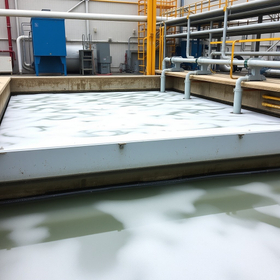
Is the amount of oil measured by the "amount remaining after extraction with hexane"? This explains the measurement method and the flow of treatment leading to flotation separation, coagulation pressure flotation, and biological treatment.
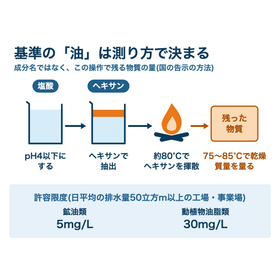
Oil-containing wastewater refers to the wastewater from factories or businesses that contains oil. Oils can be categorized into mineral oils, such as gasoline, diesel, and grease, and animal and vegetable oils, such as soybean oil and tallow. The former typically comes from automotive maintenance shops, while the latter is produced by the food manufacturing industry. ■ How is the "oil" in wastewater measured? The oil content in wastewater is measured as n-hexane extractable substances. According to the method specified by national notification, the sample is acidified with hydrochloric acid to a pH of less than 4, extracted with hexane, and then the hexane is evaporated at about 80°C. After that, the remaining substance is dried at 75-85°C, and its mass is measured. In other words, the standard for "oil" is not based on a specific component name but is determined by the amount of substance extracted and remaining after this procedure. ■ Are the standard values different for different types of oil? The permissible limits set by national general wastewater standards are 5 mg/L for mineral oils and 30 mg/L for animal and vegetable oils (applicable to factories and businesses with an average daily wastewater volume of 50 cubic meters or more). Even though both are referred to as "oil," the target varies depending on which category they fall into. When discharging into the sewer system, it is important to check the standards of the Sewer Law and the regulations of each municipality. Please feel free to consult us first.
basic information
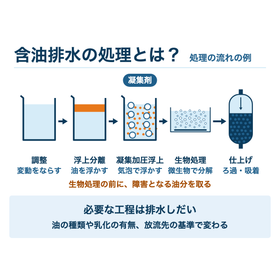
■In what order does the process proceed? To organize the flow of the process, it can be summarized as follows: 1. Adjustment: Equalizing fluctuations in water volume and quality 2. Floating separation: Separating lighter oil from water 3. Coagulation and pressure flotation: Coagulating emulsified oil and floating it with air bubbles 4. Biological treatment: Decomposing dissolved organic matter in water using microorganisms 5. Finishing: Removing remaining substances through filtration or adsorption with activated carbon ■Necessary processes depend on the wastewater The necessity of each process varies depending on the type of oil, the presence of emulsification, and the discharge standards. Not all processes are always required. ■Why doesn’t emulsified oil float? Emulsified oil, which is finely dispersed by detergents, has the property of being difficult to separate just by letting it sit. Therefore, a coagulant is used to break the emulsion and form flocs, and air is pressurized and dissolved in water to create fine bubbles, making the flocs appear lighter and allowing them to float. ■Why remove oil before biological treatment? In the wastewater treatment of food factories, it is important to properly pre-treat oil and solids that can hinder aerobic and anaerobic biological treatment.
Price range
Delivery Time
Applications/Examples of results
■ Is 5mg/L of mineral oil too strict?! In maintenance workshops for large vehicles, wastewater containing a high amount of emulsified oil is difficult to consistently meet standards even with pressure flotation, so it is common to add adsorption methods after flotation treatment. To ensure compliance with standards, it is reassuring to consider the combination with adsorption methods. ■ How to determine the conditions for coagulation? In the coagulation pressure flotation of vegetable oil manufacturing plants, the effectiveness of the coagulant greatly changes depending on the alkalinity and salt concentration of the wastewater. Therefore, it is important to determine the optimal injection conditions for the chemicals through jar tests. The conditions for coagulation may change if the raw materials change. ■ Things to keep an eye on in daily management 1. Raw water: Analyze not only treated water but also raw water at different times of the day. 2. Chemicals: Check the remaining amount in tanks for coagulants and the condition of pH meters. 3. Cleaning: Do not allow solids to accumulate in the adjustment tank or pressure flotation device. 4. Scum: Scum collected through flotation separation should be treated as sludge. ■ Consultation on water treatment chemicals and equipment Our company offers consultations on water treatment chemicals such as coagulants and wastewater treatment equipment. Please feel free to reach out to us.
catalog(2)
Download All Catalogs

Recommended products

Distributors

Since our founding, we have continued to provide flexible services with the motto of accurately supplying a diverse range of products that respond to changes in the times and the diversification of consumer needs, tailored to various applications and requirements. With the corporate slogan "Chemical Engineering Partner," we, as a group of experts in chemical technology, actively discover ideas to solve our customers' problems from advanced technologies both domestically and internationally, and propose them.