
What is the difference between domestic wastewater and industrial wastewater? 【Basic Knowledge】
Is the water in factory cafeterias and toilets considered "domestic wastewater"? This explains the legal definition, the contents of the pollutants, and the differences in regulatory perspectives.
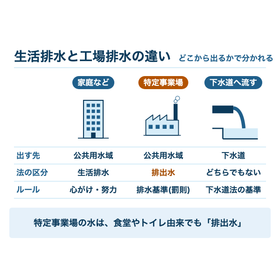
Domestic wastewater and industrial wastewater are both water that has been used, but they are classified differently under the law. The Water Pollution Prevention Act defines domestic wastewater as "water discharged into public water areas as a result of human activities such as cooking, laundry, and bathing," and excludes "discharge water" from this definition. ■ What about water from factory cafeterias and restrooms? Under the same law, discharge water is defined as water discharged into public water areas from factories or business establishments that have specific facilities (designated business establishments). Since discharge water is excluded from the definition of domestic wastewater, water that comes from cafeterias or restrooms in designated business establishments is classified as discharge water. The key point is not whether the water comes from the kitchen, but rather where it is discharged into public water areas. ■ What happens to water that flows into the sewer system? Public water areas as defined by the Water Pollution Prevention Act do not include public sewers with wastewater treatment plants. Therefore, in terms of definition, water flowing into the sewer system does not fall under either discharge water or domestic wastewater according to this law. When discharging water from designated business establishments into the sewer system, it is required to meet the standards set by government ordinances at the discharge point into the public sewer based on the Sewer Act. Please feel free to consult with us first.
basic information
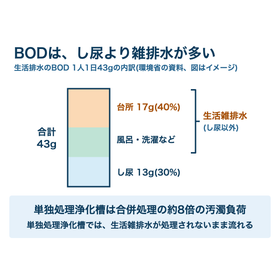
■What is the difference in the contents of waste? According to the guidelines for promoting measures against domestic wastewater based on national standards, the BOD of domestic wastewater is 43g per person per day. Of this, human waste accounts for 13g (30%), the kitchen for 17g (40%), and the bath for 9g (21%). Wastewater from sources other than human waste, such as kitchens, baths, and laundry, is referred to as domestic mixed wastewater. In terms of BOD, domestic mixed wastewater is calculated to be greater than human waste. Additionally, nitrogen in domestic wastewater is often present as organic nitrogen or ammonia, while phosphorus is mainly found in organic phosphate compounds. ■Industrial wastewater varies by industry On the other hand, industrial wastewater varies in form and concentration depending on the industry and processes involved. Industries with relatively high nitrogen concentrations include food manufacturing and metal machinery surface treatment, while those with high phosphorus concentrations include food manufacturing, hospitals, and laundry services. ■Does the type of septic tank make a difference? In a standalone septic tank that only treats human waste, domestic mixed wastewater flows through untreated. With the amendment of the Septic Tank Law in 2000, it became mandatory for newly established septic tanks to be combined treatment septic tanks. Standalone septic tanks have about eight times the pollution load compared to combined treatment septic tanks.
Price range
Delivery Time
Applications/Examples of results
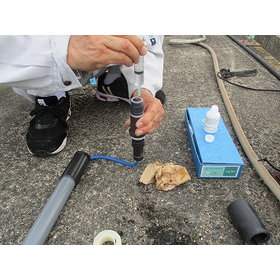
■How is the approach to regulation different? When comparing the handling under the Water Pollution Prevention Act, it is as follows: 1. Discharge water: Discharge water that does not comply with discharge standards must not be released (Article 12). 2. Domestic wastewater: Everyone should strive to properly handle cooking waste and used cooking oil, and to use detergents appropriately (Article 14-6). ■Penalties and Obligations to Make Efforts For those who discharge domestic wastewater, unless otherwise specified by laws such as the Sewerage Act, it is stipulated that they must strive to reduce the pollution load through the establishment of appropriate facilities (Article 14-7). There are penalties for violations of Article 12, but the regulations regarding domestic wastewater require efforts and consideration. ■What are the measures for domestic wastewater being promoted in the community? When the governor of a prefecture recognizes that it is particularly necessary to promote domestic wastewater measures in public water areas where water quality environmental standards are not being met, they designate priority areas for domestic wastewater measures. Municipalities within the region will establish plans to promote domestic wastewater measures. ■Inspection of wastewater within business premises Our company offers services for inspecting chemicals used in wastewater treatment and for wastewater inspection services. If you are having trouble managing wastewater within your business premises, please feel free to consult with us first.
catalog(2)
Download All Catalogs
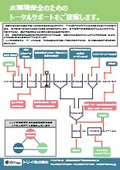
Recommended products



Distributors

Since our founding, we have continued to provide flexible services with the motto of accurately supplying a diverse range of products that respond to changes in the times and the diversification of consumer needs, tailored to various applications and requirements. With the corporate slogan "Chemical Engineering Partner," we, as a group of experts in chemical technology, actively discover ideas to solve our customers' problems from advanced technologies both domestically and internationally, and propose them.