
What is Dissolved Oxygen (DO)? How to Measure It and Management Guidelines [Basic Knowledge]
The concentration of oxygen dissolved in water, DO. This explains the upper limit of the amount that can dissolve, which varies with water temperature, the concept of calibration, and the standards for rivers and guidelines for aeration tanks.
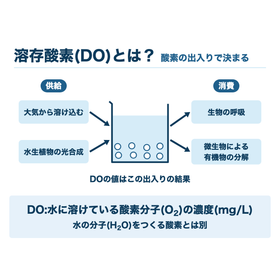
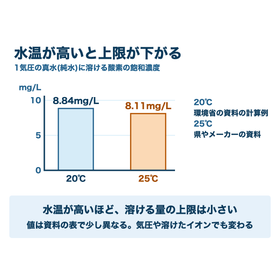
Dissolved Oxygen (DO) refers to the concentration of oxygen molecules (O2) that are dissolved in water, expressed in mg/L. It is different from the oxygen that makes up water molecules (H2O). DO is essential for the survival of aquatic organisms such as fish and is also used as an important indicator of water quality in rivers and lakes. ■ Where does oxygen come from and where does it go? Oxygen in water is supplied by diffusion from the atmosphere and through photosynthesis by aquatic plants, and it is consumed through respiration by organisms and the decomposition of organic matter by aerobic microorganisms. The value of DO is determined by this exchange and fluctuates throughout the day in natural water bodies. ■ There is a limit to how much can dissolve! There is a limit (saturation level) to the amount of oxygen that can dissolve in water, which varies depending on conditions. The saturation level changes with water temperature and atmospheric pressure, and it decreases as the concentration of dissolved ions increases. In pure water at 20°C and 1 atmosphere, the saturation concentration is 8.84 mg/L. ■ Is there less oxygen in summer water? The higher the water temperature, the lower the saturation level. In pure water at 1 atmosphere, at 25°C, it is 8.11 mg/L, which is lower than at 20°C. These values may vary slightly depending on the reference table used. Please feel free to consult us for more information.
basic information
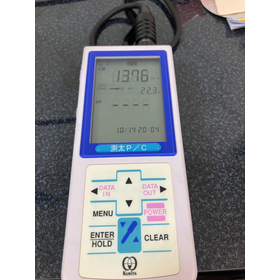
■ Can it exceed 100%?! DO (Dissolved Oxygen) is expressed not only in concentration but also as a percentage of saturation (saturation level, %). When phytoplankton actively photosynthesize in the surface layer of a lake, the saturation level can exceed 100%, which is referred to as supersaturation. ■ What is the official measurement method? According to environmental standards, it is stipulated that measurements should be taken using methods defined by Japanese Industrial Standards or water quality automatic monitoring measurement devices that use membrane electrodes or optical sensors, yielding comparable results. The section on dissolved oxygen in this standard (JIS K0102) includes methods such as iodine titration, the Miller method, membrane electrode method, and optical sensor method. ■ Calibrate the DO meter before use There are methods to calibrate the DO meter using air or water saturated with air. Calibration also includes corrections based on the local atmospheric pressure and salinity in saline water. This is because the higher the salinity of the water, the lower the amount of dissolved oxygen. ■ What about water with hydrogen sulfide? When measuring DO at the bottom layer, if hydrogen sulfide is present, one should be aware of the potential for sensor damage or the indication of high values.
Price range
Delivery Time
Applications/Examples of results
■What are the standards for rivers? According to environmental standards, the DO levels for rivers are set at 7.5 mg/L or higher for types AA and A, 5 mg/L or higher for types B and C, and 2 mg/L or higher for types D and E. ■Is a higher aeration tank better? The DO during the operation of the standard activated sludge method is often designed to be around 1 to 2 mg/L. The height of the DO during operation greatly affects the oxygen supply, which means it significantly impacts the power required for aeration. Keeping the DO unnecessarily high can lead to wasted electricity. ■What happens with over-aeration? In the case of wastewater from food factories, maintaining the DO in the aeration tank at around 0.5 to 2 mg/L is usually sufficient. Over-aeration can promote nitrification, causing sludge to float in the settling tank, but the direct cause is not the high DO, but rather a low BOD-MLSS load. ■Check the DO meter values as well Aeration adjustments are made based on the values from the DO meter. If the values are off, there is a risk of over-aerating or insufficient oxygen supply. Our company also offers consultations regarding the maintenance of DO meters and the updating of aeration devices. Please feel free to reach out to us first.
catalog(3)
Download All Catalogs
Recommended products






Distributors

Since our founding, we have continued to provide flexible services with the motto of accurately supplying a diverse range of products that respond to changes in the times and the diversification of consumer needs, tailored to various applications and requirements. With the corporate slogan "Chemical Engineering Partner," we, as a group of experts in chemical technology, actively discover ideas to solve our customers' problems from advanced technologies both domestically and internationally, and propose them.