
What are the effluent water quality standards for septic tanks? BOD and removal rates [Basic Knowledge]
The water discharged from the purification tank has standards based on both the concentration of BOD and the removal rate. I will explain the differences in the regulations of the two laws and the mechanism of the inspection.
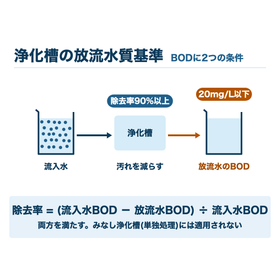
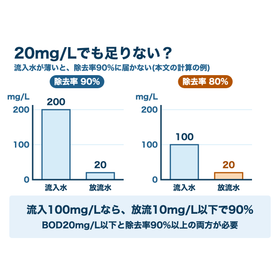
■Where are the standards for effluent determined? Article 4, Paragraph 1 of the Sewage Treatment Plant Law states that the Minister of the Environment shall establish technical standards for the water quality of effluent from sewage treatment plants by ministerial ordinance. These standards are outlined in Article 1-2 of the Enforcement Regulations related to the Sewage Treatment Plant Law. ■BOD must be 20 mg/L or less The enforcement regulations require that the BOD (Biochemical Oxygen Demand) of the effluent be 20 mg/L or less, and that the BOD removal rate be 90% or more. This means that both the concentration and the reduction rate must be met simultaneously. However, this standard does not apply to deemed sewage treatment plants (standalone treatment plants). ■Why is the removal rate also specified?! The removal rate is calculated by subtracting the BOD of the effluent from the BOD of the inflow water, and then dividing that value by the BOD of the inflow water. For example, if the inflow water is 200 mg/L and the effluent is 20 mg/L, the removal rate is exactly 90%. If the inflow water is diluted at 100 mg/L, then with an effluent of 20 mg/L, the removal rate only reaches 80%, and it would need to be reduced to below 10 mg/L to achieve 90%. Please feel free to consult us first.
basic information
■ Are there standards in the Building Standards Act? Article 32 of the Enforcement Order of the Building Standards Act specifies the performance that septic tanks should have under normal usage conditions, categorized by area and the number of people being treated. The standards in the enforcement regulations differ in that they focus on the water quality of the effluent, while the standards for septic tanks pertain to the treatment performance required by their structure. ■ Performance for Other Areas In areas designated as "other areas" without specific specifications, the following applies: 1. Up to 500 people: Removal rate of 65% or more, effluent BOD of 90 mg/L or less 2. 501 to 2,000 people: Removal rate of 70% or more, effluent BOD of 60 mg/L or less 3. More than 2,001 people: Removal rate of 85% or more, effluent BOD of 30 mg/L or less In areas designated by the specific administrative authority as having particular sanitary issues, the classification is as follows: 50 people or less, 51 to 500 people, and more than 501 people, where for over 501 people, the removal rate must be 85% or more, and the effluent BOD must be 30 mg/L or less. The number of E. coli in the effluent must be 800 CFU/mL or less, regardless of the area. ■ Stricter Standards if Applicable If there are stricter values or items other than BOD specified in the wastewater standards of the Water Pollution Control Act or in Article 4, Paragraph 1 of the Septic Tank Law, performance that complies with those standards is required.
Price range
Delivery Time
Applications/Examples of results
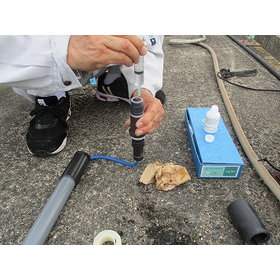
■Do large septic tanks also relate to the Water Pollution Prevention Act? According to the Enforcement Order of the Water Pollution Prevention Act, septic treatment facilities, including septic tanks, are designated facilities unless they serve a population of 500 or fewer. Septic tanks serving more than 501 people may fall under the scope of this law. ■How can we verify compliance with the standards? The Septic Tank Law stipulates water quality inspections to be conducted within five months after the start of use, following a three-month period (Article 7), as well as annual regular inspections (Article 11). Inspections check parameters such as pH, dissolved oxygen levels, turbidity, residual chlorine concentration, and BOD. This system verifies whether the septic tank is functioning correctly based on these parameters. The specific parameters may vary by prefecture. ■What causes the quality of discharged water to deteriorate?! Incorrect usage or insufficient maintenance can lead to poor water quality in the discharged water or unpleasant odors. It is also stipulated in the enforcement regulations that substances that hinder the operation of the septic tank, such as pesticides, detergents, and oils, should not be discharged. Our company offers consultations regarding water quality around septic tanks and the chemicals used for maintenance. Please feel free to contact us.
catalog(2)
Download All Catalogs

Recommended products





Distributors

Since our founding, we have continued to provide flexible services with the motto of accurately supplying a diverse range of products that respond to changes in the times and the diversification of consumer needs, tailored to various applications and requirements. With the corporate slogan "Chemical Engineering Partner," we, as a group of experts in chemical technology, actively discover ideas to solve our customers' problems from advanced technologies both domestically and internationally, and propose them.