
How to Measure Total Nitrogen and Total Phosphorus? Simple Measurement and Official Methods [Basic Knowledge]
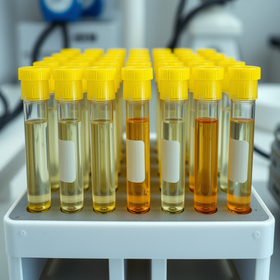
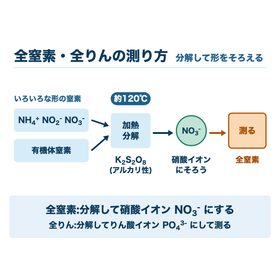
Decompose various forms of nitrogen and phosphorus and align them into a single form before measuring. This explains the mechanism of the official method and points to note when using a simplified method.
Total nitrogen refers to the total amount of nitrogen contained in water. It includes inorganic nitrogen from ammonia nitrogen, nitrite nitrogen, and nitrate nitrogen, as well as organic nitrogen found in organic compounds such as proteins. Total phosphorus is also measured as a total amount rather than measuring each type of phosphorus compound individually. ■ How is the "total" amount measured? If the forms are different, they cannot be measured together. Therefore, chemicals are added, and the sample is heated and decomposed to standardize everything into one form before measurement. 1. Total nitrogen: Decomposed with alkaline potassium peroxydisulfate to convert nitrogen compounds into nitrate ions. 2. Total phosphorus: Decomposed with potassium peroxydisulfate, etc., and measured as phosphate ions. In the decomposition of total nitrogen, the sample is heated to about 120°C in an autoclave. ■ Official methods are determined by notification The method of measurement when comparing with wastewater standards is specified by a notification from the Minister of the Environment. Methods for determining nitrogen and phosphorus content are designated by Japanese Industrial Standards (JIS) K0102, among others. Please feel free to consult us first.
basic information
■What is the total nitrogen method? It is a method of measuring nitrogen in different forms and summing them up. It involves adding nitrate nitrogen and nitrite nitrogen to the Kjeldahl nitrogen, which includes organic nitrogen and ammonia nitrogen. Although it requires more effort due to the number of items measured, it allows for understanding the breakdown by form. ■What are the weaknesses of the method that measures with ultraviolet light? There is a method that measures nitrate ions after decomposition by absorbing ultraviolet light at a wavelength of 220 nm. While this method is simpler than the total nitrogen method, it can lead to errors if there are substances that absorb at the same wavelength, such as bromide ions or undecomposed organic matter. Therefore, in wastewater from seawater systems with high bromide ion concentrations, the errors can be significant, and the total nitrogen method is sometimes used. ■Phosphorus is measured with a blue color. After decomposition, phosphate ions are reacted with molybdate to form phosphomolybdic acid, which is then reduced with ascorbic acid to measure the absorbance of molybdenum blue. ■Is the value of phosphate ions the same as total phosphorus? The value of phosphate ions measured without decomposition does not include the portion that converts to phosphate ions during decomposition. It needs to be treated as a separate value from total phosphorus. When comparing, it is essential to confirm which value is being referred to.
Price range
Delivery Time
Applications/Examples of results
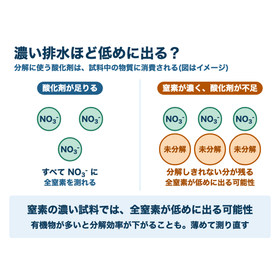
■Does more concentrated wastewater yield lower results?! The oxidizing agents used for decomposition are consumed by the substances in the sample. If there is insufficient oxidizing agent in a sample with high nitrogen concentration, the total nitrogen may appear lower. If there are many organic substances that do not contain nitrogen, the decomposition efficiency may also decrease. Such samples should be diluted and re-measured for confirmation. ■Shape changes after collection The form of nitrogen in wastewater left at room temperature may change. The best method is to analyze the sample immediately after collection. ■Is it acceptable to record using a simple method? Facilities subject to total load regulations in Tokyo Bay, Ise Bay, and the Seto Inland Sea are required to measure nitrogen and phosphorus pollution loads. A revision in 2004 added simple measurement methods, but these are limited to methods that yield results comparable to designated measurement methods. At the time of the revision, facilities with an average daily wastewater volume of 50 cubic meters or more but less than 400 cubic meters were primarily targeted. It is advisable to confirm usable methods with local authorities. ■Rental of measurement devices In addition to this, our company offers rental of total nitrogen, total phosphorus, and COD measurement devices for a fixed fee that includes maintenance. Please feel free to consult with us first.
catalog(2)
Download All Catalogs

Recommended products




Distributors

Since our founding, we have continued to provide flexible services with the motto of accurately supplying a diverse range of products that respond to changes in the times and the diversification of consumer needs, tailored to various applications and requirements. With the corporate slogan "Chemical Engineering Partner," we, as a group of experts in chemical technology, actively discover ideas to solve our customers' problems from advanced technologies both domestically and internationally, and propose them.