
What are the standards for sewer discharge? Rules for wastewater flowing into the sewer system [Basic Knowledge]
Standards for discharging factory wastewater into the sewer system. This explains the differences from the wastewater standards of the Water Pollution Control Law, the pollution control facilities, and the variations depending on the municipality.
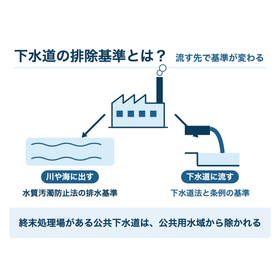
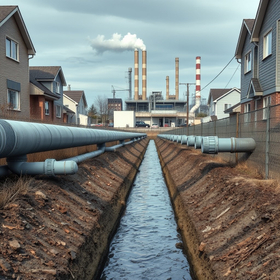
The wastewater standards of the Water Quality Pollution Prevention Act apply to water discharged into public water areas such as rivers and seas. ■ Standards for Sewage Systems under the Sewage Act Under this law, public sewage systems that have a treatment facility are excluded from public water areas, so the wastewater discharged into these sewage systems is subject to standards based on the Sewage Act and local government ordinances. Generally, these are referred to as sewage discharge standards. ■ Is there an obligation to connect to the sewage system? According to the Sewage Act, once the public sewage system is in operation, landowners within the drainage area must promptly install drainage facilities to discharge sewage into the public sewage system. However, there are exceptions, such as when permission is obtained from the public sewage system manager. Additionally, if the volume of sewage discharged on the busiest day exceeds 50 cubic meters, it is necessary to notify the public sewage system manager in advance about the start date of use. ■ Why are standards necessary? Highly acidic sewage can damage sewage pipes. Harmful substances can weaken the activity of microorganisms at treatment facilities, and heavy metals accumulate in sludge, making disposal difficult. Oil can clog pipes. Please feel free to consult with us.
basic information
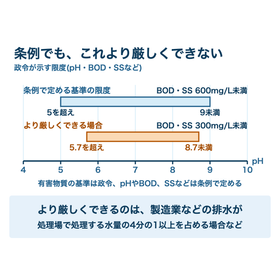
■What are the two mechanisms? 1. Restrictions on the exclusion of specific business sites: Business sites with specific facilities must not discharge wastewater that does not comply with the standards set by government ordinances or regulations. If they violate this, they will be subject to penalties without prior orders. 2. Installation of treatment facilities: Users who continuously discharge wastewater that does not meet the standards, not limited to specific business sites, can be mandated by local ordinances to install treatment facilities. Which of these applies depends on the conditions of the business site. ■Are there items that cannot be made stricter by ordinance? The standards for harmful substances are defined by government ordinances. On the other hand, parameters such as pH, BOD, and SS are set by local governments through ordinances, but the government ordinance states that "these must not be made stricter," indicating limits such as pH being above 5 and below 9, and BOD and SS being below 600 mg/L. Additionally, the standards for treatment facilities include ranges such as temperatures above 45°C and iodine consumption above 220 mg/L. ■Cases where stricter standards can be applied In cases where the wastewater from manufacturing industries accounts for more than a quarter of the volume treated at the treatment facility, stricter standards can be applied, with pH set to be above 5.7 and below 8.7, and BOD and SS below 300 mg/L.
Price range
Delivery Time
Applications/Examples of results
■What are the differences among municipalities? Municipal standards may specify that pH should be above 5 and below 9, and that BOD and SS should be below 600 mg/L. However, the standards may vary depending on factors such as the volume of wastewater, whether it is a specific facility, and the district. It is essential to check the latest standards of the municipality where the discharge will occur. ■What about measurement and recording? According to the Sewerage Act Enforcement Regulations, those who install specific facilities must measure water quality, with pH and temperature measured at least once a day during the discharge period, BOD measured at least once within a period not exceeding 14 days, and other parameters measured at least once within a period not exceeding 7 days. Records must be kept for 5 years. However, public sewerage administrators may set different frequencies. ■Different legal retention periods The retention period for records under the Water Pollution Prevention Act is 3 years, so be aware of this difference. ■Where to submit notifications? When establishing a specific facility, notification to the public sewerage administrator is required, and installation cannot occur for a principle of 60 days from acceptance. Torii has experience in inspecting wastewater treatment facilities, pH meters, and consulting on water treatment chemicals. Please feel free to contact us first.
catalog(2)
Download All Catalogs

Recommended products








Distributors

Since our founding, we have continued to provide flexible services with the motto of accurately supplying a diverse range of products that respond to changes in the times and the diversification of consumer needs, tailored to various applications and requirements. With the corporate slogan "Chemical Engineering Partner," we, as a group of experts in chemical technology, actively discover ideas to solve our customers' problems from advanced technologies both domestically and internationally, and propose them.