
What is the measurement method for TOC? Combustion oxidation and wet oxidation [Basic Knowledge]
Burn organic matter or oxidize it with chemicals? The mechanisms and suitability of the oxidation methods and detection methods of TOC analyzers that convert it to carbon dioxide for measurement.
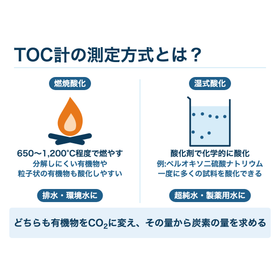
The TOC analyzer is a device that oxidizes organic matter in water to convert it into carbon dioxide, allowing for the determination of the amount of carbon contained in the organic matter. It is used for managing a wide range of organic pollution in water, from ultra-pure water to wastewater. According to the national notification that establishes the inspection methods for drinking water, total organic carbon analyzers are defined as a combination of sample introduction, decomposition, carbon dioxide separation, and detection components. The differences in methods mainly lie in the combinations of "how to oxidize" and "how to measure carbon dioxide." ■ How does the combustion oxidation method oxidize? Samples are injected into a combustion tube (such as one containing a catalyst) heated to a high temperature of approximately 650 to 1,200°C, where the organic matter is burned to produce carbon dioxide. The high combustion temperature allows for the oxidation of organic matter that is difficult to decompose and particulate organic matter that does not dissolve in water. This is why it is widely used in environmental water and industrial wastewater, which are prone to contain suspended solids. The combustion temperature varies by model, and some devices heat combustion tubes filled with platinum catalysts in furnaces up to 900°C. Be sure to check the specifications for the conditions specific to each model. Please feel free to consult us first.
basic information
■ How does the wet oxidation method oxidize? An oxidizing agent is added to the sample, chemically oxidizing organic matter to carbon dioxide. For example, sodium peroxodisulfate is used as an oxidizing agent, and some systems combine heating or ultraviolet irradiation to assist the reaction. ■ Why is wet oxidation suitable for ultra-pure water? In combustion methods, there is a limit to the amount of sample that can be injected at one time. In contrast, wet oxidation allows for a milder reaction than combustion, enabling the oxidation of a larger amount of sample at once, making it more effective for measuring low concentrations. However, its oxidizing power does not match that of combustion, and the recovery rate tends to decrease for particulate organic matter or substances that are difficult to decompose. Therefore, it is suitable for managing clean water such as ultra-pure water and pharmaceutical water. ■ How is carbon dioxide measured? 1. Infrared absorption: Utilizing the property that carbon dioxide absorbs specific infrared wavelengths. It has high selectivity and is less affected by coexisting components. 2. Conductivity: Organic matter is decomposed using ultraviolet light, and the change in conductivity accompanying the decomposition is measured. ■ Combination of oxidation and detection Typical methods include combinations such as combustion oxidation with infrared absorption, wet oxidation with infrared absorption, and ultraviolet oxidation with conductivity.
Price range
Delivery Time
Applications/Examples of results
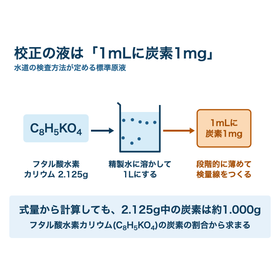
■What are the points to note when measuring with conductivity?! The method of determining TOC from the difference in conductivity before and after decomposition, without separating carbon dioxide from the sample, can be affected positively or negatively by ionic organic substances or organic substances containing nitrogen, sulfur, phosphorus, or halogens. ■What should be used for calibration? In the water supply testing method, 2.125g of potassium hydrogen phthalate is dissolved in purified water to make a 1L solution, which is used as the standard stock solution. This solution contains 1mg of carbon per 1mL. Calculating from the molecular weight of potassium hydrogen phthalate (C8H5KO4), the carbon in 2.125g is approximately 1.000g. This is then diluted stepwise to create a calibration curve. ■Things to check before choosing a method 1. Type of sample: Is it wastewater or environmental water, or clean water like ultra-pure water? 2. Suspended matter: How much particulate organic matter needs to be measured? 3. Concentration range: How low of a concentration needs to be measured? ■Rental of measuring devices Our company offers fixed-rate rentals of COD, total nitrogen, and total phosphorus measuring devices, as well as consultations for the maintenance of automatic measuring devices. Please feel free to contact us first.
catalog(2)
Download All Catalogs

Recommended products



Distributors

Since our founding, we have continued to provide flexible services with the motto of accurately supplying a diverse range of products that respond to changes in the times and the diversification of consumer needs, tailored to various applications and requirements. With the corporate slogan "Chemical Engineering Partner," we, as a group of experts in chemical technology, actively discover ideas to solve our customers' problems from advanced technologies both domestically and internationally, and propose them.