
What is compressor drain oil-water separation? [Basic Knowledge]
Water (drain) that comes from compressed air may contain oil. This explains the mechanism of drain production, points to note about cloudy white drain, and treatment devices.
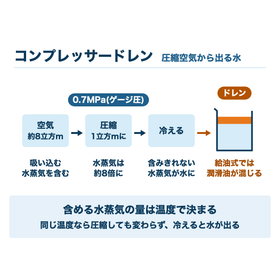
■Where does the drain come from? Air contains water vapor. The amount of water vapor that air can hold is determined by temperature, so when compressed air that has become hot cools down, the excess water vapor that can no longer be held condenses into water. This is the drain from the compressor. ■Why is it easier for water to come out when compressed?! Compressed air at 0.7 MPa (gauge pressure) is about 8 times the pressure of atmospheric pressure. To create 1 cubic meter of compressed air, about 8 cubic meters of air must be drawn in, which means the amount of water vapor brought in per cubic meter increases by about 8 times. On the other hand, the amount of water vapor that air can hold is determined by temperature and does not change even when compressed at the same temperature. Therefore, when it cools, the excess that cannot be held turns into water. ■Why is there oil mixed in? The drain contains not only dust from the drawn-in air but also lubricating oil from oil-injected compressors. For applications where oil in the air is particularly undesirable, using an oil-free compressor is an option. Methods for treatment include oil-water separation tanks, filters using adsorbents, and combinations of these. Please feel free to consult us first.
basic information
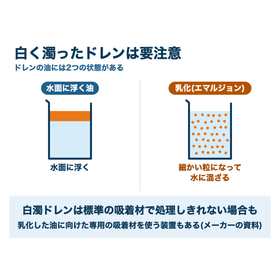
■Is the white cloudy drain a cause for concern?! In the oil from the drain, in addition to the oil floating on the water's surface, there is also emulsified (emulsion) oil that is mixed with water in fine particles. A white cloudy drain may not be adequately treated with standard adsorbents, and there are devices available that use specialized adsorbents designed for emulsified oil. ■Mechanism of the treatment device 1. Oil-absorbing material: Fibers that adsorb oil, which first remove the oil content. 2. Activated carbon: Adsorbs the remaining oil content to finish the process. There are devices that process in two stages, and some have a structure that allows natural drainage without using power. Some products claim to be able to treat oil concentrations up to 500 mg/L, and the treatment range is determined for each product. ■Adsorbents decrease with use There is a limit to the amount of oil that adsorbents can capture. The time until replacement varies depending on the compressor's operating time and the concentration of oil in the drain. The higher the oil concentration, the quicker the replacement will be. For example, in one product, with operation for 8 hours a day on the 22nd of the month and a drain discharge rate of 4.0 L/hour, the replacement guideline is approximately 2,128 hours at 200 ppm and about 1,418 hours at 300 ppm.
Price range
Delivery Time
Applications/Examples of results
■Does the amount of drain increase in summer? Warm air can hold more water vapor, so generally, the amount of drain increases during the hot and humid summer months. Even with the same compressor, the amount of drain flowing into the treatment system varies by season. ■How clean is the treated water? Oil-water separation devices can reduce the oil content in treated water (n-hexane extractable substances) to below 5 mg/L. National wastewater standards also set the limit for mineral oils at 5 mg/L, applicable to specific facilities that discharge into public water bodies, particularly factories with an average daily discharge of 50 cubic meters or more. When discharging into the sewer system, separate sewer discharge standards apply. In some regions, local regulations may impose stricter standards or additional requirements. ■What should you look for when choosing a device? 1. Oil concentration: Each device has guidelines for the inflow oil concentration it can handle. 2. Presence of turbidity: Drains with advanced emulsification may require specialized adsorbents. 3. Standards for discharge destination: Verify local regulations in addition to national standards. As long as the compressor is running, drain will continue to be produced. Our company offers consultations on wastewater treatment, including drain management. Please feel free to reach out to us.
catalog(2)
Download All Catalogs

Recommended products







Distributors

Since our founding, we have continued to provide flexible services with the motto of accurately supplying a diverse range of products that respond to changes in the times and the diversification of consumer needs, tailored to various applications and requirements. With the corporate slogan "Chemical Engineering Partner," we, as a group of experts in chemical technology, actively discover ideas to solve our customers' problems from advanced technologies both domestically and internationally, and propose them.