
What is the disinfection of vegetables with hypochlorous acid? Concentration and soaking time [Basic Knowledge]
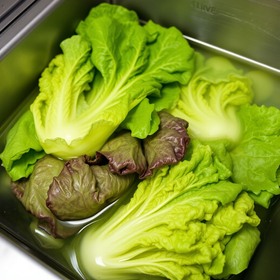
When sterilizing raw vegetables in food service facilities and food factories, I will explain the key points regarding the concentration and time indicated in the national manual, the order of pre-processing, and the management of the sterilizing solution.
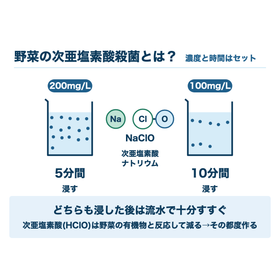
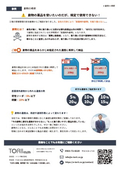
Vegetables and fruits that are served without heating do not undergo a process to reduce bacteria at the center temperature like cooked foods do. Therefore, in school lunch facilities and food factories, there may be a process of sterilization using sodium hypochlorite solution after washing. ■ Which facilities does the national manual apply to? The national hygiene management manual for large-scale cooking facilities applies to cooking facilities that provide the same menu for 300 meals or more at one time or 750 meals or more in a day. When serving vegetables and fruits without heating, they should be thoroughly washed with running water and sterilized if necessary, followed by thorough rinsing with running water. ■ Some facilities cannot skip sterilization! Facilities that serve meals to the elderly, young children, or individuals with weakened immunity are required to perform sterilization when serving food without heating. If the skin is removed before serving, this requirement is excluded. ■ Concentration and time are set together When using sodium hypochlorite solution, if the concentration is 200 mg/L, the immersion time is 5 minutes; if it is 100 mg/L, the time is 10 minutes. In both cases, after immersion, they should be rinsed with running water. Please feel free to consult us first.
basic information
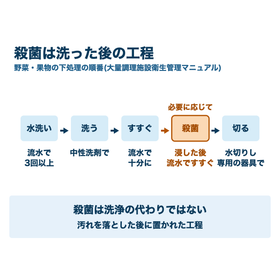
■What is the order of preparation? The preparation of vegetables and fruits is done in the following order: 1. Wash with running water at least three times. 2. Wash with a neutral detergent. 3. Rinse thoroughly with running water. 4. Sterilize if necessary, and rinse thoroughly with running water. 5. Drain and cut with a dedicated cutting board and knife. Sterilization is not a substitute for cleaning; it is a step that follows the removal of dirt. ■Does the sterilizing solution weaken over time? Hypochlorous acid reacts with the organic matter contained in vegetables and decreases. When it reacts, organic chlorine compounds are also produced. Diluted solutions lose their effectiveness over time, so they should not be prepared in advance but made fresh each time. In the production of cut vegetables, the sterilizing solution is also prepared anew for each batch. ■How to check the concentration? Before use, check the concentration with test strips. Even when using the solution continuously, confirm with a chlorine concentration meter or test strips that the concentration is maintained. If the concentration of the solution has decreased, there is a risk that it will not be sufficiently sterilized even if soaked for the designated time. ■What items do you want to record? 1. Concentration: The value checked with test strips, etc. 2. Time: The duration of soaking. 3. Preparation: When the solution was made.
Price range
Delivery Time
Applications/Examples of results
■How much can bacteria be reduced by disinfection? Reports indicate that washing lettuce with sodium hypochlorite at 51 mg/L can reduce the number of bacteria by about 1 to 2 orders of magnitude. Instead of relying solely on disinfection, it is important to combine other management practices from the manual, such as refrigerating at temperatures below 10°C when it takes more than 30 minutes to cook. ■Cases divided by the presence or absence of disinfection In 2016, an outbreak of enterohemorrhagic E. coli food poisoning occurred in elderly facilities in Tokyo and Chiba Prefecture due to cucumber with yuka seasoning, affecting 84 patients. Among the facilities that served the same menu, those that implemented disinfection processes did not have any cases of illness. ■What are the usage standards for additives? Sodium hypochlorite used in food is treated as a disinfectant food additive, and the usage standards prohibit its use on sesame. There are no restrictions on its use for foods other than sesame. When used for disinfection, it is necessary to comply with the standards for food and additives. ■What we can do We provide consultation on the supply of chemicals, including sodium hypochlorite, and how to measure residual chlorine. Please feel free to contact us for more information.
catalog(3)
Download All Catalogs

Recommended products








Distributors

Since our founding, we have continued to provide flexible services with the motto of accurately supplying a diverse range of products that respond to changes in the times and the diversification of consumer needs, tailored to various applications and requirements. With the corporate slogan "Chemical Engineering Partner," we, as a group of experts in chemical technology, actively discover ideas to solve our customers' problems from advanced technologies both domestically and internationally, and propose them.