
What is the treatment of ammonia wastewater? Three methods [Basic Knowledge]
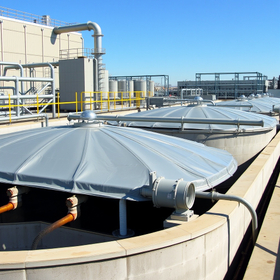
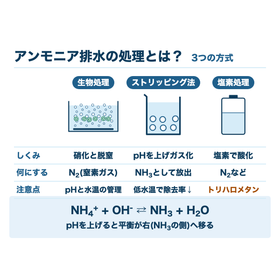
What are the differences between biological treatment, stripping, and chlorine treatment? This explains the conditions and points to note for the three methods based on the equilibrium of ammonia.
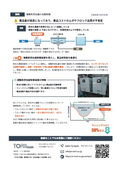
Ammonia in wastewater exists in a state of equilibrium between ammonium ions (NH4+) and ammonia (NH3). When the pH is raised, this equilibrium shifts towards the NH3 side. Here, we will discuss three representative treatment methods. ■ What are the differences among the three methods? 1. Biological treatment: Converts nitrogen into nitrogen gas through nitrification and denitrification. 2. Ammonia stripping method: Raises the pH to release it as gas. 3. Discontinuous chlorine treatment method: Oxidizes with chlorine to produce nitrogen gas and others. ■ Chlorine treatment progresses in stages Generally, nitrogen gas is produced through the following reactions: NH3 + HClO → NH2Cl + H2O NH2Cl + HClO → NHCl2 + H2O NH2Cl + NHCl2 → N2 + 3HCl ■ Should pH be raised or maintained? The stripping method increases NH3 by raising the pH. On the other hand, the bacteria responsible for nitrification in biological treatment are sensitive to pH and water temperature, so careful management of pH and maintenance of water temperature are necessary for efficient treatment. The target pH varies depending on the method. Please feel free to consult us first.
basic information
■What are the conditions for the stripping method? The following equilibrium is shifted to the right by increasing the pH, allowing NH3 to be released as a gas into the atmosphere and removed. NH4+ + OH- ←→ NH3 + H2O The treatment pH is adjusted to 10.5 to 11. Since slaked lime (calcium hydroxide) tends to form calcium scale, sodium hydroxide is used as the alkali agent. ■What happens to the released ammonia? Ammonia gas is typically absorbed in sulfuric acid and recovered as ammonium sulfate (sulfate of ammonia). 2NH3 + H2SO4 → (NH4)2SO4 ■How does water temperature affect the removal rate? Stripping is a method based on gas-liquid equilibrium, so the removal rate is influenced by water temperature, decreasing as the temperature drops. During winter or other periods when water temperature decreases, attention must be paid to the decline in removal rate. ■What are the advantages and disadvantages of chlorine treatment? Chlorine treatment has the advantage of being fast-acting, less affected by water temperature, and controllable via ORP (oxidation-reduction potential) measurement. On the other hand, a disadvantage is that organic matter in the water can react with chlorine to produce trihalomethanes, which are known to be carcinogenic.
Price range
Delivery Time
Applications/Examples of results
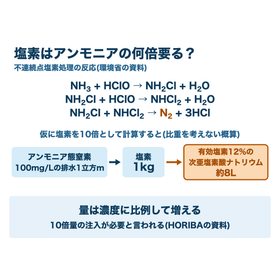
■How much chlorine is needed compared to ammonia? The chlorine consumed by 1 mg/L of ammonia in water is between 7.6 and 15 mg/L. The value changes depending on whether it is counted as nitrogen or ammonia, so both are treated as guidelines. Regardless of how it is counted, it remains true that much more chlorine is needed than ammonia. ■What happens to the amount of chemicals when the concentration is high? The amount of chlorine increases in proportion to the concentration of ammonia. In wastewater with high concentrations of ammonia nitrogen, the amount of sodium hypochlorite used also increases, affecting the cost of chemicals and storage facilities. The stripping method and discontinuous point chlorine treatment method are also used as pretreatment methods to reduce ammonia concentration. ■Biological treatment focuses on the balance of alkalinity Nitrification is a reaction that produces acid, which decreases the alkalinity in the liquid. Therefore, nitrification alone requires a lot of alkalinity for neutralization. On the other hand, denitrification produces alkalinity, so the denitrified liquid can be used to supplement the nitrification process. At Torii, we accept inquiries regarding wastewater treatment chemicals, including pH adjusters and sodium hypochlorite. Please feel free to consult with us.
catalog(2)
Download All Catalogs
Recommended products



Distributors

Since our founding, we have continued to provide flexible services with the motto of accurately supplying a diverse range of products that respond to changes in the times and the diversification of consumer needs, tailored to various applications and requirements. With the corporate slogan "Chemical Engineering Partner," we, as a group of experts in chemical technology, actively discover ideas to solve our customers' problems from advanced technologies both domestically and internationally, and propose them.