
What are the standards for factory wastewater? Rules determined by the discharge destination [Basic Knowledge]
River, sea, or sewage system? The standards for factory wastewater become clear when tracing the destination of the water and the conditions of the facility in order.
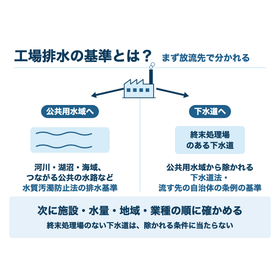
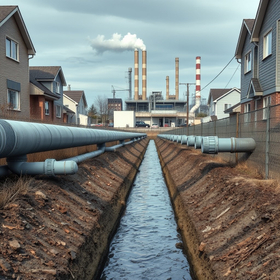
The standards that apply to factory wastewater are not determined solely by the name of the industry. Whether to refer to the wastewater standards of the Water Pollution Prevention Act, sewer standards, or prefectural ordinances depends first on where the wastewater is discharged. After that, conditions are checked in the order of facilities, water volume, region, and industry. ■ The first point of divergence is the discharge destination The Water Pollution Prevention Act regulates water discharged into public water areas such as rivers, lakes, and coastal waters. On the other hand, public sewers and watershed sewers with wastewater treatment facilities are excluded from public water areas. Water discharged into such sewers is subject to the standards set by the Sewer Act or the ordinances of the municipality where it is discharged. Conversely, even if it is called a sewer, those without a wastewater treatment facility do not meet the exclusion criteria. ■ Are external waterways also public water areas? According to the definition of the law, public ditches, irrigation canals, and other waterways that connect to water areas such as rivers and coastal waters are also included in public water areas. It is important to trace where the water that leaves the site ultimately flows to, using plans or on-site checks. Please feel free to consult with us first.
basic information
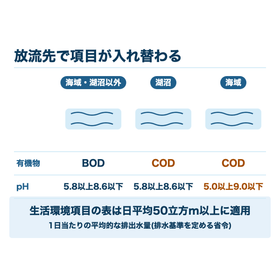
■ Are there specific facilities? The wastewater standards under the Water Pollution Prevention Act apply to factories and business establishments with specific facilities (designated by government ordinance), meaning the water that flows from these specific business establishments into public water areas. The law refers to this water as "discharge water." ■ Is discharge water only from process water? In terms of definition, discharge water is considered to be water discharged from specific business establishments into public water areas and is not limited to wastewater from specific facilities. Whether it meets the standards is determined by the water at the discharge point of that establishment. ■ A volume of 50 cubic meters is the dividing line According to the ministerial ordinance that sets the wastewater standards, the table of living environment items such as BOD and SS applies to factories and business establishments that have an average daily discharge water volume of 50 cubic meters or more. ■ Items change between rivers and seas! In the notes of the same ministerial ordinance, the applicable items and values change depending on the discharge destination. 1. BOD: Applicable when discharged to areas other than seas and lakes 2. COD: Applicable when discharged to seas and lakes 3. pH: Outside of seas, it should be between 5.8 and 8.6; for seas, it should be between 5.0 and 9.0 Which standard of BOD or COD to comply with is also determined by the discharge destination.
Price range
Delivery Time
Applications/Examples of results
■Are there changes in standards depending on the industry? The supplementary provisions of the ministerial ordinance include provisional standards for certain industries. For example, regarding nitrogen content, there are values for the natural gas mining industry until September 30, 2028. Additionally, it is noted that certain items, such as pH, will not be applied for the time being to the ryokan industry that utilizes specific hot springs. ■Is it within the area of the ordinance? Prefectures can establish stricter wastewater discharge standards through ordinances for areas where national standards are insufficient. The ordinances also specify the boundaries of the areas, so it is important to confirm the location. ■Is the total volume regulation not based on the entire volume? In designated areas such as Tokyo Bay, facilities with an average daily discharge of 50 cubic meters or more are subject to total volume regulation standards. The enforcement regulations exclude water used solely for cooling purposes, which does not increase the load, from the volume used to calculate the load. ■Five items to organize your company's standards 1. Discharge destination: Public water bodies or sewage systems 2. Facilities: Are there specific facilities? 3. Water volume: Average daily discharge volume 4. Region: Is it an area subject to additional regulations or total volume regulation? 5. Industry: Is it subject to provisional standards, etc.? We at Torii also accept consultations regarding inspections of wastewater treatment facilities and selection of water treatment chemicals. Please feel free to contact us first.
catalog(1)
Download All Catalogs
Recommended products







Distributors

Since our founding, we have continued to provide flexible services with the motto of accurately supplying a diverse range of products that respond to changes in the times and the diversification of consumer needs, tailored to various applications and requirements. With the corporate slogan "Chemical Engineering Partner," we, as a group of experts in chemical technology, actively discover ideas to solve our customers' problems from advanced technologies both domestically and internationally, and propose them.