
What is a sludge dewatering machine? Types and how to choose, chemicals before dewatering [Basic Knowledge]
The results of the dehydrator vary not only by model but also by the coagulant used in the previous stage. This explains the main characteristics of different models and the items to consider when making a selection.
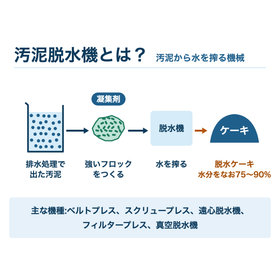
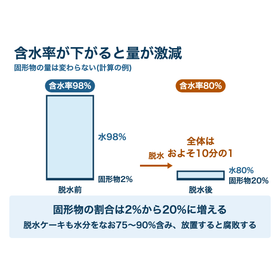
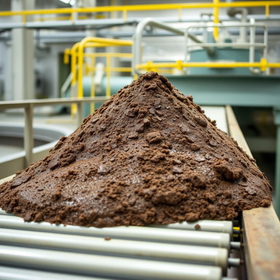
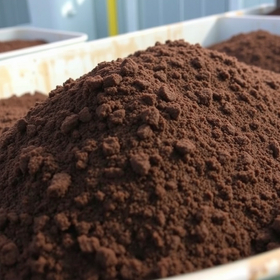
A sludge dewatering machine is a device that squeezes water from sludge generated during wastewater treatment, turning it into cake-like dewatered sludge (dewatering cake). ■ Reasons for Choosing Mechanical Dewatering Natural dewatering methods, such as drying beds, require a large area and can produce odors, which is why mechanical dewatering is widely used to reduce the volume of sludge in a smaller space. ■ Cost Implications In wastewater treatment for food factories, the costs for handling and disposing of excess sludge account for about 70% of the total operating costs. Reducing water content is therefore also significant in terms of costs. ■ Does a Slight Decrease in Moisture Content Lead to a Huge Reduction in Volume? The proportion of water contained in sludge is referred to as moisture content, while the proportion of solids is the value obtained by subtracting the moisture content from 100%. For example, if sludge with a moisture content of 98% is dewatered to 80%, the proportion of solids increases from 2% to 20%. Since the amount of solids remains unchanged, the overall volume is calculated to be approximately one-tenth. ■ Dewatering Cake Still Contains a Lot of Water! Dewatered sludge still contains 75-90% moisture, and if left unattended, it can rot and produce unpleasant odors. It is also important to consider the arrangements for storage and transportation after dewatering. Please feel free to consult us first.
basic information
■What are the main types of dewatering machines? 1. Belt press: Sludge is sandwiched between two filter cloths and squeezed by rollers. 2. Screw press: Sludge is pushed into a narrow space and squeezed by a slowly rotating screw. 3. Centrifuge: Sludge is separated by being pressed against the inner wall of the outer cylinder by centrifugal force from high-speed rotation. 4. Filter press: Sludge is squeezed through filter cloths and operated in batches. 5. Vacuum dewatering machine: Sludge is suctioned and filtered through a rotating cylindrical filter cloth. ■How does the moisture content of the finished product differ? Generally, filter presses have a lower moisture content compared to other methods, with belt presses following closely. Centrifuges tend to have a higher moisture content in sludge with a high organic matter content due to the difference in specific gravity between solids and water. Vacuum dewatering machines tend to have higher moisture content because the pressure difference applied is smaller. ■Why is a coagulant added before dewatering? By creating strong flocs with a coagulant, fine particles become less likely to slip through, and the filter cloth is less likely to clog. As a result, this leads to a reduction in moisture content. Organic sludge often has a negatively charged surface that repels itself, so cationic coagulants are frequently used to neutralize the charge.
Price range
Delivery Time
Applications/Examples of results
■What items should be compared when evaluating models? When comparing dewatering machines, the following items are considered: 1. Dewatering rate and SS recovery rate 2. Equipment cost and operating cost 3. Installation area 4. Ease of maintenance and working environment Centrifugal dewatering machines are widely used in wastewater treatment in food factories because they take up little space and help maintain a hygienic environment. ■The choice of chemicals varies by model! Centrifugal dewatering machines apply strong forces generated by rotation to the floc. Therefore, it is necessary to select polymer coagulants that can create robust flocs and ensure a high SS recovery rate. ■In the case of screw presses Screw presses have relatively large holes in the outer cylinder, so selecting chemicals that create strong flocs and the right reaction conditions is important. ■Should coagulants be determined through testing? In filter presses, the selection of filter cloth, pressure and time of pressing, and combinations of coagulants are determined through testing. To achieve effective dewatering, it is necessary to test several types of coagulants and understand the optimal combinations of dosage and pH. We can also provide advice on selecting coagulants tailored to the properties of the sludge and the dewatering machine. Please feel free to consult with us first.
catalog(3)
Download All Catalogs
Recommended products

Distributors

Since our founding, we have continued to provide flexible services with the motto of accurately supplying a diverse range of products that respond to changes in the times and the diversification of consumer needs, tailored to various applications and requirements. With the corporate slogan "Chemical Engineering Partner," we, as a group of experts in chemical technology, actively discover ideas to solve our customers' problems from advanced technologies both domestically and internationally, and propose them.