
What is an RO system? Key points on configuration and operational management [Basic Knowledge]
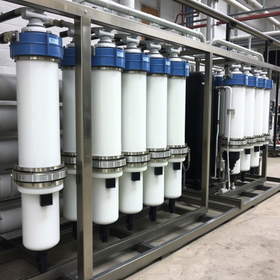
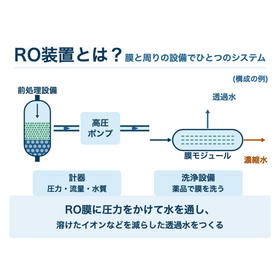
The RO system is a single system that includes not only the membrane but also pumps, instruments, and cleaning equipment. This explains the configuration of the system and the key points to focus on during daily operation.
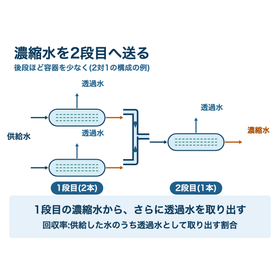
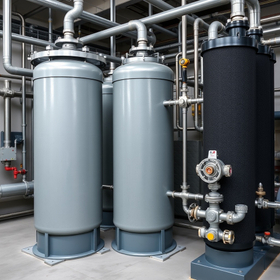
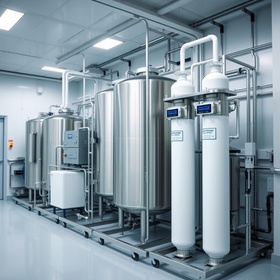
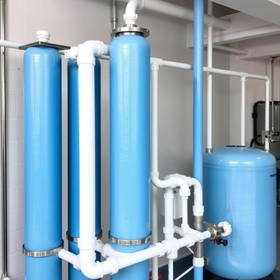
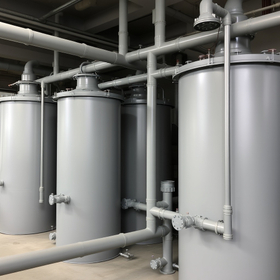
An RO system (reverse osmosis membrane system) is a device that applies pressure to an RO membrane to allow water to pass through, producing permeate water with reduced dissolved ions and other impurities. While the membrane is the main component, it is essential to combine it with surrounding equipment and manage daily operations to fully utilize its performance and ensure long-term use. ■ What is an RO system made of? 1. Pre-treatment equipment: Removes turbidity and residual chlorine before water enters the membrane. 2. High-pressure pump: Applies pressure to the water supplied to the membrane. 3. Membrane module: Contains spiral-shaped elements loaded into a pressure vessel. 4. Instruments: Measure pressure, flow rate, water quality, etc. 5. Cleaning equipment: Tanks, pumps, and filters used to wash the membrane with chemicals. ■ Why are pressure vessels arranged in two stages? There is a limit to the amount of permeate water that can be extracted per element. Therefore, when aiming to increase recovery rates, the concentrated water from the first stage is sent to the second stage to extract additional permeate water. ■ Fewer vessels in the later stages As the permeate water is extracted and the flow rate decreases, it is common to reduce the number of vessels in the later stages, arranging them in ratios such as 2 to 1. Please feel free to consult us first.
basic information
■Is a higher recovery rate better? The recovery rate refers to the proportion of supplied water that is extracted as permeate. Increasing the recovery rate reduces water waste, but it leads to concentration of water on the supply side of the membrane, making scaling more likely. Conversely, lowering the recovery rate increases the amount of supply water needed to obtain the same amount of permeate. Therefore, the recovery rate is primarily adjusted to ensure it does not exceed the design value on the concentrated water side. ■Compare operating data using converted values! The amount and quality of permeate can vary based on operating conditions such as water temperature, pressure, and recovery rate. Therefore, measured values are compared using converted values adjusted to standard conditions. By recording converted values daily, early signs of fouling can be detected. ■When should chemical cleaning be performed? The following changes are indicators for chemical cleaning: 1. The converted permeate flow rate has decreased by about 10%. 2. The converted water quality (salt passage) has worsened by about 10%. 3. The differential pressure between the supply side and the concentrated water side has increased by about 15%. ■Delaying cleaning makes recovery difficult If cleaning is performed after exceeding the indicators, it may become difficult to restore performance. Timely cleaning is crucial.
Price range
Delivery Time
Applications/Examples of results
■What should you be careful about when starting up? When starting operation, first flow water at low pressure to expel the air inside the membrane, and then gradually increase the pressure. If pressure is applied suddenly while air remains, there is a risk of water hammer damaging the membrane. For new elements, the permeate water immediately after starting operation is discarded for a certain period of time. The duration for discarding varies by manufacturer. ■A little extra effort when stopping! If left in a stopped state, concentrated water remains in the pressure vessel. Therefore, during a stop, it is necessary to flow permeate water or supply water at low pressure to push out the concentrated salt. If stopping for an extended period, measures are taken to prevent the membrane from drying out and to use a preservation solution to inhibit microbial growth. ■Check the destination of concentrated water as well Concentrated water contains higher levels of salts and other substances, so it is necessary to consider its destination and treatment methods. When treating wastewater with RO membranes, measures must be taken to ensure that returning concentrated water to the treatment facility does not disrupt the treatment function. Depending on the source water and required water quality, suitable pretreatment and chemicals will vary. Please feel free to consult with us first.
catalog(3)
Download All Catalogs

Recommended products




Distributors

Since our founding, we have continued to provide flexible services with the motto of accurately supplying a diverse range of products that respond to changes in the times and the diversification of consumer needs, tailored to various applications and requirements. With the corporate slogan "Chemical Engineering Partner," we, as a group of experts in chemical technology, actively discover ideas to solve our customers' problems from advanced technologies both domestically and internationally, and propose them.