
What is a pure water system? Key points of the 2-bed 3-tower mechanism and operation [Basic Knowledge]
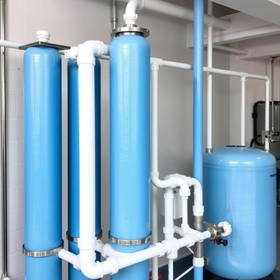
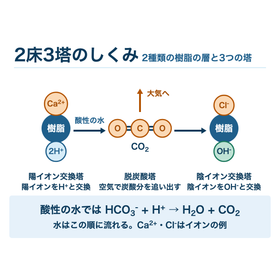
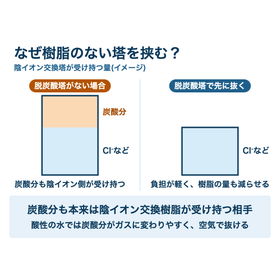
Why is there a tower without resin between the cation tower and the anion tower? I will explain the reasons for the arrangement of two beds and three towers, as well as the key points for operation.
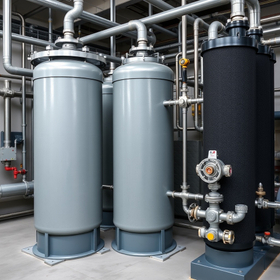
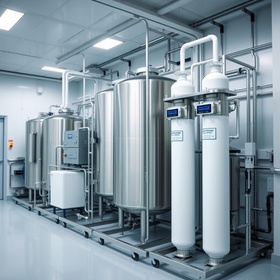
The pure water system is a device that creates pure water by removing ions dissolved in water. In the method using ion exchange resin, "2 beds and 3 towers" or mixed bed systems are common. Here, we will look at the meaning of the name "2 beds and 3 towers" and the reason for the order of the towers. ■ Meaning of the name "2 beds and 3 towers" "2 beds" refers to two types of resin layers for cations and anions, while "3 towers" refers to the following three towers. Water flows through them in this order: 1. Cation exchange tower: exchanges cations with hydrogen ions 2. Decarbonation tower: exposes water to air to expel carbonic acid 3. Anion exchange tower: exchanges anions such as chloride ions with hydroxide ions ■ Is there no resin in the middle tower?! In the first tower, calcium and other ions are exchanged with hydrogen ions, making the water acidic. In acidic water, dissolved carbonic acid tends to convert to gas. When air is blown in, it escapes into the atmosphere as carbon dioxide. ■ Why remove it first? Carbonic acid is originally the responsibility of the anion exchange resin. By expelling it with air first, the burden on the anion side is reduced, and the amount of resin packed in the tower can also be decreased. Please feel free to consult with us first.
basic information
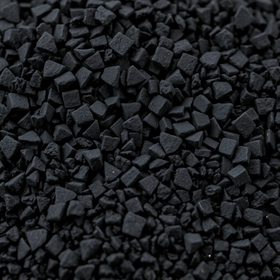
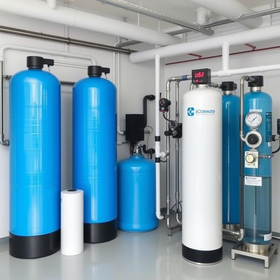
■ The resin on the anion side is not limited to one type? Anion exchange resins can be either strong basic or weak basic. In raw water with high levels of chloride ions or sulfate ions, a configuration is sometimes adopted where weak basic resin is placed in front of strong basic resin. ■ Acid and alkali are used for regeneration Resins that have been used continuously have hydrochloric acid or other acids flowed through the cation side, and alkalis such as caustic soda are flowed through the anion side to restore their exchange capacity. The wastewater generated during regeneration requires treatment such as neutralization before discharge. ■ Pure water cannot be produced during regeneration! While regeneration is taking place, the production of pure water stops. Therefore, it is common to have a tank to store pure water in anticipation of the time required for regeneration. ■ Why remove chlorine beforehand? Chlorine remains in tap water for disinfection purposes. If it is passed through as is, it can lead to degradation of the resin. Therefore, activated carbon or similar materials are placed in the preliminary stage to remove residual chlorine before passing the water through the resin. ■ The configuration is determined by the raw water and the required purity The quality of the raw water affects the quality of the treated water and the wear of the resin. Based on how much pure water is needed and the characteristics of the raw water, the configuration of the system is selected.
Price range
Delivery Time
Applications/Examples of results
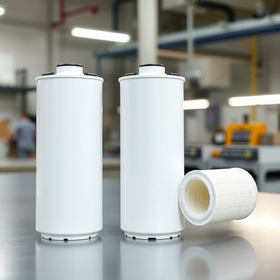
■Combination with RO membranes is also possible! In addition to ion exchange resins, RO membranes (reverse osmosis membranes) are also used as a means to remove ions. Water treated through RO membranes can be used as a pretreatment, followed by finishing processes such as ion exchange. These devices are combined according to the required purity. ■Purity is measured by electrical conductivity The purity of pure water is expressed in terms of conductivity (ease of electrical conduction) and specific resistance. The fewer ions present, the harder it is for electricity to pass through, resulting in a higher specific resistance. The quality of treated water is managed by measuring conductivity or specific resistance. ■Where is it used? It is used for boiler feed water, cleaning of parts and products, and as manufacturing water for food and pharmaceuticals. In boilers, if tap water is used as is, the hardness components can concentrate and cause scaling, so pure water is sometimes used. ■There is also the option of a pure water system that handles regeneration! In a "cartridge pure water system" that uses a container filled with resin, the supplier collects the resin that has lost its effectiveness for regeneration. This system is characterized by not requiring on-site regeneration work, regeneration chemicals, or drainage facilities. Please feel free to consult us first.
catalog(3)
Download All Catalogs
Recommended products



Distributors

Since our founding, we have continued to provide flexible services with the motto of accurately supplying a diverse range of products that respond to changes in the times and the diversification of consumer needs, tailored to various applications and requirements. With the corporate slogan "Chemical Engineering Partner," we, as a group of experts in chemical technology, actively discover ideas to solve our customers' problems from advanced technologies both domestically and internationally, and propose them.