
What is sand filtration? The mechanism and management of backwashing [Basic Knowledge]
Is the sand immediately after washing not sufficiently filtered yet? This explains the mechanism by which the sand layer captures turbidity, as well as the procedures, timing, and management points for backwashing.
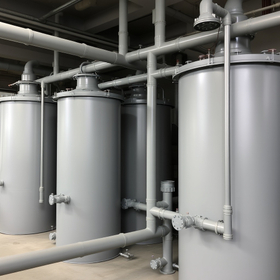
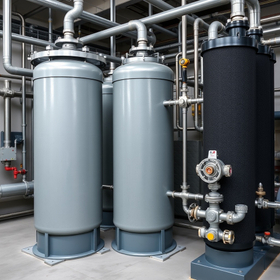
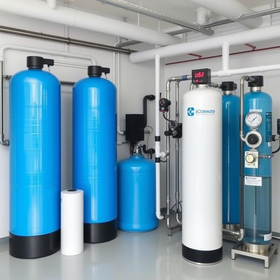
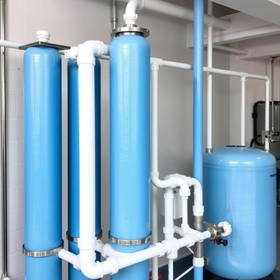
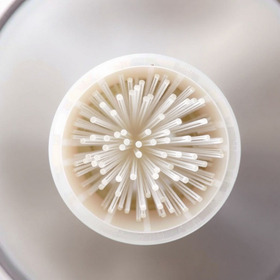
Sand filtration is a method of passing water through a layer filled with granular filter media such as sand to remove turbidity from the water. In addition to filtration ponds at water treatment plants, pressure-type filters (filtration towers) that pass water through a sealed container under pressure are also used in the treatment of industrial water and wastewater. ■ What is the difference between rapid filtration and slow filtration? Slow filtration is a method that removes impurities using a microbial film (biological filtration membrane) that forms on the surface of the sand. To avoid damaging this membrane, the filtration rate is generally kept below 5 m/day. Rapid filtration, on the other hand, is a method of passing water that has undergone treatment such as coagulation at a high speed. The filtration rate for rapid filtration is over 120 m/day, compared to about 4 m/day for slow filtration (with upper limits ranging from 180 m/day to 720 m/day). The sand layer is regularly cleaned through backwashing. ■ Does sand only remove turbidity through "sieving"? In rapid filtration, turbidity is removed not only by sieving particles through the gaps in the sand but also by adhering to the surface of the sand or settling between the grains of sand. As can be seen from the accumulation of turbidity within the sand layer during continuous filtration, turbidity is captured not only on the surface but also within the sand layer itself. Please feel free to consult us first.
basic information
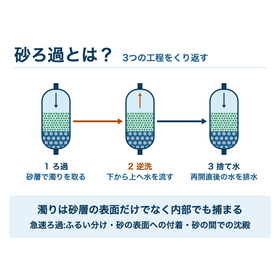
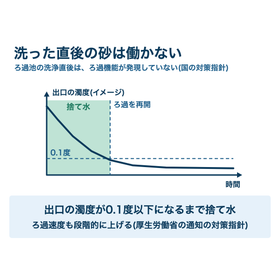
■Why is backwashing necessary? As filtration continues, impurities accumulate in the sand layer, making it difficult for water to pass through. Therefore, water is flowed from the bottom to the top, contrary to the direction of filtration, to loosen the sand layer and wash away the accumulated dirt. This is called backwashing. Depending on the equipment, surface cleaning by spraying water from nozzles onto the surface of the sand or air cleaning may also be combined. In filtration ponds using granular activated carbon, there are examples of washing in the order of "backwash → surface wash → backwash" or "backwash → air cleaning → backwash." Cleaning is performed at an appropriate backwashing rate, and at the end of the cleaning process, the backwashing rate is gradually reduced. ■Operation is a repetition of three processes 1. Filtration: Water passes through the sand layer to remove impurities 2. Backwashing: Water flows in the reverse direction to discharge dirt 3. Wastewater: Drainage of water immediately after resuming filtration ■Does the sand not work immediately after washing?! In the filtration ponds of water treatment plants, the filtration function is not activated immediately after washing. Therefore, it is necessary to gradually increase the filtration rate and to drain wastewater until the turbidity at the outlet is below 0.1 degrees. Careful operation is required right after washing.
Price range
Delivery Time
Applications/Examples of results
■ When should backwashing be performed? Backwashing can be initiated when the filtration resistance (loss of head or differential pressure) reaches a set value, or it can be done regularly based on time intervals. In pressure filtration towers at factories, some municipalities require backwashing on a timer, as backwashing only when pressure rises can easily lead to clogging. Even if there is little clogging, it is important to wash at appropriate intervals. ■ Why combine with coagulants? After oil-water separation, a small amount of polyaluminum chloride (PAC) may be added to the wastewater before passing it through the filtration tower. This is because suspended solids and oil in the water form flocs with the coagulant, which are then captured by the filter media. ■ Points to check during daily inspections 1. Differential pressure: Is the time until cleaning shorter than before? 2. Cleaning wastewater: Is the turbidity sufficiently reduced at the end of cleaning (usually aiming for below 2 NTU)? 3. Filter media: Is there a reduction in the amount of sand or any irregularities on the surface? ■ Consultation on filtration equipment and coagulants We offer consultations on water treatment chemicals such as filtration equipment and coagulants. Please feel free to reach out to us.
catalog(3)
Download All Catalogs


Recommended products




Distributors

Since our founding, we have continued to provide flexible services with the motto of accurately supplying a diverse range of products that respond to changes in the times and the diversification of consumer needs, tailored to various applications and requirements. With the corporate slogan "Chemical Engineering Partner," we, as a group of experts in chemical technology, actively discover ideas to solve our customers' problems from advanced technologies both domestically and internationally, and propose them.