
What is a boiler softener? Reasons for use in water supply and regeneration/inspection [Basic Knowledge]
In low-pressure boilers, it is common to use softened water from a water softener as make-up water. This explains the reasons for needing softened water, the regeneration process, and daily inspections.
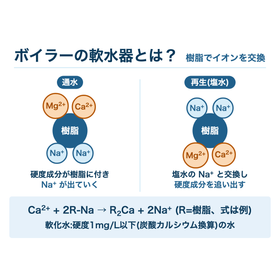
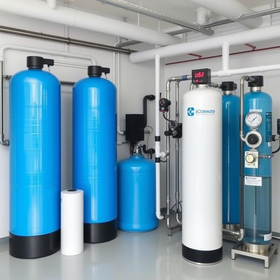
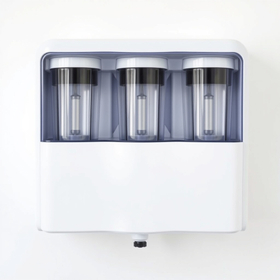
The softener for boilers (softening device) is a device that exchanges hardness components (mainly calcium ions and magnesium ions) in the supply water with sodium ions using cation exchange resin. The softened water referred to in JIS B 8223 is water that has been treated through this device to reduce hardness to 1 mg/L or less (calcium carbonate equivalent). ■ Why is soft water necessary for boiler feed water? When water evaporates inside the boiler, hardness components such as calcium remain in the concentrated water and eventually precipitate on the heat transfer surfaces. This scale blocks the path of heat, requiring more fuel to obtain the same amount of steam. According to JIS, it is difficult to prevent scale formation solely through blowdown management for certain types of boilers, and it is stipulated to use softened water or ion-exchanged water for makeup water. ■ What is the guideline for feed water hardness? According to the table in JIS B 8223, when using softened water as makeup water for multi-tube special circulation boilers, the hardness of the feed water should be 1 mg/L or less. Additionally, many boilers operating at pressures of 2 MPa or less use softened water for makeup water. Please feel free to consult us first.
basic information
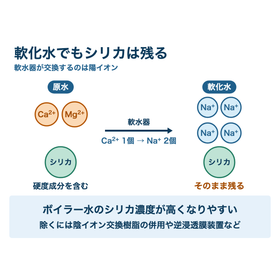
■What order does regeneration proceed in? Since there is a limited amount of hardness components that can be exchanged in the resin, regeneration is performed with brine as it approaches saturation. The general flow is as follows: 1. Backwash: Water is flowed from the bottom to loosen the resin layer and wash away accumulated turbidity. 2. Regeneration: Brine is passed through to exchange the hardness components of the resin with sodium ions. 3. Rinsing: Water is slowly flowed to push out the brine. 4. Washing: A fast flow is used to wash away any remaining brine and hardness components. ■What determines the interval of regeneration? The frequency of regeneration varies based on the flow rate, the hardness of the raw water, the amount and condition of the resin, and the concentration of the brine. ■Higher hardness reduces treatment capacity If the hardness of the raw water increases, the amount of water that can be treated with the same amount of resin decreases. ■Is silica more likely to concentrate in softened water? The softener exchanges cations such as hardness components, leaving silica behind. When softened water is used as makeup water, the silica concentration in the boiler water tends to increase, and care must be taken regarding scaling due to silica. ■Devices that also remove silica If you want to remove silica as well, ion exchange devices that also use anion exchange resin or reverse osmosis membrane systems are employed.
Price range
Delivery Time
Applications/Examples of results
■Why does boiler water become alkaline? Softened water contains alkaline components such as bicarbonates. According to JIS, these decompose under heat in the boiler and convert into sodium hydroxide. In other words, just using softened water causes the boiler water to become more alkaline. If that alone is not sufficient for pH, water quality adjusters like sodium hydroxide are added for regulation. ■Is chemical treatment necessary even with a water softener? JIS requires preparations for unexpected leakage of hardness components in boilers operating with softened water. As a precaution, methods for maintaining phosphate ion levels in boiler water near the upper limit and using polymer-based chemicals to prevent scaling are suggested. ■What should be checked during routine inspections? 1. Hardness of softened water: Ensure it does not exceed the management value (e.g., below 1 mg/L) 2. Brine tank: Check if the salt used for regeneration is replenished 3. Boiler water: Ensure pH, electrical conductivity, phosphate ions, etc., are within management value ranges ■Inspection of water softeners and boiler chemicals Torii offers inspections of water softeners and consultations on boiler chemicals. Please feel free to contact us.
catalog(3)
Download All Catalogs

Recommended products




Distributors

Since our founding, we have continued to provide flexible services with the motto of accurately supplying a diverse range of products that respond to changes in the times and the diversification of consumer needs, tailored to various applications and requirements. With the corporate slogan "Chemical Engineering Partner," we, as a group of experts in chemical technology, actively discover ideas to solve our customers' problems from advanced technologies both domestically and internationally, and propose them.