
What is the cost of pure water? How to compare purchasing, equipment, and rental [Basic Knowledge]
Whether to buy distilled water, own a device, or rent one. This explains the cost items you want to compare in the estimate, as well as the often-overlooked costs of water, electricity, and drainage.
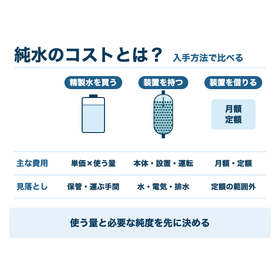
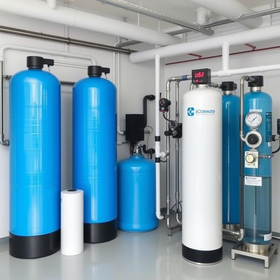
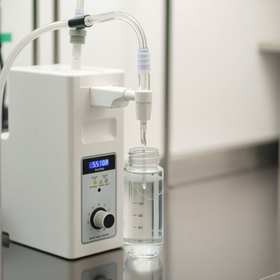
There are several options for obtaining pure water, such as buying purified water, owning a device, or renting a device. When comparing these options, it is easier to make a decision if you determine the amount you will use and the required purity, and then compare the costs per year or per liter under the same conditions, rather than just looking at the initial price or monthly fees. ■ What costs are involved when buying? Purified water is sold in containers, and there are options available in 20L tanks. The cost is determined by the unit price and the amount used, but there are also efforts involved in receiving, storing, and transporting it. ■ Options for renting or outsourcing There are examples of rental or subscription services where you can use a device for a monthly fee. Additionally, with cartridge-type pure water systems, the supplier collects and regenerates the used resin, so users do not have to perform regeneration work with chemicals or dispose of the resin themselves. ■ What is included in the fixed fee? The scope of what is included in the fixed fee varies by contract. For example, some subscriptions for pure water production devices include repair costs but do not cover transportation, installation, or consumables like replacement cartridges. Please feel free to consult with us first.
basic information
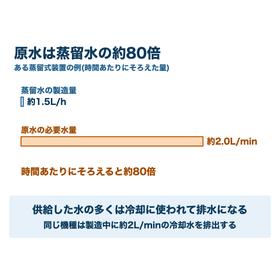
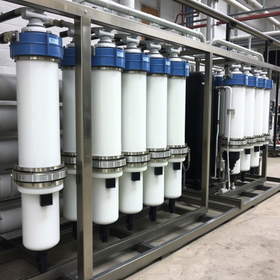
■ Don't compare the device just by the price of the main unit! When owning a device, in addition to the cost of the main unit and installation, there are also costs for electricity used during operation, raw water, wastewater, replacement parts, and more. The extent of these costs varies depending on the method used. ■ Does distillation use a lot of raw water? The specifications of distillation devices include the power consumption of the heater as well as the required amount of raw water. For some models, the production rate of distilled water is about 1.5L/h, while the required amount of raw water is about 2.0L/min, which means it is approximately 80 times higher when calculated per hour. This model discharges about 2L/min of cooling water during production, so ample wastewater facilities are necessary. Much of the supplied water is used for cooling and becomes wastewater, with only a portion turning into distilled water. ■ RO membranes also produce concentrated water. In RO membranes, a portion of the supplied water passes through the membrane, while the remainder is discharged as concentrated water. The ratio of permeate water to the supplied water volume is called the recovery rate. If the recovery rate is set too high, scaling occurs, so there is a limit to the recovery rate. The lower the recovery rate, the more raw water is needed to obtain the same amount of permeate water, and the amount of concentrated water produced also increases.
Price range
Delivery Time
Applications/Examples of results
■Is regeneration also about chemicals and wastewater treatment?! In the method of regenerating resin on-site, chemicals such as acids and alkalis, as well as equipment for neutralizing wastewater, are required. Methods that regenerate using electricity or cartridge systems that regenerate resin at the supply source do not need these. ■Water rates vary by region When using tap water for the equipment, the cost of that water is also included in the expenses. The general water rates for municipalities in prefectural capital cities (monthly average according to retail price statistics) show regional differences ranging from the 1,000 yen range to the 4,000 yen range. Factory rates vary by contract, so it is necessary to check with your own rates. If discharging wastewater into the sewer system, check the sewer usage fees as well. ■Four points to confirm in the estimate 1. Amount used: How much will be used daily or monthly 2. Required purity: How pure it needs to be based on electrical conductivity, etc. 3. Included costs: Whether installation, replacement parts, repairs, and transportation are included 4. Ancillary equipment: Whether water supply, drainage, and power supply need to be prepared ■There’s also a flat-rate usage method! Tori offers a flat-rate pure water supply service (using a pure water system installed) and maintenance for pure water systems. Please feel free to consult with us first.
catalog(3)
Download All Catalogs

Recommended products





Distributors

Since our founding, we have continued to provide flexible services with the motto of accurately supplying a diverse range of products that respond to changes in the times and the diversification of consumer needs, tailored to various applications and requirements. With the corporate slogan "Chemical Engineering Partner," we, as a group of experts in chemical technology, actively discover ideas to solve our customers' problems from advanced technologies both domestically and internationally, and propose them.