
What are the types of water treatment agents for cooling towers? Overview of their functions and components [Basic Knowledge]
Scale inhibitors, corrosion inhibitors, slime control agents. Explain the system of components, the reasons why one type is insufficient, and the relationship with concentration multiples.
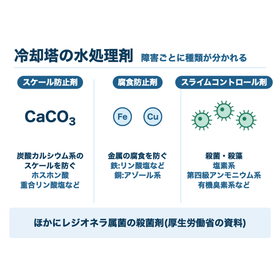
The water treatment agents used for cooling water in cooling towers are categorized based on the types of issues they aim to prevent. The main types include scale inhibitors, corrosion inhibitors, slime control agents, and disinfectants for Legionella bacteria. To prevent issues that occur in cooling water systems, these agents are used according to their specific purposes. It is essential to combine different agents, as a single type cannot prevent all issues. ■ What do scale inhibitors prevent? They are primarily used to prevent calcium carbonate scale, utilizing agents such as phosphonic acid, synthetic organic polymers, and polymeric phosphates. ■ Do corrosion inhibitors differ by metal? Corrosion inhibitors vary depending on the metal being targeted. For iron, phosphate or divalent metal-based agents are used, while azole-based agents are used for copper. ■ Types of slime control agents Various chemicals are used for disinfection and algae control, including chlorine-based, quaternary ammonium-based, isothiazolone-based, and organic bromine-based agents. Some of these also have disinfecting effects against Legionella bacteria. Please feel free to consult us first.
basic information
■Are disinfectants divided into oxidants and organic types? Disinfectants for Legionella bacteria include chlorine as an oxidant and organic compound disinfectants. Many disinfectants used in cooling water systems are organic compounds, and their composition and effective concentrations vary. ■Why is the method of addition different? Chlorine has strong oxidizing power, and if added in high concentration all at once, it can easily damage the metals in the heat exchangers and piping of refrigeration units. Therefore, it is preferable to add it continuously at low concentrations. Organic disinfectants are ideally added in shock doses from a running cost perspective, with intervals generally ranging from 2 to 7 days, depending on the season. ■Should it be combined into one agent or separated? 1. Multifunctional agents: Contain components for preventing scale, corrosion, slime, and for disinfection (or suppression). 2. Single-function agents: Use a separate disinfectant from agents for corrosion and scale prevention (two-component type). 3. Packaged agents: Solid agents are fixed in lower water tanks, etc., and dissolve over time. ■Disinfecting type and suppressing type Multifunctional agents include disinfecting types that reduce the number of bacteria and suppressing types that are used after reducing the bacterial count through chemical cleaning, which helps to prevent an increase.
Price range
Delivery Time
Applications/Examples of results
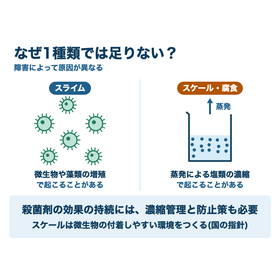
■Why is one type not enough?! Slime can proliferate due to microorganisms and algae, while scaling and corrosion can occur from the concentration of salts like calcium due to evaporation, and the causes differ. To maintain the effectiveness of biocides, it is necessary to manage concentration and implement measures to prevent scaling, slime, and corrosion. Scales that precipitate in fillers create an environment conducive to microbial attachment. ■What is concentration ratio? The concentration ratio indicates how much more concentrated the cooling water is compared to the makeup water. It is the ratio of the electrical conductivity of blowdown water to that of makeup water, and it is also approximately equal to the ratio of the amount of makeup water to the amount of blowdown water. The extent to which it can be raised depends on the water quality of the water in the cooling tower and the makeup water. ■Concentration management is necessary even with chemical addition To prevent scaling, it is essential not to overly concentrate the cooling water. Water with a high concentration of corrosive ions can lead to corrosion due to excessive concentration. The limits of concentration are guided by chloride ions and electrical conductivity, and appropriate values are adopted based on treatment conditions in chemical treatment. Our company offers consultations on water treatment chemicals tailored to the water quality of cooling water. Please feel free to contact us first.
catalog(1)
Download All Catalogs
Recommended products






Distributors

Since our founding, we have continued to provide flexible services with the motto of accurately supplying a diverse range of products that respond to changes in the times and the diversification of consumer needs, tailored to various applications and requirements. With the corporate slogan "Chemical Engineering Partner," we, as a group of experts in chemical technology, actively discover ideas to solve our customers' problems from advanced technologies both domestically and internationally, and propose them.