
What is pure water? Guidelines for purity and the concept of grades [Basic Knowledge]
How is the purity of water referred to as pure water determined? This explains the guidelines for electrical conductivity and how to interpret the grades A1 to A4 defined by JIS K 0557.
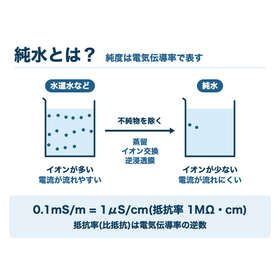
Pure water is water that has had impurities, such as ions found in tap water, removed through methods like distillation, ion exchange, and reverse osmosis. However, due to its wide range of applications, the required water quality is set according to its intended use. There are different standards for various fields, such as for analytical purposes and pharmaceuticals. ■ How is purity expressed? The purity of pure water is generally expressed in terms of electrical conductivity or its reciprocal, resistivity (specific resistance). The fewer ions remain in the water, the less current can flow. Electrical conductivity is a continuous indicator of the remaining ions observed at the outlet of the device. ■ What standards are used to determine specifications? The specifications for pure water not only include electrical conductivity but also set upper limits for items such as TOC (Total Organic Carbon). There are standards that classify the grades of pure water based on the differences in upper limits for each item. One such standard is JIS K 0557, which is introduced below. ■ Standards are not limited to domestic use There are also international standards for reagent water, such as ASTM D1193 from the United States. Additionally, there are separate standards established by CLSI for water used in clinical testing. Please feel free to consult us first.
basic information
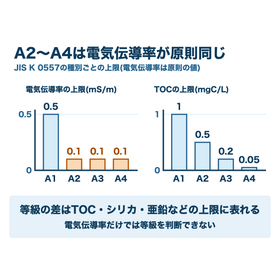
■What are the four types of JIS K 0557? JIS K 0557 (water used for testing water supply and drainage) classifies test water into A1 to A4 and sets upper limits for six items, including electrical conductivity and TOC. Here are the main values: 1. A1: Electrical conductivity ≤ 0.5 mS/m, TOC ≤ 1 mgC/L 2. A2: Electrical conductivity ≤ 0.1 mS/m, TOC ≤ 0.5 mgC/L 3. A3: Electrical conductivity ≤ 0.1 mS/m, TOC ≤ 0.2 mgC/L 4. A4: Electrical conductivity ≤ 0.1 mS/m, TOC ≤ 0.05 mgC/L ■The electrical conductivity limits for A2 to A4 are generally the same! The upper limit for electrical conductivity for A2 to A4 is measured directly from the outlet water of the equipment, and in principle, all are 0.1 mS/m. For A2, when measuring directly from the outlet of an ion exchange device with a precision filter, it is 0.01 mS/m. The differences in grade are reflected in the upper limits for TOC, silica, zinc, and others. Electrical conductivity alone cannot determine the grade. ■Be careful with unit conversions! 0.1 mS/m corresponds to 1 μS/cm, and 0.5 mS/m corresponds to 5 μS/cm. When converted to resistivity, they are 1 MΩ·cm and 0.2 MΩ·cm, respectively.
Price range
Delivery Time
Applications/Examples of results
■What are the main uses for each type? 1. A1: Cleaning of instruments, raw materials for A2 and A3 2. A2: General testing, raw materials for A3 and A4 3. A3: Preparation of reagents, testing of trace components 4. A4: Testing of trace components, etc. The higher the type, the more suitable the water is for tests measuring trace components. ■The types above are made from the types below A1 is water purified by methods such as ion exchange or reverse osmosis in the final process. A2 is made from A1 by combining ion exchange devices and precision filters, while A3 is purified by distilling either A1 or A2. A4 is purified from A2 or A3 using quartz glass distillation equipment. It is also acceptable to purify using methods that yield equivalent quality. ■Purified water in factories is managed based on its intended use JIS K 0557 is the standard for water used in testing. Purified water used for boiler feed or cleaning parts has management values such as electrical conductivity determined according to its intended use, which are verified through daily measurements. Additionally, the appropriate type of water purifier and purification method varies depending on the desired water quality and the quality of the source water. Please feel free to consult us first.
catalog(3)
Download All Catalogs

Recommended products



Distributors

Since our founding, we have continued to provide flexible services with the motto of accurately supplying a diverse range of products that respond to changes in the times and the diversification of consumer needs, tailored to various applications and requirements. With the corporate slogan "Chemical Engineering Partner," we, as a group of experts in chemical technology, actively discover ideas to solve our customers' problems from advanced technologies both domestically and internationally, and propose them.