
What is ultrapure water? The difference from pure water and the meaning of 18.2 [Basic Knowledge]
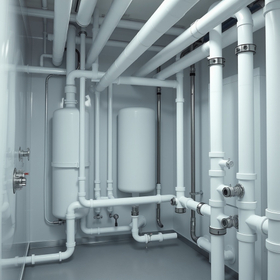
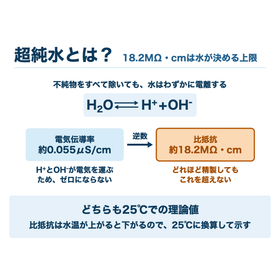
18.2 MΩ·cm is the upper limit determined by water itself at 25°C. Ultrapure water is managed not only by specific resistance but also by multiple indicators such as organic substances and fine particles.
Ultra-pure water is water that has further reduced impurities from pure water, not only ions but also organic substances, fine particles, and even living bacteria. Depending on the application, it can also have low levels of dissolved oxygen. It is used for washing substrates in semiconductor manufacturing, equipment analysis in laboratories, and cell culture, among other uses. ■ What is the difference from pure water? The quality of pure water is primarily described by its resistivity (the inverse of electrical conductivity), which indicates the low presence of ions. In ultra-pure water, in addition to this, limits are set for indicators other than ions, such as TOC (total organic carbon) and the number of fine particles. The difference lies not only in the higher numbers but also in the number of indicators being measured. ■ Where does the number 18.2 come from? Water molecules slightly dissociate into hydrogen ions and hydroxide ions. Even after removing all impurities, these ions carry electricity, so the electrical conductivity does not reach zero. The theoretical value at 25°C is about 0.055μS/cm, and taking the inverse gives a resistivity of about 18.2MΩ·cm. ■ There is a ceiling to resistivity In other words, resistivity does not exceed the upper limit determined by the water itself, no matter how much it is purified at 25°C. Please feel free to consult with us.
basic information
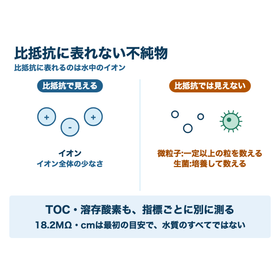
■Why write "at 25°C"? The resistivity changes with water temperature; it decreases as the temperature rises. Therefore, measuring instruments correct for temperature and display values converted to a reference temperature, such as 25°C. Simply listing numbers without standardizing the temperature does not allow for accurate comparisons. The value of 18.2 MΩ·cm is also a theoretical value at 25°C. ■Impurities not visible in resistivity! What appears in resistivity are the ions in the water. Fine particles and live bacteria cannot be captured by the resistivity value. Fine particles need to be counted based on a certain size threshold, and live bacteria must be cultured and counted separately; different measurements are required for each indicator. The same applies to organic matter's TOC and dissolved oxygen. 18.2 MΩ·cm is the initial benchmark for evaluating ultra-pure water, but it does not represent all aspects of water quality. ■Main indicators for ultra-pure water 1. Resistivity: The overall scarcity of ions 2. TOC: The amount of organic matter 3. Fine particles: The number of particles above a certain size 4. Live bacteria: The number of bacteria counted after culturing 5. Dissolved oxygen: The amount of oxygen dissolved in the water For semiconductors, ionized silica and metals are also managed individually by component.
Price range
Delivery Time
Applications/Examples of results
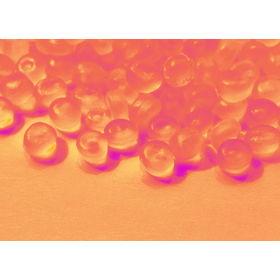
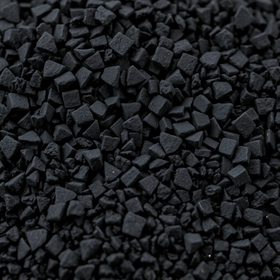
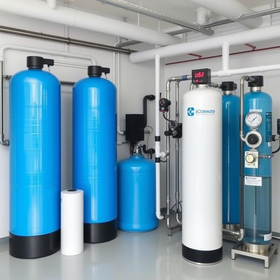
■What unit should be used for management? In the case of semiconductors, the upper limits for TOC and dissolved oxygen are indicated in units of μg/L, while metals are shown in ng/L. 1 μg/L corresponds to one-millionth of a gram in one liter of water, and 1 ng/L is one-thousandth of that amount. ■Requirements have become stricter with each generation! As semiconductor circuits have become more intricate, the required water quality for ultra-pure water has been raised. The upper limits for TOC, particles, and metals have decreased over the years. ■Do values change when stored? Ultra-pure water, when stored in a container exposed to air, can absorb carbon dioxide and other gases, leading to a decrease in specific resistance. Therefore, measures are taken to avoid storing water while it is stagnant. Some laboratory devices continuously circulate water with a pump to maintain purity. In semiconductor equipment, there are configurations that allow unused ultra-pure water to be returned to the tank for circulation. ■The foundation is pre-treated pure water Ultra-pure water is made by further refining pure water. Our company offers consultations on the production of pre-treated pure water, including the replacement of ion exchange resins in pure water systems. Please feel free to contact us for more information.
catalog(3)
Download All Catalogs

Recommended products





Distributors

Since our founding, we have continued to provide flexible services with the motto of accurately supplying a diverse range of products that respond to changes in the times and the diversification of consumer needs, tailored to various applications and requirements. With the corporate slogan "Chemical Engineering Partner," we, as a group of experts in chemical technology, actively discover ideas to solve our customers' problems from advanced technologies both domestically and internationally, and propose them.