Public transportation requires predictive dynamic pricing.


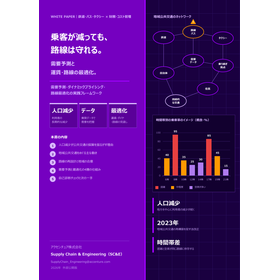
Even with a decrease in passengers, the routes can be maintained. Optimize fares, schedules, and routes through demand forecasting.
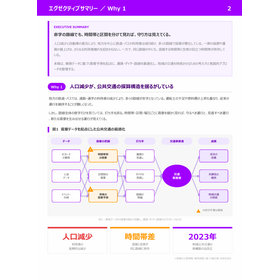
Amidst a continuous decline in users due to population decrease, uniform reductions in service and fare increases may lead to further user attrition. This white paper organizes a practical approach and concept for sustaining regional transportation by visualizing profitability by time slot and segment, based on demand forecasts derived from boarding and alighting data, and optimizing fares, schedules, and routes. It includes a four-layer system of data collection, demand forecasting, fare and schedule optimization, and regional transportation redesign, along with a three-stage roadmap progressing from 0-6 months to 18 months and beyond, and six items for self-diagnosis checks. We also offer route profitability assessments (free of charge). Please feel free to contact us if you have any requests.
basic information
**Overview of the Document** Document Title: Even with a Decrease in Passengers, Routes Can Be Maintained. Demand Forecasting and Optimization of Fares and Routes Type: White Paper (6 pages total) Published by: Accenture Ltd. Supply Chain & Engineering (SC&E) / 2026 External Release Version **Target Audience** Transportation operators such as railways, buses, and taxis (management planning, finance and cost management, operations management), and local government officials responsible for regional public transportation **Contents** - Reasons why population decline threatens the profitability of public transportation - The concept of adjusting fares and schedules "according to demand" (dynamic pricing) - Three structural barriers hindering profitability improvement - Three challenges in redesigning routes in agreement with the community - A four-layer framework for demand forecasting and optimization (data collection / demand forecasting / fare and schedule optimization / redesigning regional transportation) - Execution roadmap (STEP 1: 0-6 months Visualization, STEP 2: 6-18 months Trial, STEP 3: 18 months onward Redesign and Deployment) - Self-diagnosis checklist (6 items)
Price range
Delivery Time
Applications/Examples of results
**Main Uses (Application Scenarios)** - Understand demand and profitability by time zone, section, and day of the week from boarding and alighting data such as IC cards, and identify operations to maintain and those to reconsider. - Build a demand forecasting model and experiment with variable fares and discounts during off-peak hours by differentiating fares during congested and less crowded times. - Review the number of operations and the size of vehicles according to demand, reducing operations that carry empty seats. - Based on boarding and alighting data, form agreements with local governments and residents on route restructuring, and design overall regional mobility by combining railways, buses, taxis, and shared transportation. **How to Proceed with Support (Implementation Roadmap)** - STEP 1 (0-6 months): Visualization of demand and profitability by time zone and section, identification of key routes. - STEP 2 (6-18 months): Development of a demand forecasting model, trial of fare and schedule revisions by time zone. - STEP 3 (18 months onward): Forming agreements with the community and expanding effective initiatives to all routes. We start with a "Route Profitability Diagnosis (Free of Charge)." If you have boarding and alighting data on hand, you can begin without making large-scale system investments.
catalog(1)
Download All Catalogs
Recommended products


Distributors
Accenture transforms change into power, providing 360-degree value to customers, employees, shareholders, partner companies, and society. We support Bristol Myers Squibb by leveraging generative AI and automation to accelerate clinical trials and streamline drug development. We consolidate our full capabilities as a reinvention service to solve the most challenging problems. We guide enterprise transformation to be executed on a larger scale and with greater impact.