
What is an oil-water separator? Mechanism and key points for maintenance management [Basic Knowledge]
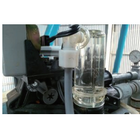
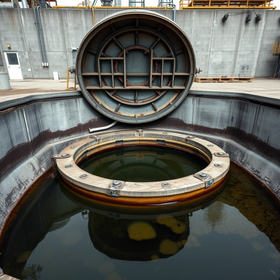
The cause of oil leaking out on rainy days may be the oil and sediment accumulated in the tank. We will explain the mechanism of the oil-water separation tank and its regular maintenance.
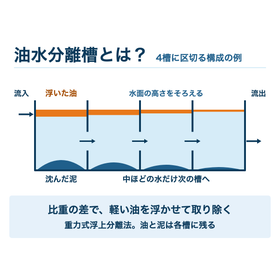
The oil-water separation tank is a facility that removes oil from wastewater containing oil generated at gas stations, car wash facilities, maintenance shops, and other locations, preventing the spread of oil into rivers and public sewer systems outside the premises. ■ Some municipalities require installation For businesses that discharge wastewater into the sewer system, municipalities may require the installation and notification of oil-water separation tanks. Industries that need to install these include gas stations, taxi companies, coin-operated car washes, maintenance shops, and transportation companies. ■ How do oil and water separate? Since oil is lighter than water, it floats to the surface when left undisturbed. This difference in specific gravity is utilized in a method called gravity separation, which removes the lighter oil by floating it. Small-scale businesses typically use natural flotation separation tanks, while larger maintenance shops may use forced flotation methods such as coagulation and pressurized flotation devices. ■ Why are the tanks divided into several sections? Generally, the tank is divided into about four sections, allowing the floating oil and settled sludge to remain in each tank while only the water in the middle is sent to the next tank. The water levels in each tank are kept equal to avoid creating a drop in flow. Please feel free to consult with us first.
basic information
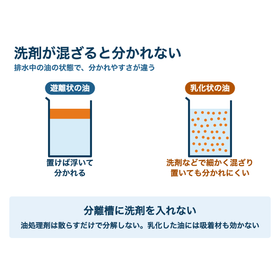
■Detergents Mix and Don't Separate?! The oil in wastewater can be categorized into free oil that separates if left alone, solid fats that can be filtered out, and emulsified oil that is finely mixed with detergents. Emulsified oil is difficult to separate even when left undisturbed, requiring a separate treatment to break the emulsion. Therefore, detergents should not be added to the separation tank. ■Oil Treatment Agents Do Not Decompose Oil treatment agents, which are primarily composed of surfactants similar to those in detergents, only disperse the oil into fine particles without breaking it down, as confirmed by product testing. Like emulsified oil, they become difficult to separate in the separation tank. ■What Are the Standards for Wastewater? According to national general wastewater standards, the permissible limit for normal hexane extractable substances is set at 5 mg/L for mineral oils and 30 mg/L for animal and vegetable oils and fats (applicable to factories and businesses with an average daily wastewater volume of over 50 cubic meters). Normal hexane extractable substances refer to the amount of substances extracted using normal hexane as a solvent and are used as a guideline for the oil content in wastewater. When discharging into public sewer systems, the standards of the Sewer Law and local ordinances apply, with some municipalities requiring mineral oil to be below 5 mg/L.
Price range
Delivery Time
Applications/Examples of results
■ Oil spills on rainy days?! In actual incidents, there have been cases where rainwater could not be processed due to sediment accumulating in the separation tank at a fueling station, causing diesel to flow into the drainage ditch. Additionally, because of a lack of cleaning, kerosene and heavy oil overflowed due to rain, with some flowing into rivers. ■ Countermeasures indicated by accident examples In another case, due to neglecting inspections and cleaning, kerosene overflowed from the tank into the adjacent retention pond. As a countermeasure, thorough regular inspections and daily checks, as well as the timely removal of accumulated oil, have been suggested. ■ What to do for daily management? 1. Inspection: Open the lid and check for oil accumulation, sediment buildup, and connected drainage ditches. 2. Record: Conduct inspections and cleaning regularly, and document the results in a log or similar. 3. Disposal: Store pumped oil and sludge in waste oil tanks and outsource their disposal as industrial waste. 4. Do not introduce: Do not place exchanged waste oil or coolant into the tank. 5. Cleaning: Regularly remove accumulated oil and sediment while the amounts are still small. Our company offers consultations for the inspection and maintenance of wastewater treatment facilities. Please feel free to contact us.
catalog(2)
Download All Catalogs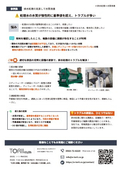

Recommended products













Distributors

Since our founding, we have continued to provide flexible services with the motto of accurately supplying a diverse range of products that respond to changes in the times and the diversification of consumer needs, tailored to various applications and requirements. With the corporate slogan "Chemical Engineering Partner," we, as a group of experts in chemical technology, actively discover ideas to solve our customers' problems from advanced technologies both domestically and internationally, and propose them.