
What is the difference between distilled water and purified water? A comparison with pure water and deionized water [Basic Knowledge]
All of them are "clean water," but the things represented by the names are slightly different. I will organize them based on the difference between names that indicate how they are made and names that indicate standards.
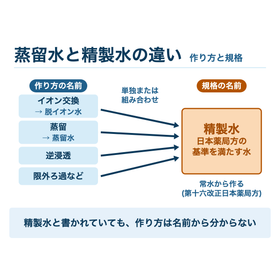
Deionized water, distilled water, and purified water are all types of water that have had impurities reduced, but the names represent slightly different things. Knowing the differences will help you choose the specified water correctly. ■ Names that indicate how they are made 1. Deionized water: Water from which dissolved ions have been removed by exchanging them with ion exchange resin. 2. Distilled water: Water that has been heated to create steam, which is then cooled back into water. Both deionized water and distilled water are names that indicate "how they were made." ■ Is purified water a name that indicates "standards"? Purified water is the name of water defined in the Japanese Pharmacopoeia, which is the standard for pharmaceuticals. Not only distilled water but also water purified by methods such as ion exchange resin has been referred to as purified water. In other words, purified water is a name that indicates "what kind of water it should be" rather than how it is made. ■ Names indicating how they are made and names indicating standards Deionized water and distilled water are names indicating how they are made, while purified water is a name indicating the standards that should be met. By separating these two concepts, it becomes less confusing. Even if it says purified water, you cannot tell from the name which method was used to make it. Please feel free to consult us first.
basic information
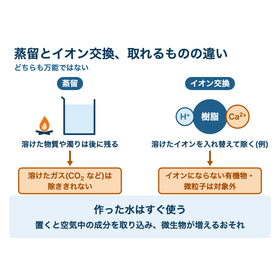
■What is purified water according to the Japanese Pharmacopoeia? In the sixteenth edition of the Japanese Pharmacopoeia, purified water is defined as water produced from "ordinary water" using systems that involve ion exchange, distillation, reverse osmosis, or ultrafiltration, either alone or in combination. Please refer to the latest edition of the Japanese Pharmacopoeia for current regulations. ■Purified water is not the same as distilled water! It is often thought that "purified water means distilled water," but the standards do not limit the method of production to just one. While distilled water may meet the standards for purified water, purified water is not synonymous with distilled water. ■Differences between distillation and ion exchange in what they can remove Distillation is a method that converts water into steam, leaving behind dissolved substances and turbidity. However, gases that are dissolved cannot be completely removed by distillation alone, and substances like carbon dioxide may enter. Ion exchange is a method that replaces dissolved ions in water to remove them, but it does not target organic substances or fine particles that do not become ions. ■Use the water immediately after production! Water that has had impurities reduced may absorb components from the air or allow microorganisms to proliferate if left standing. The Japanese Pharmacopoeia (fifteenth edition) also stipulated that purified water should be used promptly after production.
Price range
Delivery Time
Applications/Examples of results
■In what situations should they be differentiated? 1. Deionized water and other pure water: for cleaning parts, boiler feed water, etc. 2. Distilled water: for preparing reagents and conducting tests, etc. 3. Purified water (Japanese Pharmacopoeia): in situations where compliance with standards is required, such as in pharmaceutical manufacturing. Even though they are all "clean water," the choice varies depending on whether the quality of water or compliance with standards is required. ■Where is it commonly found? Purified water sold in drugstores is a packaged product. The Japanese Pharmacopoeia distinguishes between this packaged water and water used within manufacturing facilities. ■What are the key points when selecting in a factory? 1. What is the purpose of the water? 2. Which components do you want to reduce, and to what extent? 3. Is it necessary to use water specified by standards? Additionally, since ion exchange resins have a limited capacity for exchangeable ions, they are regularly regenerated with chemicals for repeated use. ■Check the content rather than the name When a client specifies "pure water" or "purified water," it is reassuring to verify the numerical values or standards of the required water quality rather than judging solely by the name. Please feel free to consult with us first.
catalog(3)
Download All Catalogs

Recommended products


Distributors

Since our founding, we have continued to provide flexible services with the motto of accurately supplying a diverse range of products that respond to changes in the times and the diversification of consumer needs, tailored to various applications and requirements. With the corporate slogan "Chemical Engineering Partner," we, as a group of experts in chemical technology, actively discover ideas to solve our customers' problems from advanced technologies both domestically and internationally, and propose them.