
What is water quality testing? What are the differences between drinking water, wastewater, and process water? 【Basic Knowledge】
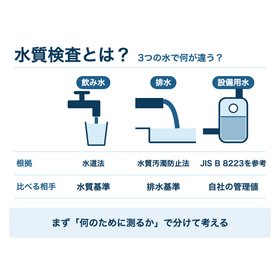
In drinking water, wastewater, and utility water, the regulations that serve as the basis for water quality testing and the items measured differ. Let's organize the three differences.
Water quality testing involves collecting water samples to measure components and bacteria, comparing them against standards and management guidelines. In factories and facilities, drinking water, wastewater, and utility water may be located on the same premises. First, by considering the purpose of each type of measurement separately, it becomes easier to organize the necessary tests. ■ Who tests drinking water? According to the ministerial ordinance regarding water quality standards under the Water Supply Act, there are currently 52 established standards. If you are simply using tap water, the water supply operator conducts tests to ensure compliance with water quality standards. Testing becomes necessary for the facility mainly in the following cases: 1. Dedicated water supply: Supplies water to more than 100 residents or has a maximum daily supply exceeding 20 cubic meters. 2. Specific buildings: As stipulated by the Building Health Act, designated items must be tested at least once every six months. 3. Commercial drinking wells: Must be tested at least once a year according to national guidelines. ■ Testing and recording for dedicated water supply The regulations for testing under the Water Supply Act apply to dedicated water supplies, and records must be kept for five years. It is also required to check color, turbidity, and residual disinfection effects at least once a day. The frequency and items of testing vary depending on the category. Please feel free to consult us first.
basic information
■Measure the items reported for wastewater! According to the Water Pollution Prevention Act, from April 2011, it is mandatory to measure, record, and preserve the discharge water from specified facilities. The key points are as follows: 1. Items: The items listed in the notification for specified facilities 2. Frequency: At least once a year for each discharge outlet 3. Timing: During the period or time when the pollution condition is estimated to be the worst 4. Record: Record in the prescribed format and preserve for three years ■Check the regulations and penalties as well Local regulations may require a greater frequency. There is a fine of up to 300,000 yen for failure to record or preserve, or for false records. If there are discrepancies in the reported items, a notification of changes is also necessary. ■Is equipment water measured to protect the equipment? Water for boiler feed, etc., serves a different purpose than drinking water or wastewater. To prevent scale buildup on heat transfer tubes, it is important to establish management standards based on JIS B 8223. For example, for boiler water with a normal operating pressure of 1 MPa or less, an electrical conductivity of 400 mS/m or less is one guideline. Adjustments are made by controlling the amount of blowdown to ensure this value is not exceeded.
Price range
Delivery Time
Applications/Examples of results
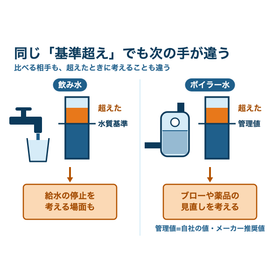
■Does the method of sampling affect the results? According to the Water Supply Act Enforcement Regulations, the sampling location is generally at the water supply faucet. For wastewater, choose a time when it is believed to be the most contaminated. Bottles for bacterial testing should be handled in a way that avoids contact with the inside to prevent contamination. Before sampling, let the water run for a while to discard any water that has accumulated in the pipes. If the sampling method differs, even the same water can yield different results. ■What should the results be compared to? Drinking water should be compared to water quality standards, while wastewater should be compared to wastewater standards and additional regulations. For process water, the management values set by the company or the recommended values from the manufacturer serve as benchmarks. Even if both exceed the "standards," there may be situations where the supply of drinking water needs to be stopped, whereas for boiler water, it may lead to considerations for blowdown or a review of chemicals. ■How to grasp daily trends Regular inspections alone may make it difficult to capture daily changes. Torii offers rental of water quality measurement devices and water treatment chemicals for boilers and wastewater treatment. By monitoring daily values, it becomes easier to compare trends alongside the results of regular inspections. Please feel free to consult with us first.
catalog(2)
Download All Catalogs

Recommended products



Distributors

Since our founding, we have continued to provide flexible services with the motto of accurately supplying a diverse range of products that respond to changes in the times and the diversification of consumer needs, tailored to various applications and requirements. With the corporate slogan "Chemical Engineering Partner," we, as a group of experts in chemical technology, actively discover ideas to solve our customers' problems from advanced technologies both domestically and internationally, and propose them.