
What is the dilution calculation of sodium hypochlorite? How to calculate ppm [Basic Knowledge]
How much should you dilute a 12% solution to make 200 ppm? This explains the dilution calculation formula and examples used in business, precautions for making in advance, and guidelines for concentrations based on different uses.
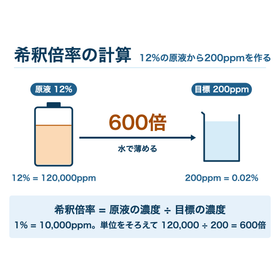
Sodium hypochlorite is sold as a high-concentration product and is a chlorine-based agent used after dilution. On-site, the concentrated solutions labeled "12%" and "6%" are diluted with water to the appropriate concentration for the intended purpose. ■ What is the relationship between % and ppm? ppm is a unit that represents one part per million, and 1% corresponds to 10,000 ppm. Therefore, 12% is 120,000 ppm, and 6% is 60,000 ppm. The concentration of disinfectants may also be indicated alongside values such as 0.02% (200 ppm) and 0.1% (1,000 ppm). Additionally, concentrations may be expressed in mg/L, and here we will approximate 1 ppm as 1 mg/L. ■ How much should I dilute? The dilution factor is calculated by dividing the concentration of the original solution by the target concentration. Ensure that the units are consistent when performing the calculations. 1. From 12% to 200 ppm: 120,000 ÷ 200 = 600 times 2. From 6% to 200 ppm: 60,000 ÷ 200 = 300 times 3. From 12% to 1,000 ppm: 120,000 ÷ 1,000 = 120 times Even for the same 200 ppm, the 6% original solution requires twice the amount compared to the 12% solution. Please feel free to consult us first.
basic information
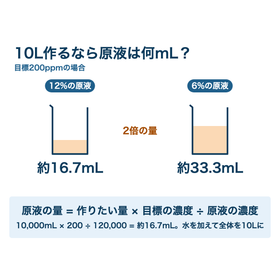
■How much concentrate should be added in mL? The amount of concentrate needed is calculated as "desired volume × target concentration ÷ concentrate concentration." For example, to make 10L of a 200ppm solution with a 12% concentrate, you would need approximately 16.7mL (10,000mL × 200 ÷ 120,000), and for a 6% concentrate, about 33.3mL. ■Add water to make a total of 10L Add water to this concentrate to make a total of 10L. This is a rough estimate that does not consider the difference in specific gravity between the concentrate and water. ■What are the concentration guidelines for different uses? 1. Disinfection of cooking utensils and floors (norovirus prevention): Chlorine concentration of about 200ppm 2. Floors or items contaminated with vomit or feces: 0.1% (1,000ppm) 3. Disinfection after cleaning building water tanks: Disinfect with a solution containing effective chlorine of 50-100mg/L at least twice, and let it sit for more than 30 minutes after disinfection. ■Dilution factor for water tank disinfectant For example, to dilute a 12% concentrate to 100mg/L, the dilution factor would be 120,000 ÷ 100, which equals 1,200 times. This is the concentration of the solution used for disinfection and is different from the residual chlorine remaining in the water after filling. Please also check the product labels and the procedures of each facility for concentration and usage.
Price range
Delivery Time
Applications/Examples of results
■Is it okay to prepare in advance? The diluted solution of chlorine-based disinfectants loses its effective concentration over time. It is basic practice not to prepare diluted solutions in advance, but to dilute only the necessary amount each time you use it and to use it all up. Both the diluted solution and the concentrated solution should not be placed in direct sunlight or in high-temperature areas. ■What should you check when diluting? 1. Concentration of the concentrated solution: Check the concentration of the product you are using on the label and follow the instructions for use and dosage. The concentration varies by product. 2. Temperature of the water: Do not use boiling water to dilute. 3. Labeling of the container: If you are using a PET bottle or similar, clearly indicate that it is a disinfectant along with the name of the chemical and its concentration to prevent accidental ingestion. 4. Age of the concentrated solution: The effective chlorine may decrease during storage, so when calculating based on the labeled concentration, it may actually be weaker. ■Consultation on capacity changes and dilution Our company also supports capacity changes and dilution of industrial chemicals. We supply sodium hypochlorite, including lightweight products in 15kg containers, and conduct inspections and cleaning of water tanks in buildings. Please feel free to consult with us first.
catalog(3)
Download All Catalogs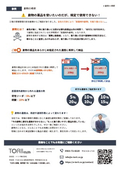


Recommended products









Distributors

Since our founding, we have continued to provide flexible services with the motto of accurately supplying a diverse range of products that respond to changes in the times and the diversification of consumer needs, tailored to various applications and requirements. With the corporate slogan "Chemical Engineering Partner," we, as a group of experts in chemical technology, actively discover ideas to solve our customers' problems from advanced technologies both domestically and internationally, and propose them.