
What are nitrification and denitrification? The mechanism of nitrogen removal [Basic knowledge]
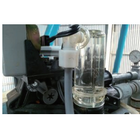
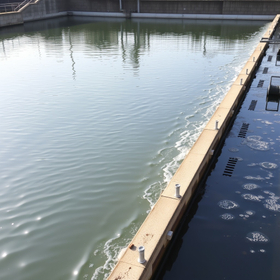
Convert ammonia into nitric acid and release it as nitrogen gas from water. Why is the denitrification tank placed before the nitrification tank? Explain the conditions and combinations of the two reactions.
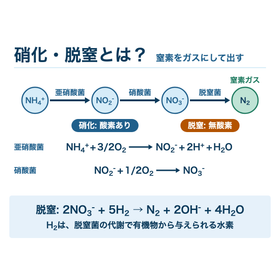
Nitrogen in wastewater exists in forms such as organic nitrogen, ammonia, nitrite, and nitrate. When removing nitrogen through biological treatment, a combination of "nitrification," which oxidizes ammonia in the presence of oxygen, and "denitrification," which converts the resulting nitrite and nitrate into nitrogen gas, is used. ■ Is nitrification a relay of two types of bacteria? Nitrification proceeds through the following two reactions: 1. Nitrosomonas: NH4+ + 3/2O2 → NO2- + 2H+ + H2O 2. Nitrobacter: NO2- + 1/2O2 → NO3- These two types of bacteria are collectively referred to as nitrifying bacteria, each using ammonium ions and nitrite ions as energy sources. ■ Where does the nitrogen go? Denitrifying bacteria, when lacking the necessary oxygen to oxidize organic matter, instead use the oxygen from nitrite or nitrate. As a result, substances like nitrate are reduced to nitrogen gas, which then escapes into the atmosphere. In the case of nitrate, it is represented as "2NO3- + 5H2 → N2 + 2OH- + 4H2O," where the H2 is provided from organic matter by the metabolism of denitrifying bacteria. Please feel free to consult with us first.
basic information
■Two reactions with opposite conditions! Nitrification occurs in the presence of dissolved oxygen, while denitrification occurs in an anaerobic environment or under conditions of very low dissolved oxygen. Although it is difficult to determine the upper limit of dissolved oxygen that can be tolerated during denitrification, it is typically around 0.5 mg/L. Additionally, denitrification requires organic matter, with a BOD amount 3 to 5 times that of the nitrogen content. If there is insufficient organic matter, denitrification becomes difficult. ■Nitrifying bacteria grow slowly The maximum growth rate of nitrite bacteria is exceptionally low compared to other microorganisms, being about 0.3 per day even at 25°C. If there is excessive withdrawal of excess sludge, leading to a short sludge age (the number of days calculated by dividing the amount of sludge in the tank by the daily excess sludge amount), nitrite bacteria will no longer be able to remain in the activated sludge. ■Optimal water temperature is around 28°C The water temperature needs to be maintained within the range of 15 to 38°C, with around 28°C being optimal. ■How much oxygen is needed? When oxidizing to nitrate, the oxygen required for nitrification is approximately 4.6 kg per kg of ammonia nitrogen. This aeration is in addition to the oxygen used for the oxidation of BOD and the respiration of sludge.
Price range
Delivery Time
Applications/Examples of results
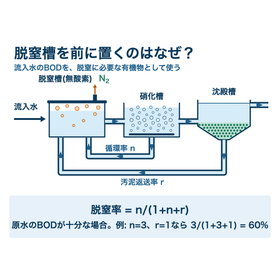
■Why place the denitrification tank in front? It is widely used to place the denitrification tank in front of the nitrification tank and circulate the mixed liquid from the nitrification tank to the denitrification tank. This is because the BOD of the inflow water can be utilized as organic matter necessary for denitrification. If the BOD of the raw water is sufficient, the denitrification rate at this stage can be calculated from the circulation rate n and the sludge return rate r as "n/(1+n+r)", for example, if n=3 and r=1, it would be 60%. Since increasing circulation also increases power consumption, it is usually designed to be between 50-80%, with the remainder often removed in the subsequent second denitrification tank by adding substances like methanol. ■There are substances that stop nitrification! Substances that inhibit the activity of nitrite bacteria include toxic substances such as cyanide and mercury ions, as well as thiourea-based organic compounds. Additionally, the higher the concentration of ammonium ions, pH, and liquid temperature, the more likely it is for gaseous ammonia, which is toxic to nitrite bacteria, to be produced. ■Measuring nitrogen in treated water To confirm whether nitrification and denitrification are progressing well, the nitrogen levels in the treated water are measured. Our company offers devices for measuring total nitrogen, total phosphorus, and COD on a subscription basis, including maintenance. Please feel free to consult with us first.
catalog(2)
Download All Catalogs
Recommended products











Distributors

Since our founding, we have continued to provide flexible services with the motto of accurately supplying a diverse range of products that respond to changes in the times and the diversification of consumer needs, tailored to various applications and requirements. With the corporate slogan "Chemical Engineering Partner," we, as a group of experts in chemical technology, actively discover ideas to solve our customers' problems from advanced technologies both domestically and internationally, and propose them.