
What are MLSS and MLVSS? Concentration management of activated sludge [Basic knowledge]
How many kg of sludge is contained in 1 cubic meter of the aeration tank? I will explain the meanings of MLSS and MLVSS, as well as concentration management using SV30 and SVI.
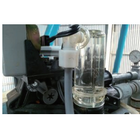
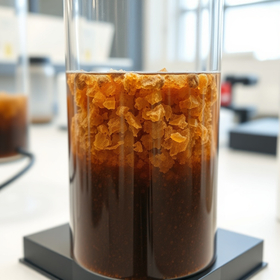
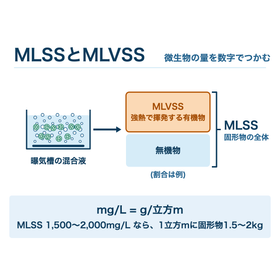
In the activated sludge method, clusters of microorganisms break down the pollutants in wastewater in a tank where air is supplied. The indicators for quantifying the amount of these microorganisms are MLSS and MLVSS. ■ What is MLSS? MLSS stands for Mixed Liquor Suspended Solids, which indicates the concentration of suspended solids in the mixed liquor of the aeration tank, expressed in mg/L. It serves as a guideline for the amount of activated sludge present and is a fundamental indicator for managing the aeration tank. ■ Difference from MLVSS MLVSS refers to the portion of MLSS that consists of organic matter that volatilizes upon strong heating. MLSS includes both organic and inorganic matter. MLVSS isolates only the organic portion from this. Even with the same sludge, the numbers differ depending on which value is used. ■ How many kg in 1 cubic meter? mg/L is equivalent to g/cubic meter. In standard activated sludge methods for wastewater, the design MLSS is 1,500 to 2,000 mg/L, which calculates to 1.5 to 2 kg of solid matter in 1 cubic meter of the aeration tank. Please feel free to consult with us first.
basic information
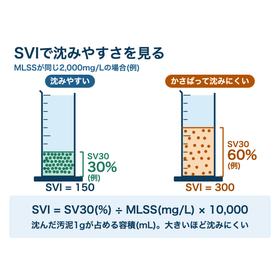
■The concentration varies depending on the type of drainage. In food factories, the MLSS (Mixed Liquor Suspended Solids) in aeration tanks is generally maintained at 3,000 to 5,000 mg/L. In long-term aeration methods, it ranges from 3,000 to 6,000 mg/L, while in membrane filtration methods (MBR), it is about 8,000 to 15,000 mg/L. These values are higher than the design values for sewage, and the appropriate values vary significantly depending on the method used. ■What is SV30? SV30 is the ratio of the volume occupied by the settled sludge after placing a mixed liquor sample taken from the aeration tank into a graduated cylinder and letting it sit for 30 minutes. ■Assessing settleability with SVI! From SV30 and MLSS, you can calculate the SVI (Sludge Volume Index), which indicates the settleability of the sludge. SVI = SV30(%) ÷ MLSS(mg/L) × 10,000 For example, if SV30 is 30% and MLSS is 2,000 mg/L, then 30 ÷ 2,000 × 10,000 = 150. The SVI represents the volume (mL) occupied by 1g of settled sludge. A larger value indicates that the sludge is bulky and settles poorly. If SV30 increases to 60% while MLSS remains at 2,000 mg/L, the SVI would be 300.
Price range
Delivery Time
Applications/Examples of results
■ How to adjust MLSS? MLSS is primarily adjusted by the amount of excess sludge withdrawn. Increasing the withdrawal will lower the MLSS, while decreasing it will raise the MLSS. Microorganisms proliferate by decomposing organic matter in the wastewater, so if the increased amount is not removed as excess sludge from the system, the concentration will continue to rise. ■ Viewing in conjunction with retention time In standard activated sludge processes for wastewater, the aeration tank is designed for a retention time of about 6 to 8 hours. Even with the same MLSS, if the amount of incoming water or the concentration of pollutants changes, the BOD load per kg of sludge (BOD-MLSS load) will also change. ■ Why does SVI increase?! When bulking occurs, making the sludge difficult to settle, the SVI increases. An increase in SVI is one of the typical manifestations of bulking. ■ Changing concentration with the seasons During winter, when water temperatures drop, reactions slow down, so we compensate by maintaining a higher MLSS. The same applies during periods of increased BOD inflow. Therefore, it is important to organize and analyze operational data to manage concentrations according to seasonal changes. Please feel free to consult with us first.
catalog(3)
Download All Catalogs
Recommended products











Distributors

Since our founding, we have continued to provide flexible services with the motto of accurately supplying a diverse range of products that respond to changes in the times and the diversification of consumer needs, tailored to various applications and requirements. With the corporate slogan "Chemical Engineering Partner," we, as a group of experts in chemical technology, actively discover ideas to solve our customers' problems from advanced technologies both domestically and internationally, and propose them.