
What are the microorganisms in activated sludge? Protozoa and filamentous bacteria [Basic Knowledge]
When viewed under a microscope, something is moving in the sludge?! This explains the types of microorganisms in activated sludge and the organisms that indicate the treatment conditions.
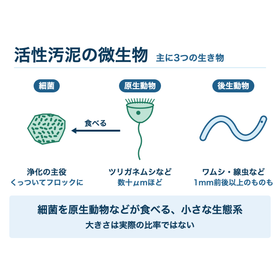
Activated sludge is not just mud. It is a collection primarily composed of various microorganisms that take in and decompose organic matter in wastewater. It mainly consists of the following organisms: 1. Bacteria 2. Protozoa 3. Metazoans (multicellular animals such as rotifers and nematodes) It forms a small ecosystem where bacteria are consumed by protozoa and others. ■ The main players are bacteria Among them, the main players in purification are bacteria. Aggregative bacteria release a viscous substance (EPS) outside their cells to stick together, forming small clumps called "flocs." A well-known bacterium for this function is Zoogloea. When left undisturbed, flocs settle down, leaving clear water on top. ■ Protozoa eat bacteria! Vorticella, a type of ciliate, has fine hairs (cilia) arranged in a ring around its mouth and consumes bacteria from the water. Its size is about several tens of micrometers. Some amoebas can reach several hundred micrometers. Organisms like protozoa and rotifers that feed on suspended bacteria in the water also play a role in clarifying treated water. Please feel free to consult us first.
basic information
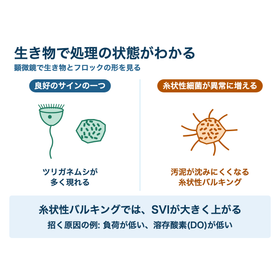
■Can you understand the state of treatment by living organisms? The types and numbers of microorganisms that can be distinguished under an optical microscope serve as one indicator of the treatment state. Nematodes are also widely present, making them an indicator of the condition of activated sludge. The organisms in activated sludge are interconnected through a predator-prey relationship, so the abundance of certain organisms reflects the treatment conditions. ■The presence of Vorticella is a sign of good conditions! When the treatment conditions are good, Vorticella (a type of ciliate) appears in large numbers. Members of the Vorticella group are organisms that emerge when purification is at its best. ■Metazoans are mostly larger! Metazoans are multicellular organisms other than protozoa, including rotifers and nematodes. Many of them are larger than protozoa, with some measuring around 1 mm or more. ■Observe the shape of the flocs In daily management, the shape of the flocs and their aggregation state are observed under a microscope, along with the appearance of protozoa and metazoans. To determine whether the treatment is proceeding well based on the appearance of the flocs, microscopic observation is the most desirable method. By examining both the shape of the flocs and the types of organisms present, a clearer understanding of the treatment state can be achieved.
Price range
Delivery Time
Applications/Examples of results
■What happens when filamentous bacteria increase?! Among bacteria, there are filamentous bacteria that grow long like threads. When these increase abnormally, it becomes difficult for sludge to settle. This phenomenon is called filamentous bulking. It causes a significant rise in SVI, making it difficult for water and sludge to separate properly in the sedimentation tank. Filamentous bacteria are responsible for issues like bulking and scum, which hinder solid-liquid separation. ■Under what conditions do they tend to increase? The main causes of filamentous bulking are low load and low dissolved oxygen (DO). Filamentous bacteria have a shape that is advantageous for absorbing thin organic matter and oxygen. Therefore, treatment facilities with low loads become ideal habitats. Checking whether conditions of low load or insufficient oxygen are persistent can provide clues for prevention. ■Bacteria that cause scum When actinomycetes and others increase abnormally, a brown, viscous scum forms. As a countermeasure in this case, sterilization or shortening the SRT (the number of days sludge remains in the system) can be employed. By shortening the SRT, it becomes easier to remove the overgrown bacteria along with excess sludge from the system. Please feel free to consult us first.
catalog(3)
Download All Catalogs
Recommended products











Distributors

Since our founding, we have continued to provide flexible services with the motto of accurately supplying a diverse range of products that respond to changes in the times and the diversification of consumer needs, tailored to various applications and requirements. With the corporate slogan "Chemical Engineering Partner," we, as a group of experts in chemical technology, actively discover ideas to solve our customers' problems from advanced technologies both domestically and internationally, and propose them.