
What is SS (suspended solids)? Measurement methods and wastewater standards [Basic knowledge]

SS represents the amount of small particles floating in water. How do we measure it? This will explain the procedures and calculations established by the government, along with examples of drainage standards.
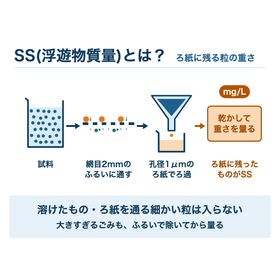
SS (Suspended Solids) is an indicator that represents the amount of undissolved particles floating in water. It is derived from the English term "Suspended Solids." It is also specified as one of the items in the effluent standards of the Water Pollution Control Law. The unit used is mg/L, indicating how many mg are contained in one liter of water. ■ What counts as "floating particles"? According to the national measurement method, the sample is first passed through a sieve with a mesh size of 2mm. Then, the residue remaining on a filter paper with a pore size of 1μm is measured as SS. This means that large debris and particles fine enough to pass through the filter paper are not included in SS. 1μm is one-thousandth of a millimeter. ■ Dissolved substances are not included! Substances like sugar and salt that dissolve in water pass through the filter paper, so they are not included in SS. Therefore, the amount of dissolved impurities in water does not appear in the SS value. ■ Number of particles? Or weight? The SS value is determined by drying the particles left on the filter paper and calculating their weight. It is a measure compared by total weight, not by the number of particles or their size. Please feel free to consult us first.
basic information
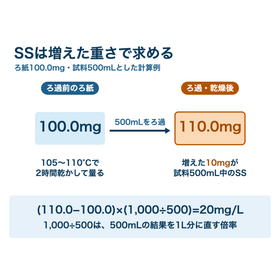
■Measurement Method Established by the Country The following procedure is specified in the national announcement. 1. Wash a glass fiber filter paper with a pore size of 1μm and a diameter of 24-55mm with water, dry it at 105-110°C for 2 hours, and weigh it. 2. Sieve the sample through a 2mm mesh and filter the passed material using the filter paper under suction. 3. Dry the filter paper at 105-110°C for 2 hours, cool it down, and weigh it. 4. Convert the increased weight to a value per liter. ■Let's Calculate! Assuming the filter paper weighs 100.0mg and the weight after filtration and drying is 110.0mg, with a sample volume of 500mL: (110.0−100.0)×(1,000÷500)=20mg/L This is the increased 10mg converted to a value per liter. The part of 1,000÷500 corresponds to the factor for scaling the result from 500mL to 1 liter. ■How to Determine the Sample Volume? The sample volume is chosen so that the SS after drying is at least 5mg. For water with an SS of about 20mg/L, this means a minimum of 250mL is required. Cleaner water will require filtering a larger volume.
Price range
Delivery Time
Applications/Examples of results
■Criteria for Discharging into Rivers and Oceans The uniform discharge standards under the Water Pollution Control Law set the SS (suspended solids) limit at 200 mg/L (with a daily average of 150 mg/L). This standard applies to factories and facilities with an average daily discharge of 50 cubic meters or more. ■What does "daily average" mean? In the discharge standards, the daily average value specifies the average level of pollution in the discharge over one day. In addition to the 200 mg/L limit, it is necessary to maintain a value of 150 mg/L when averaged over the day. ■What about discharging into the sewer system? According to the Enforcement Order of the Sewerage Act, for specific facilities, the SS standard set by local ordinances must not be stricter than 600 mg/L per liter (though it may be made stricter under certain conditions). The actual standards are determined by the ordinances of the municipality where the discharge occurs. ■Things to Confirm First The applicable standards differ depending on whether the discharge is into a river, ocean, or sewer system. For rivers and oceans, the national uniform standard applies to facilities with a daily discharge of 50 cubic meters or more. Be sure to confirm both the discharge destination and the discharge volume. Please feel free to consult with us first.
catalog(2)
Download All Catalogs
Recommended products













Distributors

Since our founding, we have continued to provide flexible services with the motto of accurately supplying a diverse range of products that respond to changes in the times and the diversification of consumer needs, tailored to various applications and requirements. With the corporate slogan "Chemical Engineering Partner," we, as a group of experts in chemical technology, actively discover ideas to solve our customers' problems from advanced technologies both domestically and internationally, and propose them.