
How to make well water drinkable? Necessary treatments and tests [Basic knowledge]
Is it safe just because of filtration and chlorine? The treatment varies depending on the dissolved components. This explains how to choose the treatment for making well water safe for drinking.
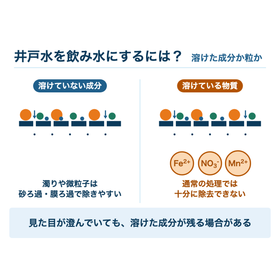
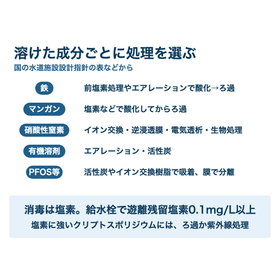
To use well water as drinking water, it is essential to first understand what it contains through testing, and then combine treatments that correspond to the results. The items and frequency of testing will be addressed on another page, so here we will focus on the concept of treatment. ■ What can be removed by filtration? Standard water purification primarily involves removing undissolved components. Turbidity and fine particles are easily removed through sand filtration or membrane filtration. On the other hand, substances dissolved in water are not adequately removed by standard treatments. Even if the water appears clear, dissolved components may still be present. ■ How effective is chlorine disinfection? Chlorine and ozone are used to treat general bacteria and E. coli. In water supply systems, it is mandated by the Water Supply Act Enforcement Regulations to maintain free residual chlorine at 0.1 mg/L or higher at the water supply tap. However, there are pathogenic organisms, such as Cryptosporidium, that are resistant to chlorine. If there is a risk of contamination in the raw water, the ministerial ordinance that establishes technical standards for water supply facilities stipulates the requirement for filtration equipment that can remove such pathogens or ultraviolet treatment equipment that can inactivate them. Please feel free to consult with us first.
basic information
■What should the dissolved components be treated with? The main treatment methods for each dissolved component are as follows: 1. Iron: Oxidation through pre-chlorination or aeration followed by filtration 2. Manganese: Oxidation with chlorine or similar substances followed by filtration 3. Nitrate nitrogen: Ion exchange, reverse osmosis, electrodialysis, biological treatment (denitrification) 4. Organic solvents (such as trichloroethylene): Aeration, activated carbon For PFOS and PFOA, methods include adsorption using activated carbon or ion exchange resins, and separation through membrane treatment. ■What does aeration do? It is a treatment that promotes good contact between water and air. In addition to driving volatile organic chlorinated compounds out of the water, it supplies oxygen from the air to the water, facilitating the oxidation of dissolved iron. However, depending on the form of iron, oxidation may not be fully achieved with aeration alone, so caution is necessary. ■There is a reason for the order of treatment! Ultraviolet treatment is only applicable when the turbidity and color of the water being treated do not hinder the process. Therefore, in well water with high turbidity or iron content, it is essential to remove these factors in the preceding stage.
Price range
Delivery Time
Applications/Examples of results
■What to do when contamination is detected? According to the national guidelines for sanitary measures for drinking wells, when it is determined that health hazards may arise from the supplied water, the installer must immediately stop the water supply and follow the instructions of the health department. For wells where contamination has been confirmed, prefectures will encourage the installer to connect to the water supply. ■Switching to a treatment device or water supply Choosing between installing a treatment device or switching to a water supply is a decision that should be compared in terms of water quality and cost. ■Things to confirm before considering treatment 1. Items in the test results that are close to or exceed the standards 2. Whether the components are dissolved or floating as particles 3. The amount used for drinking water and the location where a treatment device can be placed 4. Who will be responsible for maintenance, such as replacing filter media or replenishing chemicals The distinction between dissolved components and particles is key in determining the appropriate treatment. ■What Torii can do Torii offers sodium hypochlorite (for disinfection), activated carbon for adsorption, and filtration devices for iron and manganese removal, among others. Based on the test results, we will assist you in organizing which treatments are necessary. Please feel free to consult with us first.
catalog(2)
Download All Catalogs

Recommended products









Distributors

Since our founding, we have continued to provide flexible services with the motto of accurately supplying a diverse range of products that respond to changes in the times and the diversification of consumer needs, tailored to various applications and requirements. With the corporate slogan "Chemical Engineering Partner," we, as a group of experts in chemical technology, actively discover ideas to solve our customers' problems from advanced technologies both domestically and internationally, and propose them.