
What are the water quality standards for pools? Management of residual chlorine and pH [Basic Knowledge]

What is the purpose of the upper limit of 1.0 mg/L? Why is combined chlorine not included in the standards? I will explain the meaning of the standard values and the relationship between chlorine agents and pH.
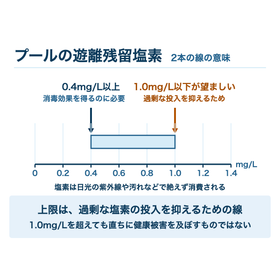
The pool water is disinfected with chlorine while managing free residual chlorine and pH levels. Rather than just memorizing the numbers, understanding what each value protects can make daily decisions easier. ■ What is the lower limit of 0.4 mg/L? To achieve disinfection effectiveness against pathogens such as bacteria and viruses that may infect people in the pool, a level of 0.4 mg/L or higher is necessary. The lower limit is the line to ensure disinfection effectiveness. The national hygiene standards for swimming pools also stipulate that it should be 0.4 mg/L or higher. ■ Chlorine is constantly consumed Free residual chlorine is continuously consumed due to decomposition by sunlight's ultraviolet rays, as well as dirt, hair, and swimsuits brought in by people entering the pool, so it is necessary to continuously replenish chlorine agents. ■ Is the upper limit of 1.0 mg/L a health line? The upper limit for free residual chlorine is set to prevent excessive chlorine input. Even if it exceeds 1.0 mg/L, it does not immediately cause health damage. The upper limit is described as "desirable" for this reason. Please feel free to consult us first.
basic information
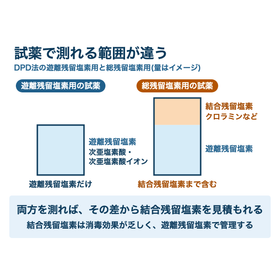
■What is the difference between free and combined chlorine? Chlorine that remains in the form of hypochlorous acid or hypochlorite ions is called free residual chlorine, while chloramines, which are formed when these react with ammonia or organic nitrogen compounds, are referred to as combined residual chlorine. The total of both is called total residual chlorine. Since combined residual chlorine has poor disinfection effectiveness, pool chlorine disinfection is managed using free residual chlorine. ■Differentiating measurements starts with choosing the right reagents The DPD method has reagents for free residual chlorine and total residual chlorine, so care must be taken to avoid mixing them up. Measuring with the total residual chlorine reagent will yield a value that includes the less effective combined residual chlorine. By measuring both, you can estimate the amount of combined residual chlorine from the difference. ■Are there standards for combined residual chlorine? There are no national standards for combined residual chlorine. Since it can be managed using other indicators such as potassium permanganate consumption, it was determined during the revision of standards in 2001 that there was little need to establish a standard value. Additionally, ultraviolet treatment systems are purification equipment designed to decompose trace organic substances in pool water, particularly combined residual chlorine (chloramines).
Price range
Delivery Time
Applications/Examples of results
■Why is pH near neutral? If the pH is not within the appropriate range, it can cause pain to the eyes of swimmers. By maintaining a pH close to neutral, efficient purification and disinfection can be achieved. Additionally, if free residual chlorine is maintained at 0.4 mg/L or higher within the standard pH range, sufficient disinfection effectiveness is ensured. It is important to consider pH and chlorine together. ■pH is affected by chlorine agents! The type of chlorine agent used has the greatest impact on the pH of pool water. The direction in which the pH moves changes depending on the chlorine agent. 1. Sodium hypochlorite solution: Alkaline 2. Calcium hypochlorite, dichloroisocyanuric acid: Neutral 3. Trichloroisocyanuric acid: Acidic Chlorinated isocyanuric acid agents tend to become acidic with prolonged use, so it is important to prepare pH adjusters in advance. ■According to the chlorine agent used We offer pool-related chemicals such as lightweight 15 kg containers of sodium hypochlorite solution, solid chlorine agents, pH adjusters, and coagulants. We also provide consultations on pH management tailored to the type of chlorine agent. Please feel free to contact us first.
catalog(3)
Download All Catalogs

Recommended products





Distributors

Since our founding, we have continued to provide flexible services with the motto of accurately supplying a diverse range of products that respond to changes in the times and the diversification of consumer needs, tailored to various applications and requirements. With the corporate slogan "Chemical Engineering Partner," we, as a group of experts in chemical technology, actively discover ideas to solve our customers' problems from advanced technologies both domestically and internationally, and propose them.