
What is chlorine injection at water treatment plants? The role of sodium hypochlorite [Basic Knowledge]
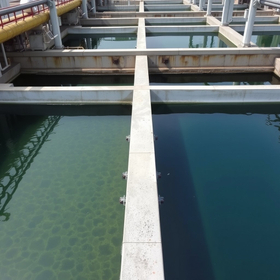
At water treatment plants, where and for what purpose is chlorine added? This explains the purposes of pre-chlorination and intermediate chlorination, discontinuous point chlorine treatment, and how to determine the injection amount.
At water purification plants, chlorine agents are injected into the water for disinfection. Chlorine agents are typically injected after filtration for disinfection purposes. On the other hand, chlorine also has strong oxidative properties, so it may be used for other purposes during the treatment process. ■ What chlorine agents are used? The main chlorine agents are sodium hypochlorite and liquid chlorine, with most water supplies in recent years using commercially available sodium hypochlorite. There is also a method for self-manufacturing using electrolysis at purification plants. ■ Does it work immediately after being added? The ministerial ordinance that sets technical standards for water supply facilities stipulates that disinfection equipment must have a structure that allows the water to come into contact with the disinfectant for the necessary time to achieve disinfection effectiveness. ■ Why switch from liquid chlorine? Liquid chlorine is subject to regulations such as the High-Pressure Gas Safety Act and the Industrial Safety and Health Act. If liquid chlorine is being used, it is necessary to consider switching to safer alternatives like sodium hypochlorite to prevent secondary disasters from events like earthquakes. Due to safety and ease of handling, some water supply operators have introduced sodium hypochlorite in all purification plants. Please feel free to consult with us first.
basic information
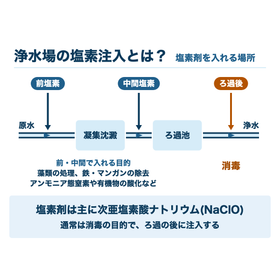
■Where to add chlorine? 1. Pre-chlorination: Injected into water before coagulation and sedimentation. 2. Intermediate chlorination: Injected between the sedimentation basin and the filtration basin. 3. Post-filtration injection: For disinfection purposes. ■Why add it before or during? The purpose is to treat organisms such as algae, to convert dissolved iron and manganese into insoluble forms for removal, to oxidize ammonia nitrogen and organic matter, and to address unpleasant odors and tastes. Theoretically, about 0.6 mg/L of chlorine is needed to oxidize 1 mg/L of iron ions, about 1.3 mg/L for manganese ions, and 7.6 mg/L for ammonia nitrogen. ■Manganese also utilizes the function of sand! Dissolved manganese is removed when passed through manganese sand in the presence of free chlorine, due to the contact oxidation effect. In water treatment plants, manganese sand is used as filtration sand when processing around pH 7. ■Switching from pre-chlorination to intermediate chlorination When chlorine is added to raw water containing organic matter, disinfection by-products such as trihalomethanes are produced. In intermediate chlorination, organic matter is coagulated and sedimented in the sedimentation basin before chlorine is contacted, which helps to suppress their formation.
Price range
Delivery Time
Applications/Examples of results
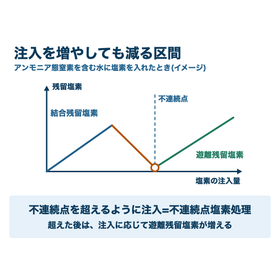
■Does ammonia reduce residual chlorine?! When chlorine is added to water containing ammonia nitrogen, combined residual chlorine is first formed. Beyond a certain concentration, even if the injection increases, residual chlorine decreases and approaches zero. Further injection then increases free residual chlorine. This point is called the breakpoint, and the method of injection beyond this point is referred to as breakpoint chlorination. ■How is the injection amount determined? The injection rate is determined so that the residual chlorine in the water at the supply faucet reaches a specified concentration, taking into account the chlorine consumption during the water purification process and after leaving the water treatment plant. The decomposition of chlorine when exposed to ultraviolet light also affects the consumption rate. ■Pathogens that are resistant to chlorine! There are pathogenic organisms that are difficult to inactivate with chlorine. A representative example is Cryptosporidium, and the ordinance requires filtration or ultraviolet treatment facilities if there is a risk of contamination in the source water. ■Preparation to ensure injection does not stop The same ordinance requires facilities to adjust the supply of disinfectants and backup equipment for injection facilities. Our company handles electric pumps for injection and sodium hypochlorite (including lightweight 15kg packages). Please feel free to consult with us first.
catalog(3)
Download All Catalogs

Recommended products










Distributors

Since our founding, we have continued to provide flexible services with the motto of accurately supplying a diverse range of products that respond to changes in the times and the diversification of consumer needs, tailored to various applications and requirements. With the corporate slogan "Chemical Engineering Partner," we, as a group of experts in chemical technology, actively discover ideas to solve our customers' problems from advanced technologies both domestically and internationally, and propose them.