
What is residual chlorine? Standards for tap water and the differences between free and combined chlorine [Basic Knowledge]
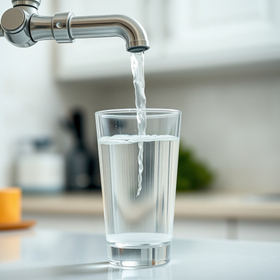
The standard for water supply is a lower limit of "0.1 mg/L or more." This explains the difference in values obtained from free and combined chlorine, as well as the phenomenon where adding chlorine does not increase the levels.
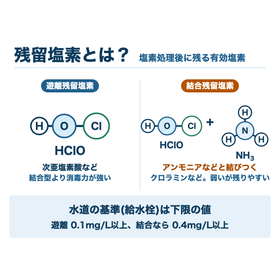
Residual chlorine refers to the effective chlorine that remains in water after chlorine treatment. Residual chlorine can be divided into free forms (free residual chlorine), such as hypochlorous acid, and combined forms (combined residual chlorine), such as chloramines, both of which possess oxidizing power. ■ Why keep chlorine? Chlorine acts quickly on bacteria, especially pathogenic bacteria in the digestive system, even in small amounts. Therefore, residual chlorine serves as an indicator that the disinfection effect is maintained. ■ The standard for tap water is a "minimum" value! According to the Water Supply Act Enforcement Regulations, it is stipulated that water from supply faucets must be disinfected with chlorine to maintain free residual chlorine at 0.1 mg/L or higher (for combined residual chlorine, 0.4 mg/L or higher). In cases where there is a significant risk of contamination by pathogenic organisms, the requirement is for free residual chlorine to be at least 0.2 mg/L (for combined residual chlorine, at least 1.5 mg/L). ■ Upper limit guidelines are provided separately In the water quality management target setting items, the target value for residual chlorine is set at 1 mg/L or lower. Residual chlorine can cause a chlorine smell and, if too concentrated, can impair taste. However, at concentrations typical of tap water, it is believed that there are no health effects. Please feel free to consult us first.
basic information
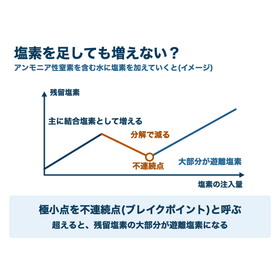
■What is the difference between free and combined chlorine? When water contains ammonia, chlorine binds with it to form combined types such as chloramines. Combined chlorine reacts slowly, so combined residual chlorine has a weaker disinfection effect compared to free residual chlorine. Even at the same concentration, the disinfection power differs between free and combined forms. ■Is four times the value needed for combined chlorine? According to the enforcement regulations, when managing with combined residual chlorine, a level of 0.4 mg/L or higher, which corresponds to four times the amount of free residual chlorine, is required. Even with the same numerical value, the meaning changes depending on which form it is. ■Does adding chlorine not increase the amount?! In water containing ammonia nitrogen, when chlorine is added, initially, the residual chlorine mainly increases as combined chlorine. After a certain point, that combined chlorine begins to decompose, and the residual chlorine starts to decrease. After reaching a minimal point, it will increase again according to the amount added. ■Free chlorine increases beyond the minimal point This minimal point is called the breakpoint. Once the breakpoint is exceeded, the majority of the residual chlorine becomes free chlorine. If you want to manage with free chlorine, you need to add chlorine until you surpass this point.
Price range
Delivery Time
Applications/Examples of results
■Is chlorine only used for ammonia? Bivalent iron, manganese, hydrogen sulfide, nitrite ions, and other components also consume chlorine. The remaining amount used by these components is measured as residual chlorine. The amount of chlorine added does not match the amount of residual chlorine measured. ■Be cautious with water that has high ammonia levels! If you inject without accurately understanding the amount of ammonia nitrogen, it can lead to excessive chemical dosing or insufficient treatment. This is because water containing ammonia requires a large amount of chlorine injection. ■It decreases even during distribution Chlorine is consumed even within distribution pipes and storage tanks. The decrease in residual chlorine in the distribution pipes is affected by factors such as water temperature. It is important to check not only the value when leaving the water treatment plant but also the value at the tap. ■Having more is not necessarily better? If residual chlorine is too high, the chlorine smell becomes stronger, and it can easily corrode metals. Additionally, it can react with humic substances in the water to produce trihalomethanes. Our company offers consultations on chlorine agents such as sodium hypochlorite and injection amounts. Please feel free to consult with us first.
catalog(3)
Download All Catalogs


Recommended products






Distributors

Since our founding, we have continued to provide flexible services with the motto of accurately supplying a diverse range of products that respond to changes in the times and the diversification of consumer needs, tailored to various applications and requirements. With the corporate slogan "Chemical Engineering Partner," we, as a group of experts in chemical technology, actively discover ideas to solve our customers' problems from advanced technologies both domestically and internationally, and propose them.