
What is chlorine disinfection of well water? Sterilizers and injection amounts [Basic knowledge]
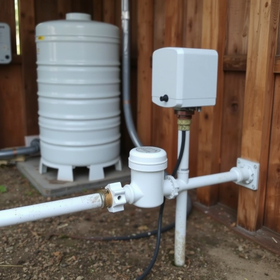
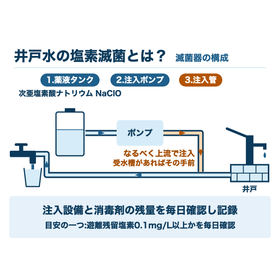
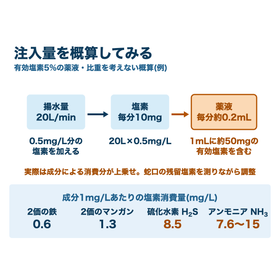
A chlorine disinfection device that injects sodium hypochlorite into well water. This explains the structure of the device, the concept of the injection amount, and the reasons why the injection stops.
Chlorine disinfection of well water is a method that involves injecting a disinfectant into the pumped water to maintain residual chlorine. The disinfectant primarily used is a solution of sodium hypochlorite. Here, we will explain the equipment and the concept of injection amounts. ■ What is the disinfectant made of? A well water chlorine disinfection system mainly consists of the following components: 1. Chemical tank: Holds the sodium hypochlorite solution 2. Injection pump: Draws the chemical from the tank and pressurizes it for delivery 3. Injection pipe: Directs the chemical into the well water piping ■ Can you notice if the injection stops? If the injection stops due to a malfunction of the injection pump or pipe, the water used during that time will not be disinfected. There have been incidents at water treatment plants where alarms for low residual chlorine did not activate due to incorrect settings. It is essential to regularly check that alarms are functioning properly. ■ Operation of the disinfection system includes inspections The injection equipment and the remaining amount of disinfectant should be checked and recorded daily. Following incidents at drinking wells, daily checks and records have been implemented as a response. The amount of chemical, injection pump, and injection pipe should also be inspected daily. Please feel free to consult with us first.
basic information
■What determines the injection amount? The injection rate of the disinfectant is set considering water quality, retention time, season, and other factors to ensure that the residual chlorine concentration at the water supply faucet always maintains the specified level. As a guideline, the Large-Scale Cooking Facility Hygiene Management Manual states that when using well water for disinfection, it is necessary to check daily that the free residual chlorine is at least 0.1 mg/L. ■Caution regarding hydrogen sulfide and ammonia! The components dissolved in well water consume some of the injected chlorine. The chlorine consumption per 1 mg/L of component is as follows, compared to 0.6 mg/L of divalent iron and 1.3 mg/L of divalent manganese: 1. Hydrogen sulfide: 8.5 mg/L 2. Ammonia: 7.6 to 15 mg/L 3. Nitrite: 1.5 mg/L It is evident that the consumption is significantly higher compared to iron and manganese. ■Estimating the injection amount A 5% effective chlorine solution contains approximately 50 mg of effective chlorine per 1 mL, not considering specific gravity. If you want to add 0.5 mg/L of chlorine to a water flow rate of 20 L/min, that would be 10 mg per minute, which means approximately 0.2 mL of the solution per minute. In practice, the consumption due to components will be added, so adjustments are made while measuring the residual chlorine at the faucet.
Price range
Delivery Time
Applications/Examples of results
■ Chlorine is present, but E. coli?! There have been cases where pathogenic E. coli was detected in the water used at a ryokan (traditional inn) that uses spring water, where chlorine was directly added to the piping connected to the kitchen. It is presumed that the water was supplied before the chlorine had an effect. On the other hand, facilities that added chlorine to the piping flowing into the water storage tank did not detect E. coli. ■ Place the injection point as upstream as possible To ensure sufficient contact time, the injection should be done just before the receiving tank if there is one, or as close to the water source as possible if there isn't. This is because time is needed for the water to come into contact with the disinfectant to achieve its effect. ■ What causes the injection to stop? In injection systems, injection failures can occur due to the formation of air bubbles or scale. Therefore, it is also important to check the actual injection amount. There have been cases in deep well facilities where residual chlorine levels dropped due to hose blockages. ■ Be cautious of chemical degradation in summer! Sodium hypochlorite decomposes and loses effectiveness when stored for long periods, especially at high temperatures. At Torii, we offer consultations regarding sodium hypochlorite and injection equipment. Please feel free to reach out to us for advice.
catalog(3)
Download All Catalogs


Recommended products






Distributors

Since our founding, we have continued to provide flexible services with the motto of accurately supplying a diverse range of products that respond to changes in the times and the diversification of consumer needs, tailored to various applications and requirements. With the corporate slogan "Chemical Engineering Partner," we, as a group of experts in chemical technology, actively discover ideas to solve our customers' problems from advanced technologies both domestically and internationally, and propose them.