
Dispersion machine line: Powder supply - Continuous dispersion support


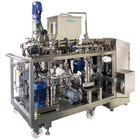

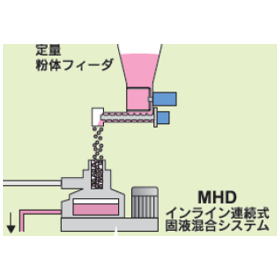
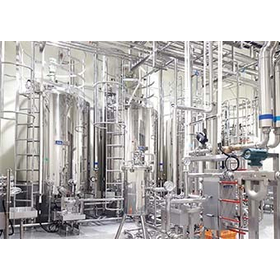
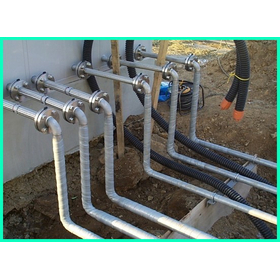
From powder supply to dispersion, defoaming, and transfer. A dispersion machine line compatible with high-viscosity slurries has been established.
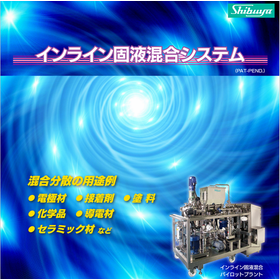
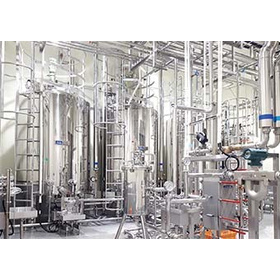
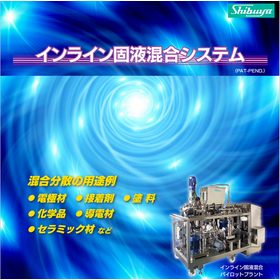
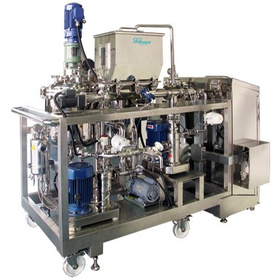
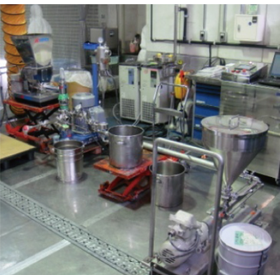
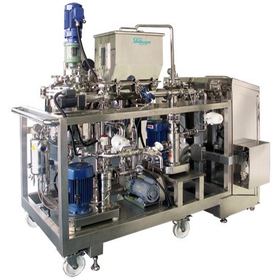
We offer a solid-liquid mixing line that includes powder supply, dispersion, degassing, and transfer, centered around the disperser. In high solid content and high viscosity slurries, the powder supply conditions and instantaneous concentration fluctuations significantly affect dispersion quality. This system optimizes the entire process rather than just the disperser alone, achieving quality stabilization and productivity improvement. Additionally, by combining inline dispersers, batch dispersers, static mixers, etc., we can propose systems tailored to material characteristics and processing conditions. We accommodate a variety of slurry applications, including battery materials, CNTs, electronic materials, adhesives, inks, and food. We can provide consistent support from lab testing to scale-up and mass production line construction.
basic information
Supports continuous processing lines using dispersers. It is possible to build a solid-liquid mixing system that includes powder supply, dispersion, degassing, and transfer. It accommodates uniform dispersion with high-shear dispersers, high solid content and high viscosity slurries, and quality stabilization through continuous processing. Additionally, it is possible to design processes that combine inline dispersers, batch dispersers, static mixers, powder feeders, degassing equipment, tanks, piping, and temperature control equipment. We support evaluation with laboratory equipment, pilot verification, scale-up, and the establishment of mass production lines. Individual designs will be made according to material properties and processing conditions.
Price range
Delivery Time
Model number/Brand name
Inline solid-liquid mixing MHD disperser
Applications/Examples of results
Battery material slurries, CNT conductive materials, electronic materials, adhesives, inks, paints, food and beverages, etc., are adopted in various solid-liquid mixing lines. In high solid content and high viscosity slurries, issues such as clumping, agglomeration, sedimentation, and sudden concentration fluctuations during powder addition significantly affect quality. This system supports quality stabilization and productivity improvement by optimizing the entire process, including powder supply, dispersion, defoaming, and transfer. Additionally, it can accommodate scale-up verification from lab conditions to mass production conditions.
Detailed information
Related Videos
catalog(2)
Download All Catalogs

News about this product(5)
-
【June 2, 2026 (Tuesday) - June 5, 2026 (Friday)】 Announcement of participation in 'FOOMA JAPAN 2026'
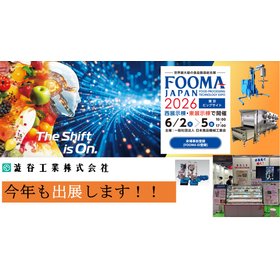
Shibuya Kogyo Co., Ltd. will exhibit at FOOMA JAPAN 2026, which will be held at Tokyo Big Sight from June 2 (Tuesday) to June 5 (Friday), 2026. We will introduce various devices that contribute to "quality improvement," "labor saving," and "cleaning efficiency" in food and beverage manufacturing. [Exhibition Details] ■ Two-stage superheated steam circulation baking machine (JESTOS Jr.) *Panel display and tasting available - Achieves fluffy, high-quality baking in a short time using superheated steam - Capable of low-temperature to high-temperature cooking (with a firm browning) with just one machine - Prevents oxidation by blocking outside air with a shielding nozzle (patented) ■ 3D nozzle type container cleaning machine (TSW4000 model) *Actual machine display - Achieves high cleaning power with low water usage and short time - Contributes to reduced cleaning time and utility costs ■ Continuous and batch continuous solid-liquid mixing system *Panel display - Stable inline processing of mixing and dispersing powders and liquids - Accommodates high-viscosity materials and high solid content such as proteins, achieving uniformity and reproducibility in quality - Capable of engineering proposals including process design On the day, you can experience solutions to on-site challenges through actual machines, panels, and tastings. Please be sure to stop by our booth.
-
Notice of Participation in 'FOOMA JAPAN 2026' from June 2 (Tuesday) to June 5 (Friday), 2026
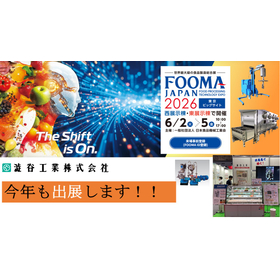
Shibuya Kogyo Co., Ltd. will exhibit at FOOMA JAPAN 2026, which will be held at Tokyo Big Sight from June 2 (Tuesday) to June 5 (Friday), 2026. We will introduce various devices that contribute to "quality improvement," "labor saving," and "cleaning efficiency" in food and beverage manufacturing. [Exhibition Details] ■ Two-stage superheated steam circulation baking machine (JESTOS Jr.) *Panel display and tasting available - Achieves high-quality baking that is fluffy in a short time using superheated steam - Capable of low-temperature to high-temperature cooking (with a firm browning) with a single machine - Prevents oxidation by blocking outside air with a shielding nozzle (patented) ■ 3D nozzle type container cleaning machine (TSW4000 model) *Actual machine display - Achieves high cleaning power with low water usage and short time - Contributes to reduced cleaning time and utility costs ■ Continuous and batch continuous solid-liquid mixing system *Panel display - Stabilizes the mixing and dispersion of powders and liquids inline - Accommodates high-viscosity materials and high solid content such as proteins, achieving uniform quality and reproducibility - Capable of engineering proposals including process design On the day, you can experience solutions to on-site challenges through actual machines, panels, and tastings. Please feel free to stop by our booth.
-
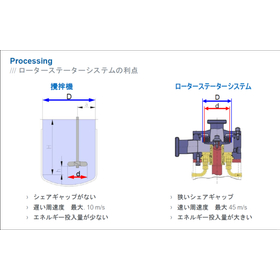
What are the reasons for changes in results from the lab to mass production? Causes and countermeasures for the deterioration of distributed quality during scale-up.
Despite obtaining good dispersion results in the lab, the challenge of unstable quality upon mass production occurs in many settings. The main cause of this is that the dispersion conditions are not replicated due to differences in scale. In lab equipment, the smaller size leads to higher energy density, making shear and flow more uniform, while in mass production equipment, the larger scale often results in insufficient dispersion energy at the same rotational speed and processing time. Additionally, differences in equipment structure and flow patterns can cause variations in the shear history and residence time experienced by particles, leading to differences in the dispersion state. Furthermore, simple scale-up does not ensure that critical parameters such as flow rate, residence time, and shear intensity match, making it difficult to reproduce the same results as in the lab. To address these challenges, it is essential to focus on process design based on dispersion energy density and flow conditions rather than merely increasing equipment size. By designing the system so that particles pass through the processing area under consistent conditions, it is possible to achieve reproducible dispersion quality even when the scale changes, as seen in inline continuous processing.
-
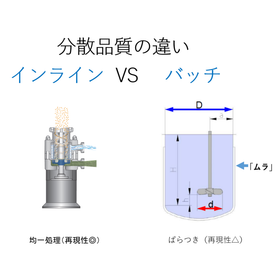
Why is continuous processing highly reproducible? An explanation of the mechanism that stabilizes distributed quality.
In dispersion processes, the variation in quality is one of the significant challenges. Even when processing under the same equipment and conditions, it is not uncommon for the dispersion state to differ from batch to batch. The main factor behind this is the variability in the dispersion history experienced by the particles. In batch processing, the shear and residence time experienced by each particle differ depending on their position and flow state within the tank. As a result, there is a mixture of sufficiently dispersed particles and undispersed particles, leading to variations in quality. This tendency becomes particularly pronounced under high viscosity or high solid content conditions. On the other hand, in continuous processing, particles pass through a consistent processing area, receiving nearly the same dispersion conditions. Because shear energy and residence time can be controlled consistently, the variability in dispersion history is minimized, resulting in a uniform and highly reproducible dispersion state. Moreover, continuous processing is advantageous during scale-up. By adjusting the flow rate, it becomes easier to replicate similar dispersion quality from the lab to mass production. This helps reduce the risk of quality fluctuations during the transition from development to mass production. What is crucial in dispersion processes is to provide the same processing history to all particles. Continuous processing easily meets this condition and is an effective method for stabilizing quality and ensuring reproducibility.
-
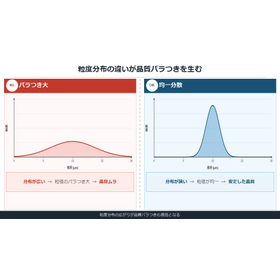
Why does dispersion not become uniform? An explanation of the causes of aggregation residuals and distribution variability, as well as design points to achieve uniform dispersion.
In dispersion engineering, there are many cases where, although the appearance seems mixed, the particles are not actually uniformly dispersed. One of the causes of this is that the aggregation between particles has not been sufficiently resolved. When there is insufficient dispersion energy, the particles do not break down to primary particles, and aggregates remain. Additionally, if the shear conditions or flow state are uneven, the dispersion state can vary locally, resulting in variations in particle size distribution. This is particularly true in high-viscosity systems or high solid content slurries, where low flowability makes it difficult for energy to be transmitted uniformly, leading to dispersion inconsistencies. Furthermore, in batch processing, variations in mixing uniformity and residence time tend to make it difficult to maintain a uniform dispersion state throughout the process. To achieve uniform dispersion, it is important to design dispersion energy according to particle characteristics and to maintain uniform flow conditions in the process design. By maintaining consistent shear conditions, as in inline continuous processing, it is possible to achieve a uniform dispersion state and reproducible quality. The order of input, the wettability of the powder, and the initial mixing state of the dispersion also have a significant impact on uniformity. In particular, if local clumps or uneven distribution occur during powder input, it becomes difficult to resolve them in subsequent dispersion processes, leading to dispersion inconsistencies.
Recommended products






Distributors

Our company is headquartered in Kanazawa City, Ishikawa Prefecture, and has sales offices and factories both within and outside the prefecture. We focus on the bottling business, which involves filling beverages and other products, and we are expanding into various fields such as solid-liquid mixing and dispersion systems, laser processing machines (including fiber lasers and CO2 lasers), and semiconductor assembly equipment (such as taping machines, multifunctional test handlers, ball mount machines, and bonders). Please feel free to contact us if you have any inquiries.