
CNT conductive material paste dispersion system



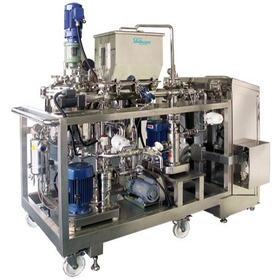
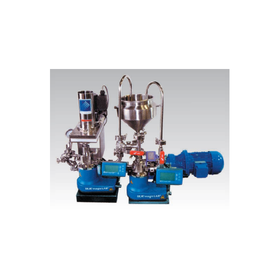
CNT dispersion is determined by the process. Control of aggregation stabilizes conductivity.
In conductive paste using CNT (carbon nanotubes), the strength of aggregation and the difficulty of dispersion are challenges. If not sufficiently dispersed, a conductive network will not form, leading to unstable performance; on the other hand, excessive shear can lead to the destruction of the CNT structure, making the optimization of dispersion conditions essential. Furthermore, even slight differences in the dispersion state can significantly affect viscosity and conductivity, becoming a factor in quality variation during mass production. This system appropriately breaks down CNT aggregation while maintaining structure through process design that includes powder input, wetting processes, dispersion energy control, and circulation conditions. It is designed with the same logic from the lab to mass production, achieving a balance between conductivity and reproducibility.
basic information
A solid-liquid mixing dispersion system specialized for CNT conductive material dispersion. It optimizes dispersion energy (shear force) and residence time according to the aggregation characteristics, length distribution, binder type, solvent conditions, and concentration of CNTs, achieving uniform dispersion while preventing structural damage due to over-dispersion. The processes of pre-mixing, wetting, dispersion, and circulation homogenization are integrated into a single design. It supports inline processing, circulation processing, and batch processing, allowing for configuration proposals tailored to specific applications. In addition to selecting equipment including high-shear dispersion devices (such as IKA), it also addresses powder supply, piping design, CIP, and data management. A consistent scale-up design is provided from lab equipment to mass production lines.
Price information
It varies depending on the specifications.
Delivery Time
Model number/Brand name
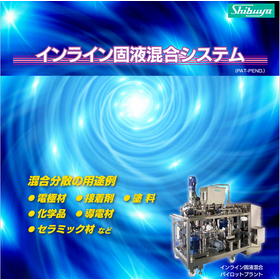
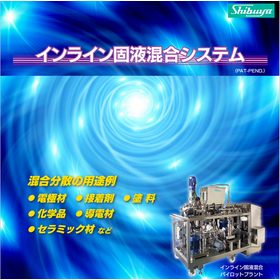
Inline solid-liquid mixing and dispersion system for battery materials
Applications/Examples of results
【Target Applications】 - CNT conductive material paste - Conductive additive dispersion for batteries - Nano dispersion for high-performance materials 【Common Issues】 - CNTs aggregate and cannot be dispersed - Conductivity is unstable - Viscosity varies - Over-dispersion leads to decreased performance - Conditions change during scale-up 【Response Content】 Optimize dispersion energy, input conditions, and circulation conditions throughout the entire process to achieve both aggregation disintegration and structural maintenance. Ensure conductivity and quality stability, and establish a reproducible process up to mass production.
Detailed information
-
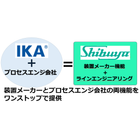
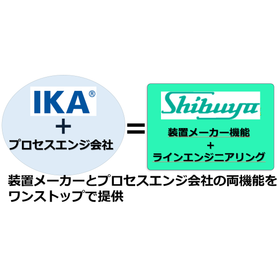
The globally renowned IKA Group and Shibuya Kogyo have been collaborating on business and technology since 2010, working together on inline continuous dispersion systems.
-
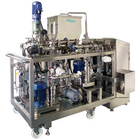
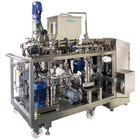
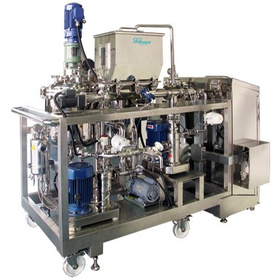
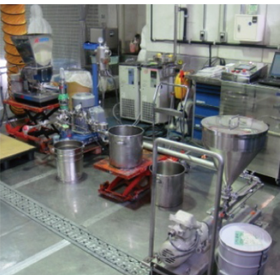
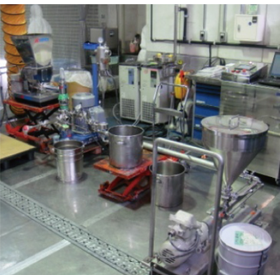
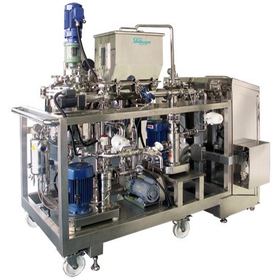
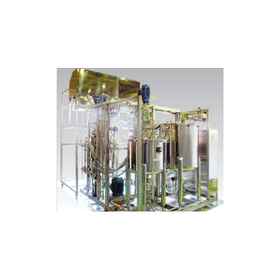
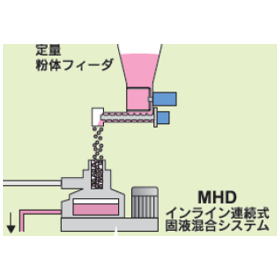
Inline solid-liquid mixing pilot plant. It achieves stable dispersion while suppressing clumping through continuous mixing. It supports space-saving and short processing times, allowing for consistent scale-up considerations from research and development to mass production.
-
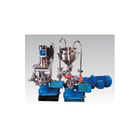
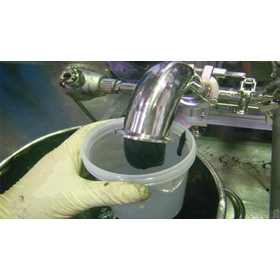
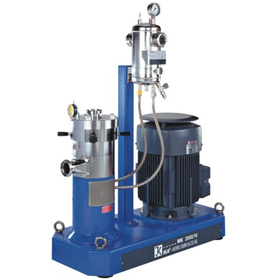
It is a small experimental device that can be used on a tabletop. It can be utilized in the early stages of process evaluation.
Related Videos
Line up(1)
| Model number | overview |
|---|---|
| Inline solid-liquid mixing dispersion system |
catalog(5)
Download All Catalogs



News about this product(3)
-
What are the reasons for the inability to disperse high solid content slurries? Causes of poor dispersion and design points for solutions.
In the dispersion process of high solid content slurries, problems such as "too high viscosity to mix" and "unable to break down agglomerates" occur. The main cause of these issues is the increased frequency of particle contact, which strengthens the cohesive forces. As the solid content concentration increases, the distance between particles decreases, leading to interference between particles that reduces fluidity and prevents sufficient dispersion energy from being transmitted. Additionally, the crowding of particles restricts flow and makes shear localized, resulting in the persistence of undispersed areas and agglomerates. Furthermore, in a high solid content state, the increase in viscosity also leads to poor circulation and stagnation, causing variability in the dispersion state within the process. Particularly in batch processing, mixing inconsistencies and differences in processing history directly translate into quality differences, making it difficult to ensure reproducibility. To achieve stable dispersion under high solid content conditions, it is important not only to increase shear force but also to consider dispersion design that takes into account inter-particle interactions, as well as process design that simultaneously controls flow and shear. By establishing a mechanism like inline continuous processing, where particles pass through the processing area under constant conditions, uniform and highly reproducible dispersion can be achieved even at high solid contents.
-
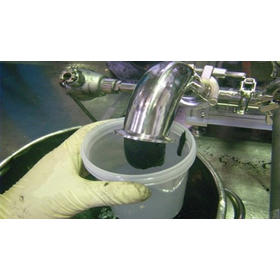
What is the optimal solution for high solid content slurry dispersion? Stabilization methods through inline processing.
In the dispersion of high solid content slurries, viscosity increases and fluidity decreases, making it prone to poor dispersion and variability. The movement of particles is restricted, making it difficult for aggregates to break apart, and it is not uncommon for undispersed areas to remain. Additionally, poor wetting during powder addition and the formation of localized high concentration areas can lead to the occurrence of clumps, which is another challenge. These issues may not be completely resolved even with strong shear applied in subsequent processes. What is important under such high solid content conditions is to efficiently transmit dispersion energy and standardize the processing conditions for each particle. However, in batch processing, variations in flow and residence time can lead to differences in the dispersion state. On the other hand, in inline continuous processing, uniform shear can be applied to particles within the flow, allowing for efficient transmission of dispersion energy even under high viscosity and high solid content conditions. This results in a uniform dispersion state for each particle, achieving stable quality. In the dispersion of high solid content slurries, it is crucial not only to apply strong shear but also to design the process considering flow and processing conditions. Inline processing is one effective method to address these challenges.
-
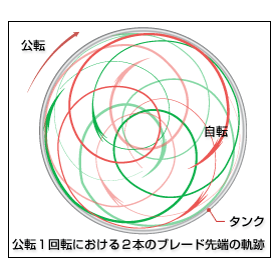
What are the reasons for the inability to disperse high-viscosity slurries? The mechanisms behind poor dispersion and design points for solutions.
In the dispersion process of high-viscosity slurries, issues such as "not being dispersed despite being mixed" and "remaining clumps" occur. The main cause of these problems is that the increase in viscosity reduces fluidity, preventing dispersion energy from being evenly transmitted throughout the system. Generally, dispersion breaks apart agglomerated particles through shear force, but in a high-viscosity state, the flow becomes localized, leading to differences between areas experiencing shear and those that do not. As a result, undispersed areas and agglomerates remain, causing variations in particle size distribution and quality issues. Furthermore, the higher the viscosity, the weaker the circulation within the equipment, making it difficult for particles to pass uniformly through the processing area, which also decreases reproducibility. In batch processing, variations in residence time and mixing state become particularly pronounced, making it easier for lot differences to occur. To achieve stable dispersion in high-viscosity systems, not only shear enhancement but also flow design and ensuring circulation are important. By simultaneously controlling flow and shear, as in inline continuous processing, uniform and highly reproducible dispersion can be achieved. Additionally, the wettability of the powder and the method of introduction during the initial dispersion are also crucial; if the initial dispersion is insufficient, the subsequent breaking efficiency decreases.
Recommended products






Distributors

Our company is headquartered in Kanazawa City, Ishikawa Prefecture, and has sales offices and factories both within and outside the prefecture. We focus on the bottling business, which involves filling beverages and other products, and we are expanding into various fields such as solid-liquid mixing and dispersion systems, laser processing machines (including fiber lasers and CO2 lasers), and semiconductor assembly equipment (such as taping machines, multifunctional test handlers, ball mount machines, and bonders). Please feel free to contact us if you have any inquiries.