
CNT water dispersion liquid manufacturing system (inline continuous type, dispersion stabilization)


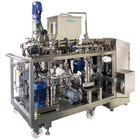

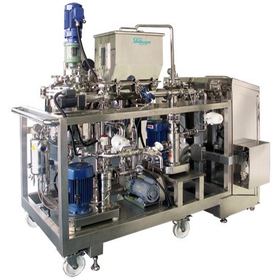
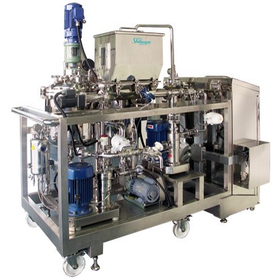
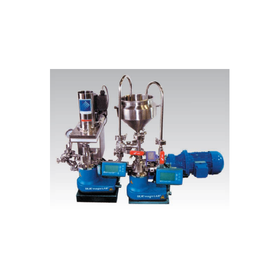
Inline continuous process that stabilizes CNT dispersion without disrupting its state.
In the production of CNT water dispersion, it is important not only to break down agglomerates but also to maintain a dispersed state. CNTs tend to agglomerate strongly at the nanoscale, and even after dispersion, re-agglomeration can occur, making stable quality assurance a challenge. This system consistently controls the process from dispersion to stabilization through inline continuous operation. It maintains a uniform dispersion state while suppressing excessive shear, preventing re-agglomeration. It accommodates water-based and low to medium viscosity conditions, contributing to the stabilization of CNT dispersion quality and improving reproducibility in mass production processes. Furthermore, by optimizing dispersion conditions and residence time, it is possible to suppress variations in the dispersion state and continuously ensure stable quality. It also supports consistent scale-up design from the lab to mass production, aiding in the stable manufacturing of CNT dispersion.
basic information
This is an inline continuous solid-liquid mixing and dispersion system designed for the manufacturing of CNT water dispersion. It enables stable dispersion processing even in low to medium viscosity ranges and is equipped with shear control and residence time design to suppress re-agglomeration. The process design allows for homogenization while maintaining the dispersion state. It supports consistent scale-up from lab scale to pilot and mass production, establishing a highly reproducible dispersion process.
Price information
It varies depending on the specifications.
Delivery Time
Model number/Brand name
Inline solid-liquid mixing dispersion system
Applications/Examples of results
【Target Applications】 - CNT aqueous dispersion (for conductive materials) - CNT ink and coating materials - Nanomaterial dispersions - Precursor dispersions for conductive materials - Functional material dispersion processes
Detailed information
-
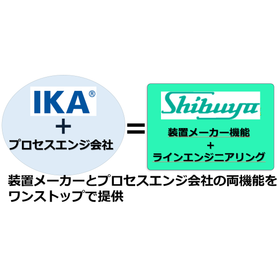
The world-famous IKA Group and Shibuya Kogyo have been collaborating on business and technology since 2010, working together on an inline continuous dispersion system.
-
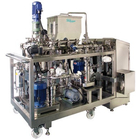
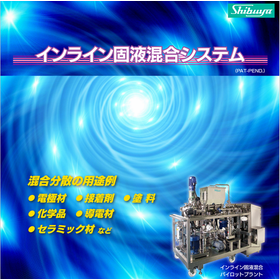
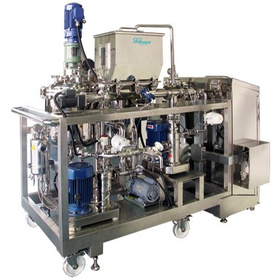
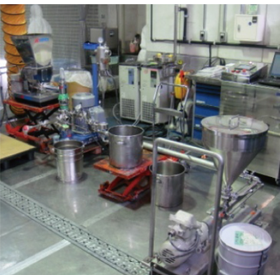
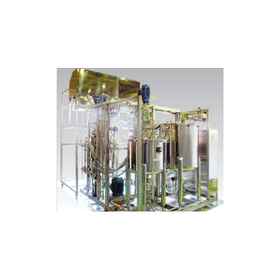
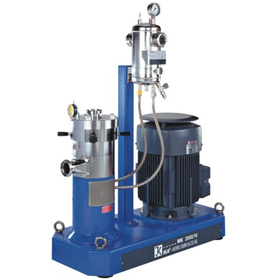
Inline solid-liquid mixing pilot plant. It achieves stable dispersion while suppressing agglomeration through continuous mixing. It is space-saving and supports short processing times, allowing for consistent scale-up considerations from research and development to mass production.
-
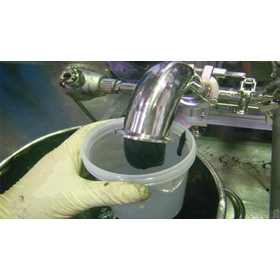
It is a small experimental device that can be used on a tabletop. It can be utilized in the early stages of process evaluation.
Related Videos
Line up(1)
| Model number | overview |
|---|---|
| Inline solid-liquid mixing dispersion system |
catalog(2)
Download All Catalogs
News about this product(2)
-
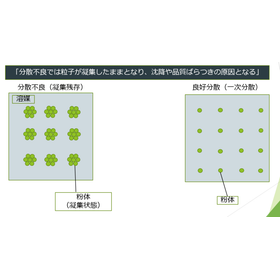
What are the causes of dispersion troubles? An explanation of the reasons for aggregation, sedimentation, and variation, as well as design points to reconsider in the dispersion process.
In dispersion engineering, issues such as unresolved agglomeration, sedimentation, and unstable particle size distribution occur frequently at many sites. These problems are caused not only by the performance of the equipment but also by inconsistencies in particle characteristics, dispersion conditions, and process design. For example, when there is insufficient dispersion energy, particles do not break down to primary particles, and agglomeration remains. Additionally, if the shear conditions or flow state are not appropriate, uniform dispersion cannot be achieved, leading to sedimentation and variations in quality. Particularly in high-viscosity systems or high solid content slurries, even slight differences in conditions can significantly impact the results. Furthermore, in batch processing, variations in mixing uniformity and residence time make it difficult to ensure reproducibility. To resolve these dispersion issues, it is important to optimize the entire process, including particle characteristics, dispersion energy, and flow design, rather than simply changing the equipment. By maintaining consistent conditions, as in inline continuous processing, stable dispersion quality and reproducibility can be achieved.
-
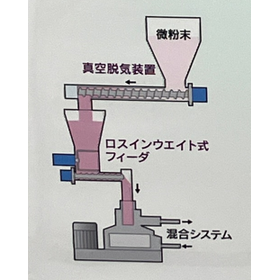
Why can't powders be supplied stably? - What causes supply irregularities in low bulk density powders?
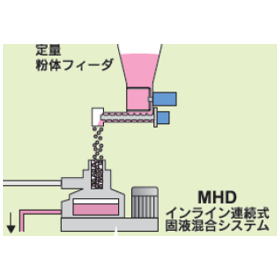
In low bulk density powders and fine powders, issues such as "unstable supply," "pulsation," and "bridging without falling" frequently occur. Particularly with CNTs, carbon black, and flake powders, the particles tend to entangle easily and have low flowability, making stable quantitative supply difficult with conventional powder feeding methods. When powder supply becomes unstable, instantaneous concentration fluctuations occur, significantly affecting the dispersion quality, viscosity, and conductivity in subsequent processes. In practice, even problems that appear to be "poor dispersion" often have their causes on the powder supply side. Moreover, in low bulk density powders, bridging, rat-holing, and supply pulsations due to air entrapment are likely to occur within the hopper, and simply relying on feeder capacity may not resolve these issues. To achieve stable supply, it is crucial to design the entire process, including hopper design, supply methods, transport conditions, and feeding methods, according to the characteristics of the powder. Our company offers a solid-liquid mixing process that includes quantitative supply using loss-in-weight feeders and integration with inline dispersion devices. By designing the entire process from powder supply to dispersion as a cohesive unit, we support the establishment of stable manufacturing conditions even for high-performance materials.
Recommended products






Distributors

Our company is headquartered in Kanazawa City, Ishikawa Prefecture, and has sales offices and factories both within and outside the prefecture. We focus on the bottling business, which involves filling beverages and other products, and we are expanding into various fields such as solid-liquid mixing and dispersion systems, laser processing machines (including fiber lasers and CO2 lasers), and semiconductor assembly equipment (such as taping machines, multifunctional test handlers, ball mount machines, and bonders). Please feel free to contact us if you have any inquiries.