
news list
latest news
We exhibited at the 3rd [Kyushu] Semiconductor Industry Exhibition on September 30 (Wednesday) and October 1 (Thursday), 2026!
Aites Co., Ltd. exhibited at the 3rd [Kyushu] Semiconductor Industry Exhibition held at Marine Messe Fukuoka Hall A and B in Fukuoka City, Fukuoka Prefecture! Thank you very much for taking the time …
31~60 item / All 108 items
-

NMR analysis of liquid crystal compounds
At Aites Co., Ltd., we conduct "NMR analysis of liquid crystal compounds." NMR is an analytical method that reveals the connections between atoms that make up a molecule, and it is used alongside mass spectrometry and infrared spectroscopy for determining the structure of compounds. In the downloadable materials, we highlight the 1H NMR, 13C NMR, and DEPT measurements of 4-butoxy-4'-cyanobiphenyl (CAS number 52709-87-2), which is used as a liquid crystal component, and introduce the information obtained from NMR. Please feel free to download and take a look.
-

Appearance observation and measurement services
We would like to introduce our "Appearance Observation and Measurement Service." We are equipped with a variety of devices to meet your needs, including appearance observation before and after reliability testing, solder joint observation, as well as dimensional measurements and surface roughness measurements of various components. You can also leave the pre-observation processing to us. Our company has IPC-certified IPC specialists on staff. We provide assistance with observations, consultations, and solutions to various observation-related concerns in accordance with international standards.
-

Observation of CMOS image sensor cross-section by mechanical polishing.
At our company, we created a cross-section of the CMOS image sensor component associated with A company's VR goggles through mechanical polishing while keeping the component intact, and we conducted structural observations of the CMOS sensor component. During the observation of the sensor component structure and sensor surface, we removed the glass filter and observed the CMOS sensor surface, where it was noted that the arrangement of the color filters was in a configuration known as a Bayer filter. In addition to mechanical polishing, methods for creating cross-sections include processing with ion beams such as FIB and CP, as well as microtome methods. Consultations are free, so please feel free to contact us if you are unsure about the cross-section creation method.
-

Strain measurement of power module package resin.
We would like to present the results of strain measurements conducted by attaching strain gauges and thermometers to the surfaces of power modules, both in the mounted state on a circuit board and in the unmounted state. In the mounted module, a slight delay in temperature change was observed, and correspondingly, the change in strain also appeared to be delayed. This is believed to be due to the slower transfer of heat to the module when it is mounted. At Aites, we conduct temperature cycle tests and temperature-humidity cycle tests, during which we can simultaneously measure the strain occurring in the mounted components. Please feel free to consult with us.
-

Evaluation of various implementation substrates
At Aites Co., Ltd., we provide a wide range of technical services for evaluation tests of printed circuit boards (mounted boards) equipped with electronic components. We conduct reliability tests, solder joint observations, whisker observations, and cross-sectional observations. We have IPC-A-610 certified IPC specialists on staff who can assist with observations in accordance with international standards, consultations, and various observation-related concerns. Additionally, we offer services such as X-ray observations, appearance inspections, and shape measurements, so please feel free to consult with us when needed.
-

We exhibited at the 31st MATE 2025.
Aites Co., Ltd. exhibited at the 31st "Micro Joining and Assembly Technology in Electronics" Symposium (MATE 2025) held at Pacifico Yokohama. We sincerely thank everyone who visited our booth.
-

【January 28, 2025 (Tuesday) - January 29, 2025 (Wednesday)】Mate2025 31st Symposium on "Micro Joining and Assembly Technology in Electronics" Announcement of Exhibition
Aites will be exhibiting at the Mate2025 31st Symposium on "Micro Joining and Assembly Technologies in Electronics," held at the Pacifico Yokohama Conference Center. We will be introducing our advanced analytical technology services, so please stop by. We sincerely look forward to your visit.
-

Analysis of organic-inorganic composite materials using FT-IR and EDX.
We will introduce an example of analyzing organic-inorganic composite materials using FT-IR and SEM-EDX. FT-IR measurements were conducted on the glossy and non-glossy areas of a PET bottle label, and the IR spectra differed between the glossy and non-glossy areas. Since the non-glossy area resembles the spectrum of acrylic resin, it is considered that the main component is acrylic resin. Additionally, SEM-EDX measurements were performed on both the glossy and non-glossy areas, and EDX spectra and backscattered electron images were obtained, revealing that the non-glossy area contained sulfur (S) and barium (Ba), which were not detected in the glossy area.
-

Notice of Participation in the 11th Conference of the Advanced Power Semiconductor Subcommittee from November 24 (Sunday) to November 26 (Tuesday), 2024
Aites will be exhibiting at the "11th Advanced Power Semiconductor Subcommittee Lecture" held at G Messe Gunma. We will be introducing the analytical technology services we offer, so please stop by. We sincerely look forward to your visit.
-

Composition analysis of LIB cathode active materials by ICP luminescence analysis.
This presentation introduces the composition analysis of active materials in cathode materials using ICP emission analysis. The cathode material in lithium-ion batteries (LIB) is one of the important components that influence the battery's voltage and energy density, and the composition of the cathode material significantly affects the battery's performance. ICP emission analysis allows for qualitative and quantitative analysis of approximately 70 elements, primarily metal elements. In addition to composition analysis of LIB cathode materials, it can also be applied to various analyses, including qualitative and quantitative analysis of additives and impurities contained in samples, as well as quantitative analysis of substances regulated by the RoHS directive.
-

Optical film light transmission characteristics
At Aites Co., Ltd., we conduct "optical film analysis." Optical films used in smartphones and other devices have various functions depending on their structure and materials. We measured the light transmittance of privacy protection films at different angles and combined cross-sectional observation with Raman analysis to investigate the mechanism of function manifestation. By investigating the transmittance characteristics of privacy protection films using angle-variable spectrophotometry, we were able to analyze the mechanism of function manifestation through cross-sectional observation and Raman analysis. At Aites, we provide consistent evaluation and analysis from material properties to the mechanisms of function manifestation.
-

Power device failure location / Slice & View three-dimensional reconstruction
I will introduce the three-dimensional reconstruction of failure locations using the Slice & View function of FIB-SEM. Continuous SEM images of the structure are obtained, and the resulting images are corrected for positional misalignment between the SEM images and visualized in three dimensions using 3D construction software (Avizo). By combining the position identification technique for cross-sectioning the failure location with the Slice & View function, it is possible to obtain continuous SEM images that retain the defective state and include information before and after the abnormal area.
-
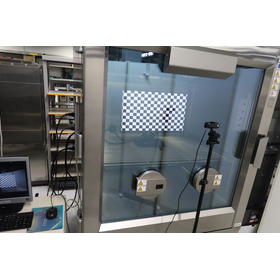
In-chamber imaging during constant temperature and humidity testing.
Our company conducts environmental testing using a constant temperature and humidity chamber with a front glass window and a camera, allowing us to capture and monitor the operational status, such as screen displays, during the tests. During environmental testing using equipment like constant temperature and humidity chambers, monitoring the condition of the test subjects with loggers (for voltage, current, resistance, temperature, etc.) is widely practiced. However, monitoring the operational status of equipment during testing can be difficult unless the test equipment is equipped with dedicated external outputs. For samples where monitoring with loggers is challenging, we combine a constant temperature and humidity chamber with a front glass window option, a camera, and monitoring software to conduct environmental tests while capturing and monitoring the condition of the test equipment.
-
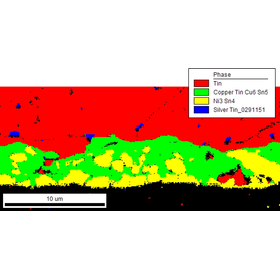
Example of analysis of compounds at the SAC solder and Ni pad interface.
We will introduce an example of the analysis of compounds formed at the interface between Sn-Ag-Cu solder and NiP pads. At the interface of NiP pads and Sn-Ag-Cu solder, compounds such as (Ni,Cu)3Sn4 and (Cu,Ni)6Sn5 grow, and surface analysis using EDX shows the distribution of Ni, Cu, and Sn within these compounds. The EBSD method is a technique that analyzes based on the crystallographic information of the sample. By combining it with elemental analysis using EDX, it is possible to estimate the composition, and in some cases, it may be possible to analyze using crystallographic data for Ni3Sn4 and Cu6Sn5 as substitutes.
-

Measurement of moisture absorption distortion
We would like to introduce the results of our investigation into the behavior of strain during moisture absorption and drying using a strain gauge. It was observed that the material expands when it absorbs moisture due to humidification, contracts when it dries due to dehumidification, and the strain returns to the state before humidification. Regarding FR-1, it is presumed that the chemical structure of the material changed due to hydrolysis, which is why it did not return to its original state.
-

Micro FT-IR imaging measurement
We would like to introduce the "Microscopic FT-IR Imaging Measurement" that we conduct. It allows for the visualization of the distribution of substances as a two-dimensional image within a specified plane. It becomes possible to evaluate changes in the distribution of substances that are difficult to assess with regular point measurements through visual images.
-

Information about the CP processing device Arblade5000_Wide Area Cross-section Milling
We offer the "CP Processing Device Arblade5000_Wide Area Cross-Section Milling." The "Arblade5000" enables extensive processing by combining a high milling rate with wide area cross-section milling capabilities. With the wide area cross-section milling holder, the cross-section milling width can be expanded up to 10mm, making it effective for electronic components that require wide area milling. 【Features】 ■ Approximately double the width of processing is possible ■ The previously localized observation range can be significantly expanded ■ Equipped with a cooling temperature adjustment function to control temperature rise caused by ion beam irradiation ■ The observable range is approximately 8mm
-

IOL testing of discrete semiconductors
Our company conducts "IOL testing of discrete semiconductors." We repeatedly turn the power ON/OFF in a room temperature environment, applying stress to the device due to temperature changes caused by the device's own heat generation during power ON. During power OFF (cooling), forced cooling is also performed using a fan. Additionally, before conducting the tests, we use representative samples to make adjustments to reach the test temperature conditions. It is possible to adjust the current/time during heating and the fan capacity/timing during cooling.
-

Observation of metallic tissue through chemical treatment.
We will introduce the observation of metallic structures through chemical treatment. By performing chemical treatment on metallic samples, it is possible to clearly observe the metallic structure. Observing the structure can reveal the condition of the sample and the history of applied heat and stress, providing clues about the quality of the product and any defects based on the structure's shape. In the catalog, you can find details on the observation of metallic structures, such as the macrostructure of aluminum plates and the soldered parts of copper terminals. Additionally, we offer other services such as cross-sectional observation and various analysis services. Please feel free to contact us if you have any requests.
-

Introduction to Micro FT-IR
At Aites Co., Ltd., we have newly introduced "Microscopic FT-IR" this fiscal year. The "Microscopic FT-IR," which combines FT-IR and optical microscopy, allows for the measurement of tiny substances on the order of several tens of micrometers, which are difficult to measure with conventional FT-IR, using an aperture (field of view diaphragm). There are three main measurement methods for Microscopic FT-IR: "transmission method," "reflection method," and "ATR method." While the transmission method is the basic measurement method in Microscopic FT-IR measurements, the reflection method or ATR method may be more suitable depending on the shape of the sample and the feasibility of sampling.
-

Notice of Participation in the 1st "[Kyushu] Semiconductor Industry Exhibition" on September 25 (Wednesday) and 26 (Thursday), 2024.
Aites Co., Ltd. will be exhibiting at the 1st "[Kyushu] Semiconductor Industry Exhibition" held at Marine Messe Fukuoka B Hall in Fukuoka City, Fukuoka Prefecture. We will be introducing our analysis technology services, so please stop by. We sincerely look forward to your visit.
-

Examples of semiconductor observation using mechanical polishing.
In the methods for cross-section preparation in semiconductor structure observation and defect analysis, CP, FIB, and mechanical polishing are mentioned, each having its own advantages and disadvantages, making it necessary to consider which method to use. In recent years, CP and FIB have become more common, and it seems that the use of mechanically polished methods, which require technical skill, is decreasing. However, it is still not something to be dismissed. While there are merits and demerits, it is possible to achieve cross-section preparation with mechanical polishing that is on par with FIB and CP. At our company, based on years of accumulated know-how, we propose the most appropriate processing method according to the observation purpose, sample composition, and structure.
-

Cross-sectional observation of substrate-mounted components (1) to (6)
We would like to introduce an example of cross-sectional observation of mounted components conducted by our company. Using commercially available computer circuit boards, we observed the solder joints of mounted components and the internal structure of the components with a metal microscope. The observation modes of the metal microscope include bright field observation, dark field observation, and polarized light observation, among others. Additionally, there are observations using transmitted light, and the observation mode is selected according to the sample. By conducting cross-sectional observations before and after reliability testing, we can evaluate the reliability of the product. When observing, it is important to select an appropriate "observation mode" to clearly capture the condition of the solder joint interface and defects such as cracks.
-

Strain measurement in thermal shock testing.
We would like to introduce the "strain measurement in thermal shock testing" conducted by our company. A sample with strain gauges attached was set up in the thermal shock testing device, and the wiring of the strain gauges was connected to an external data logger to record strain data in real time during the test. For two types of copper-clad laminates, the strain behavior during the thermal shock test was observed, and it was noted that significant strain occurred with changes in temperature. It was found that FR-1 exhibited greater strain compared to FR-4.
-

Evaluation of particle size of positive electrode active material
We would like to introduce a case of particle size measurement of positive electrode active materials using laser diffraction conducted by our company. In air or liquid, laser light is irradiated onto the particles, and the angular dependence of the intensity of the light scattered by the particles is measured. By measuring the angular dependence of the scattered light intensity, the particle size distribution (particle size distribution) is calculated from the data. Using commercially available reagents as samples, measurements were conducted in a dry state without dispersing in a solvent. The particle size measurement results for NMC oxide showed a monodisperse state with particle sizes below several tens of micrometers, and the median diameter was calculated to be 12 micrometers.
-

Chemical Analysis Concierge Service
We would like to introduce our "Chemical Analysis - Trust Us Service." When conducting component analysis of foreign substances or stains on products, it can be challenging to determine whether organic analysis or inorganic analysis is more suitable, and which specific analysis within organic or inorganic is the most appropriate. We provide a comprehensive service for customers who are struggling with the selection of analysis methods. Since each analysis device can measure different targets, it is necessary to choose a method that fits the purpose based on the information available.
-

Cross-sectional observation of substrate-mounted components.
We will introduce examples of cross-sectional observations of various components mounted on a board called an organic substrate. Inside various electronic devices around us, there are substrates equipped with electronic components. When observing the mounted substrate, you can see that numerous components are tightly soldered together. It is necessary to verify that these components are properly joined, as they will not function correctly otherwise. Please contact us if you are considering observations before and after reliability testing or cross-sectional observations.
-

Observation of Conductive Particle Shape in COG Implementation
We will introduce the observation of the shape of conductive particles in COG implementation. ICs and liquid crystal panels are implemented using the COG method with ACF (anisotropic conductive film). A resin ball is used as the core, and a metal layer (such as nickel or gold) for conductivity is deposited on its surface. During connection, the particles deform appropriately to electrically connect the IC and the panel. To confirm the degree of particle deformation and connection status, cross-sectional observations were conducted, revealing that the particle deformation was at a "medium" level, indicating an appropriate degree of deformation. By examining the deformation of conductive particles from both the planar and cross-sectional directions, we can explore the correlation with display defects. Please feel free to contact us for any inquiries regarding panel-related defects.
-

Analysis case of faulty switch contacts
Since a malfunction was suspected in the switch section of the appliance that would not power on, we will introduce a case study along with the work flow. First, we check for any shape changes such as swelling, cracking, or discoloration through visual observation. In the electrical check, we confirm whether the malfunction can be reproduced and whether it is an open or short circuit. An internal observation using X-rays revealed that the contact terminals inside the switch had melted, scattered, and disappeared, resulting in an open failure. Ultimately, we will submit a report that includes the consideration of the cause. We also accept inquiries for analysis consultations after non-destructive testing, so please feel free to contact us.
-

Raman UV-curable resin
Our company analyzes the spectra of UV-curable resins before and after UV irradiation. We irradiate UV-curable resin (acrylic type) with ultraviolet light and obtain Raman spectra before and after irradiation. By analyzing the Raman spectra, we can estimate the curing reaction to some extent. For a more detailed analysis of the curing mode, analyses such as GCMS are necessary, but our company can provide not only structural estimation but also reaction estimation through spectral analysis.