
What is RO membrane (reverse osmosis membrane)? Mechanism and applications [Basic knowledge]
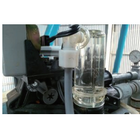
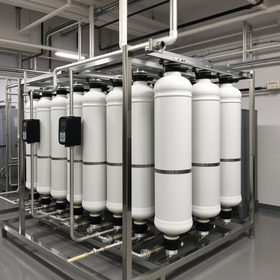
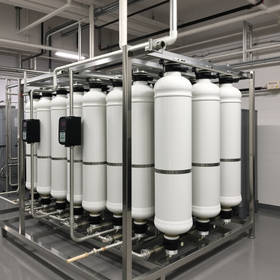
RO membranes remove even salts, allowing only almost pure water to pass through. They operate by pushing water in the opposite direction of natural "osmosis."
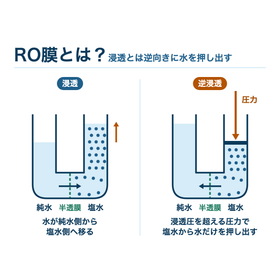
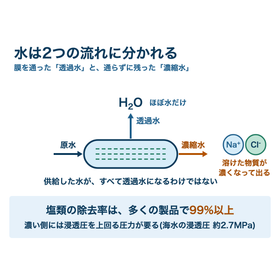
RO membranes (reverse osmosis membranes) are the membranes with the highest separation performance among pressure-driven membranes that can remove dissolved ions and small molecules from water. They are used in a wide range of water treatment applications, including seawater desalination and industrial water production. ■ What does "reverse" osmosis mean? When a semi-permeable membrane that allows water to pass through but not dissolved substances separates pure water from saltwater, water moves from the pure water side to the saltwater side. This is osmosis. When pressure equal to the osmotic pressure is applied to the saltwater side, the movement stops, and if pressure beyond that is applied, the flow reverses, pushing water out from the saltwater side. ■ Can't separation be done just by hole size?! Filtration membranes like MF membranes sieve out particles larger than the holes. In contrast, in RO membranes, water dissolves into the membrane material and passes through, while the substances to be removed cannot dissolve. They are separated based on compatibility with the material. The charge of the membrane also significantly affects removal. ■ Water splits into two flows Water that passes through the membrane is called permeate, while water that does not pass through is called concentrate. Not all supplied water becomes permeate; the remainder exits as concentrate, where the dissolved substances are more concentrated. Please feel free to consult with us first.
basic information
■Compared to other membranes? Separation membranes are classified by the size of the substances they can remove. 1. MF membrane (microfiltration membrane): particles of about 0.01 to 10 μm 2. UF membrane (ultrafiltration membrane): molecular weight of approximately 1,000 to 200,000 3. RO membrane (reverse osmosis membrane): up to a molecular weight of about 350 (can remove low molecular weight organic substances and ions) The separation capability progresses from MF to UF to RO, allowing for the removal of smaller substances. ■How much can be removed? The removal rate of salts is over 99% for many products. According to the standards for membranes used in drinking water, seawater desalination RO membranes have a salt removal rate of over 99.0%, while RO membranes are classified as having a removal rate of over 93%. ■How much pressure is needed? Pressure greater than the osmotic pressure must be applied to the concentrated side. The osmotic pressure of seawater is about 2.7 MPa (approximately 27 kg/cm²), and in seawater desalination, water is pushed out at pressures exceeding this. ■Materials and shape The mainstream material is polyamide membranes, while cellulose acetate membranes were used initially. The standard shape is a spiral type, where the membrane is rolled like sushi. ■Does water volume decrease in winter? As water temperature decreases, the viscosity of water increases, resulting in a lower permeate flow rate at the same pressure.
Price range
Delivery Time
Applications/Examples of results
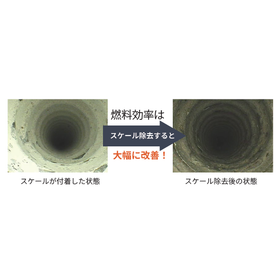
■What kind of sites are they used in? Typical applications include the following: 1. Seawater desalination 2. Production of industrial water and process water for factories 3. Production of drinking water 4. Collection and reuse of wastewater ■Why pretreatment is important RO membranes are fine enough to separate dissolved substances. As a result, when fouling occurs due to dirt adhering to the membrane surface, water flow becomes restricted. Keeping the water clean before it enters the membrane is the foundation for stable operation. ■Chlorine should be removed beforehand The mainstream polyamide membranes are weak against chlorine, and polyamide membranes deteriorate due to residual chlorine, so they cannot operate with chlorine remaining. Therefore, methods are employed to remove chlorine using substances like sodium bisulfite before the membrane. ■Things to confirm before introduction What kind of water do you want to purify, in what quantity, and to what extent? Organizing the quality of the source water, the required water quantity and quality, and the water temperature in advance will facilitate the consideration of the system, including pretreatment. Keep in mind that the permeate flow rate may vary depending on the water temperature. Please feel free to consult with us first.
catalog(2)
Download All Catalogs

Recommended products

Is there a "sweetness curve" in sweeteners? What are the differences in taste? 【Basic Knowledge】
トリイ













Why are preservatives necessary? What is the key to preventing food poisoning? 【Basic Knowledge】
トリイ









Distributors

Since our founding, we have continued to provide flexible services with the motto of accurately supplying a diverse range of products that respond to changes in the times and the diversification of consumer needs, tailored to various applications and requirements. With the corporate slogan "Chemical Engineering Partner," we, as a group of experts in chemical technology, actively discover ideas to solve our customers' problems from advanced technologies both domestically and internationally, and propose them.