
What is alkalinity? Differences from pH and management [Basic Knowledge]
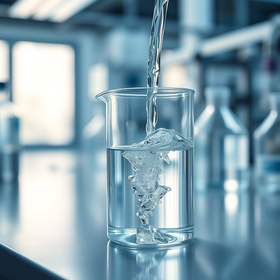
The "resilience" of water against acids, which cannot be understood by pH alone, is represented by a numerical value known as alkalinity.
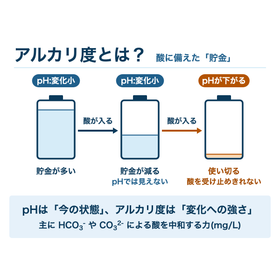
Alkalinity is an indicator of how much acid water can neutralize. It is expressed as the concentration (mg/L) of bicarbonate ions and carbonate ions dissolved in water, which contribute to its acid-neutralizing capacity. ■ How is it different from pH? pH is a value that indicates the strength of acidity or alkalinity at a given moment. In contrast, alkalinity indicates the extent to which it can buffer changes in pH when acid is added. pH reflects the "current state," while alkalinity reflects the "strength against change." ■ What if we think of it as a "savings account" for acid? Alkalinity is like a savings account for absorbing acid. Each time acid enters, the savings are used, and pH remains relatively stable. However, once the savings are depleted, the pH is more likely to drop due to the unmanageable acid. Even if the pH appears stable, the remaining balance of the savings is not visible. ■ Therefore, observe both By recording both pH and alkalinity together, it becomes easier to notice early signs of a sudden drop in pH. If alkalinity is gradually decreasing, it is a sign that the savings are diminishing. Please feel free to consult with us first.
basic information
■P Alkalinity and M Alkalinity Alkalinity is determined by the amount of acid used to reach a specified pH as acid is gradually added. Based on the endpoint pH, it is classified into the following two types: 1. P Alkalinity: the amount of acid consumed until pH 8.3 2. M Alkalinity (Total Alkalinity): the amount of acid consumed until pH 4.8 Both are expressed in terms of calcium carbonate equivalent (mg/L). If P Alkalinity is 0, it means that the water's pH was originally below 8.3. ■What is it called in JIS? In JIS, alkalinity is referred to as "acid consumption." In tables of water quality standards, it may be written as "acid consumption (pH 8.3)" along with the endpoint pH. ■Caution when reading foreign materials! Some foreign analytical methods define the endpoint for M Alkalinity as pH 4.5. Since this differs from Japan's pH 4.8 standard, be sure to check the endpoint when comparing values. ■How much in natural water? As an example, groundwater is said to be relatively high at around 30-80 mg/L, while surface water such as rivers is around 20-40 mg/L. In rivers, there is a tendency for alkalinity to gradually increase from upstream to downstream.
Price range
Delivery Time
Applications/Examples of results
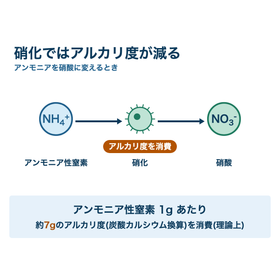
■ Alkalinity decreases during nitrification! In nitrification, which converts ammonia to nitrate, alkalinity is consumed. Theoretically, about 7 grams of alkalinity (calcium carbonate equivalent) is used for every 1 gram of ammonia nitrogen. ■ Does it also decrease during coagulation treatment? When coagulants such as aluminum salts or iron salts are added, alkalinity is consumed and pH decreases. In water with originally low alkalinity, the pH may drop too much, which can affect the coagulation process. ■ Set upper limits for boiler water management The JIS water quality standards for boiler water include acid consumption (pH 8.3) as a management item. In the case of multi-tube special circulation boilers, the standard is set at 80 to 600 mg/L for a usage pressure of 1 MPa or less, with lower limits for higher pressure categories. ■ Is insufficient alkalinity a problem? Is too much a problem? The focus varies depending on the site. In biological treatment (nitrification), the decreasing alkalinity is a concern, while in coagulation treatment, the worry is about the pH dropping too low. For boiler water, we monitor to ensure it stays within the standard range (especially the upper limit). It is important to establish a management range that suits the purpose. Please feel free to consult with us first.
catalog(3)
Download All Catalogs

Recommended products
Is there a "sweetness curve" in sweeteners? What are the differences in taste? 【Basic Knowledge】
トリイ





Why are preservatives necessary? What is the key to preventing food poisoning? 【Basic Knowledge】
トリイ





Distributors

Since our founding, we have continued to provide flexible services with the motto of accurately supplying a diverse range of products that respond to changes in the times and the diversification of consumer needs, tailored to various applications and requirements. With the corporate slogan "Chemical Engineering Partner," we, as a group of experts in chemical technology, actively discover ideas to solve our customers' problems from advanced technologies both domestically and internationally, and propose them.