
What is ion exchange resin? Functions in water treatment [Basic knowledge]
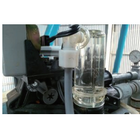
The heart of water softeners and pure water systems, ion exchange resin. This explains the mechanism by which small particles exchange ions and the reason they can be regenerated and reused repeatedly.
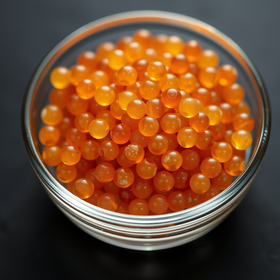
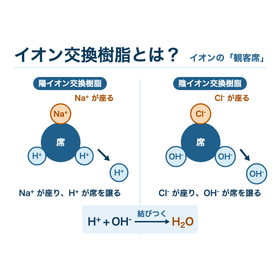
Ion exchange resin is a granular material that exchanges ions dissolved in water with different ions held by the resin. It is used as a key material in water softeners and pure water systems. ■Appearance: Just small granules The resin consists of small granules that have many sites (exchange sites) for capturing ions. When water passes through, the ions in the water are exchanged with the ions in the resin. ■There are two types: positive and negative! Dissolved ions in water can be positively charged cations or negatively charged anions. The resin also comes in two types to match these: 1. Cation exchange resin: exchanges cations such as calcium and sodium 2. Anion exchange resin: exchanges anions such as chloride ions ■What if we compare it to a spectator seat? The resin is like a row of spectator seats where ions can sit. When ions from the water arrive, the ions that were originally seated give up their seats and leave for the water. The nature of the water that comes out changes depending on what is allowed to stay seated. Please feel free to consult with us first.
basic information
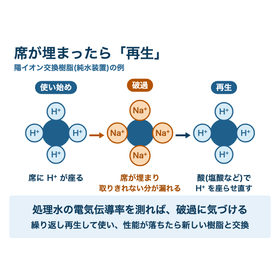
■How Purified Water is Made In the cation exchange resin, hydrogen ions (H+) are seated, while hydroxide ions (OH-) are seated in the anion exchange resin. The H+ and OH- that come out by exchanging with ions in the water combine to form water. In this way, dissolved salts are removed. ■Do Water Softener Use Sodium? In water softeners, sodium ions are seated in the cation exchange resin. This replaces hardness components (calcium, magnesium), thereby reducing the hardness of the water. ■Two-Bed and Mixed-Bed Systems 1. Two-Bed: Cation and anion resins are placed in separate towers, and water is passed through them in sequence. 2. Mixed-Bed: Two types of resins are mixed and placed in a single tower. The mixed-bed system is considered to be a method that allows for obtaining higher purity water. There are configurations where a mixed-bed system is placed behind a device that uses multiple towers for finishing. ■Once the Seats are Filled, They Cannot Be Cleared! As the seats become filled, ions that cannot be removed begin to leak into the treated water. This is called "breakthrough," and if it continues, ions cannot be sufficiently removed. The more ions dissolved in the raw water, the faster the resin wears out.
Price range
Delivery Time
Applications/Examples of results
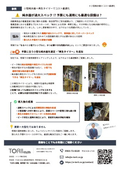
■ It can be reused after regeneration! The exhausted resin can be reused by re-establishing the original ions through chemicals. This process is called regeneration. In pure water systems, cation exchange resins use acids (such as hydrochloric acid), while anion exchange resins use alkalis (such as caustic soda). The resin in water softeners is regenerated with brine. The resin can be regenerated repeatedly, and when its performance declines, it should be replaced with a new one. ■ What are the main applications? 1. Water softeners: Water from which hardness components need to be removed, such as boiler feed water. 2. Pure water systems: Water such as purified water used in pharmaceutical manufacturing, from which all salts need to be reduced. In both cases, the goal is to reduce dissolved ions in water. The difference is that water softeners remove hardness components, while pure water systems remove all salts. ■ How to know when to replace or regenerate? The clarity of pure water is assessed by electrical conductivity and specific resistance. By regularly measuring the electrical conductivity and hardness of treated water, one can notice when exhaustion is approaching. The rate of resin depletion varies depending on the quality of the source water, so it is important to consider the amount of resin and the size of the system based on the quality of the source water and the volume of water used. Please feel free to consult us first.
catalog(3)
Download All Catalogs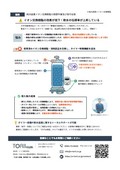

Recommended products
Is there a "sweetness curve" in sweeteners? What are the differences in taste? 【Basic Knowledge】
トリイ





Why are preservatives necessary? What is the key to preventing food poisoning? 【Basic Knowledge】
トリイ



Distributors

Since our founding, we have continued to provide flexible services with the motto of accurately supplying a diverse range of products that respond to changes in the times and the diversification of consumer needs, tailored to various applications and requirements. With the corporate slogan "Chemical Engineering Partner," we, as a group of experts in chemical technology, actively discover ideas to solve our customers' problems from advanced technologies both domestically and internationally, and propose them.