
What is biological treatment? The difference between aerobic treatment and anaerobic treatment.
Biological treatment that decomposes organic matter in wastewater using the power of microorganisms. This explains the differences between aerobic treatment, which uses oxygen, and anaerobic treatment, which does not, as well as how they can be combined.
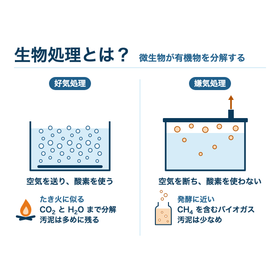
Biological treatment is a method of breaking down organic matter in wastewater through the action of microorganisms. It is widely used, from household septic tanks to industrial wastewater treatment. Biological treatment is also central to the wastewater treatment in food factories. ■ Microorganisms "eat" and clean Microorganisms take in organic matter from wastewater. Some of it is broken down into carbon dioxide and water, while the rest becomes new microbial cells or sludge. The increased microorganisms are then separated from the water as excess sludge. ■ There are aerobic and anaerobic treatments! Microorganisms can either live using oxygen or work in environments without oxygen. Depending on which one is used, the treatment is broadly divided into two types: 1. Aerobic treatment: Air is supplied, and microorganisms that use oxygen break down the organic matter. 2. Anaerobic treatment: Air is cut off, and microorganisms that do not use oxygen break down the organic matter. ■ How can we compare it to a campfire and fermentation? Aerobic treatment is similar to a campfire that uses oxygen to convert organic matter into carbon dioxide and water, but the increased microorganisms remain as a larger amount of sludge. Anaerobic treatment is closer to fermentation occurring in a tank without oxygen, producing biogas that contains methane, with less sludge. Please feel free to consult us first.
basic information
■ Mechanism of Aerobic Treatment Air is supplied through aeration, and microorganisms break down organic matter into carbon dioxide and water. A representative example is the activated sludge method, where clumps of microorganisms (flocs) are settled to separate treated water. ■ Mechanism of Anaerobic Treatment In a tank without oxygen, organic matter is gradually decomposed, ultimately producing methane by methanogenic bacteria. The characteristics compared to the activated sludge method are as follows: 1. Methane can be extracted and utilized from organic matter. 2. Excess sludge is less than that of the activated sludge method, generally considered to be around 10-30%. 3. By using it as a pre-treatment, the power required for subsequent aerobic treatment can be reduced. ■ Can it also be distinguished by how microorganisms live? 1. Suspended method: Microorganisms are suspended in water for treatment (such as the activated sludge method). 2. Biofilm method: Microorganisms are attached to the surface of carriers or contact materials for treatment. The biofilm method is a way to stably retain microorganisms within the tank. ■ How do aerobic and anaerobic treatments differ when compared? 1. Aerobic treatment: Remaining organic matter can be polished / requires power for aeration. 2. Anaerobic treatment: Suitable for high-concentration wastewater, can recover biogas / BOD removal rate is around 80-90% depending on conditions.
Price range
Delivery Time
Applications/Examples of results
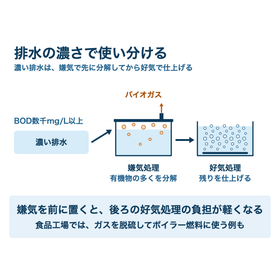
■Differentiating by the Concentration of Wastewater When directly treating high-concentration wastewater with aerobic treatment, the oxygen supply and equipment load increase significantly. Therefore, for wastewater with a BOD of several thousand mg/L or more, methods that first decompose it using anaerobic treatment have been increasing. By placing anaerobic treatment first, the burden on the subsequent aerobic treatment is reduced. Since less water is needed for dilution, it is said that the sedimentation tank can be made smaller. In food factories, there are also examples of using the gas produced from anaerobic treatment as fuel for boilers after desulfurization. ■Often Used in Combination! Anaerobic treatment alone leaves some organic matter. Therefore, a combination is used where a significant portion of the organic matter is decomposed first through anaerobic treatment, followed by finishing with aerobic treatment. There are also systems for household septic tanks that combine anaerobic and aerobic treatment. ■What to Consider When Choosing? 1. The characteristics of the wastewater, such as volume and concentration 2. The water quality required at the discharge point 3. Economic factors such as equipment costs and operating costs 4. The location and environmental conditions of the installation site These conditions will change the suitable methods and combinations. Please feel free to consult with us first.
catalog(3)
Download All Catalogs
Recommended products
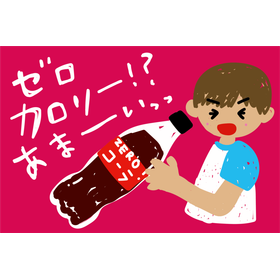
Is there a "sweetness curve" in sweeteners? What are the differences in taste? 【Basic Knowledge】
トリイ











Why are preservatives necessary? What is the key to preventing food poisoning? 【Basic Knowledge】
トリイ








Distributors

Since our founding, we have continued to provide flexible services with the motto of accurately supplying a diverse range of products that respond to changes in the times and the diversification of consumer needs, tailored to various applications and requirements. With the corporate slogan "Chemical Engineering Partner," we, as a group of experts in chemical technology, actively discover ideas to solve our customers' problems from advanced technologies both domestically and internationally, and propose them.