
What are the differences between MF, UF, NF, and RO membranes? Comparison [Basic Knowledge]
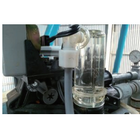
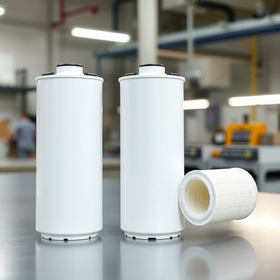
Even if the names are similar, the things that can be removed are vastly different. We will compare the differences among the four types of filtration membranes from three perspectives: size, pressure, and usage.
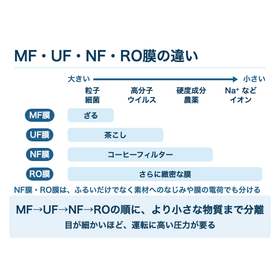
The membranes used in water treatment are classified into MF membranes, UF membranes, NF membranes, and RO membranes, depending on their separation performance and the substances involved. Although their names are similar, each has its own strengths. ■ How can the four membranes be compared to sieves? Generally, MF membranes, UF membranes, NF membranes, and RO membranes can separate smaller substances in that order. You can imagine this as a kitchen strainer, tea strainer, coffee filter, and then a much finer membrane, with each having smaller mesh sizes. The finer the mesh, the smaller the particles it can capture, but it requires higher pressure to operate. ■ Areas of expertise for each type 1. MF membrane (microfiltration membrane): Particles causing turbidity and bacteria 2. UF membrane (ultrafiltration membrane): Macromolecules such as proteins and viruses 3. NF membrane (nanofiltration membrane): Hardness components like calcium and pesticides 4. RO membrane (reverse osmosis membrane): Ions such as sodium ■ Finer is not always better! If the goal is to remove turbidity and bacteria, MF membranes or UF membranes can be used. In municipal water purification processes, membrane filtration methods utilizing MF or UF membranes are implemented. It is essential to choose a membrane that matches the desired particle size. Please feel free to consult us first.
basic information
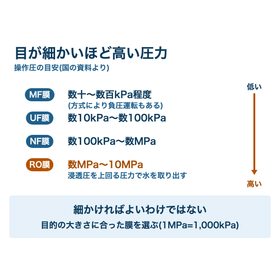
■How much can be separated? 1. MF membrane: approximately 0.01 to 10 μm 2. UF membrane: pore size of several nm to several tens of nm 3. NF membrane: pore size of about several nm, separating multivalent ions and low molecular organic substances 4. RO membrane: ions and low molecular substances 1 nm is one thousandth of 1 μm. If the thickness of a hair is 0.1 mm, the pore size of the MF membrane is less than a few thousandths of that. ■Is NF membrane between RO and UF? The NF membrane does not have a clear single definition in organizations like IUPAC, but it is generally treated as a membrane that can operate at lower pressures than RO membranes. The separation is not only based on sieving. Differences in the affinity for the membrane material and the membrane's charge are also significant factors. It is believed that the surface charge also plays a role in excluding ions. ■How much difference is there in pressure? According to national documents, the operating pressure guidelines are as follows: 1. MF membrane: approximately several tens to several hundred kPa (some methods may operate under negative pressure) 2. UF membrane: several tens kPa to several hundred kPa 3. NF membrane: several hundred kPa to several MPa 4. RO membrane: several MPa to 10 MPa In RO membranes, pressure exceeding the osmotic pressure is applied to extract water.
Price range
Delivery Time
Applications/Examples of results
■Main Uses 1. MF membranes and UF membranes: Removal of turbidity, fine particles, bacteria, etc. (water treatment, purification, etc.) 2. NF membranes: Removal of hardness components and pesticides, etc. 3. RO membranes: Seawater desalination, production of pure water and purified water. Purified water used in pharmaceuticals is also produced using systems that employ ion exchange and reverse osmosis, either alone or in combination. Although the goal is the same—"to purify water"—the type of membrane used varies depending on the target contaminants. ■Often Used in Combination! MF membranes and UF membranes are also used as pretreatment for RO membranes. By reducing microorganisms and other contaminants beforehand, it becomes easier to minimize fouling of the RO membranes. In facilities that reuse treated wastewater, configurations with RO membranes following MF membranes are introduced in national documents. ■Which Membrane to Choose? The clues for selection are the following three points: 1. The size of the contaminants to be removed (particles, macromolecules, ions) 2. Operating conditions such as the pressure applied 3. The level of contamination in the source water and the necessity for pretreatment. Note that the classification of membranes may vary by field and manufacturer, and there may be overlaps in ranges. Please feel free to consult us first.
catalog(2)
Download All Catalogs

Recommended products

Is there a "sweetness curve" in sweeteners? What are the differences in taste? 【Basic Knowledge】
トリイ













Why are preservatives necessary? What is the key to preventing food poisoning? 【Basic Knowledge】
トリイ









Distributors

Since our founding, we have continued to provide flexible services with the motto of accurately supplying a diverse range of products that respond to changes in the times and the diversification of consumer needs, tailored to various applications and requirements. With the corporate slogan "Chemical Engineering Partner," we, as a group of experts in chemical technology, actively discover ideas to solve our customers' problems from advanced technologies both domestically and internationally, and propose them.